
Dawn of War Playing Order: Every Campaign and Where to Start
Follow the Blood Ravens through Dawn of War, understand the armies fighting around them, and choose a campaign route that suits how you play.

Start with the original Warhammer 40,000: Dawn of War if you want to follow the Blood Ravens from the beginning. Play Warhammer 40,000: Dawn of War II first if controlling a few persistent squads sounds more appealing than building bases and replacing armies. Both are sensible introductions, but they teach you very different kinds of strategy.
These games belong to Warhammer 40,000, Games Workshop's science-fiction setting, where the Space Marines, alien empires and daemonic invasions have a history of their own. Total War: WARHAMMER uses Warhammer Fantasy; its Empire and elves aren’t earlier versions of these civilisations. You can understand Dawn of War without playing Total War or knowing the tabletop rules.
The series rewards a little preparation, because characters survive into later games, victories have consequences, and the Blood Ravens' hunger to recover their lost history keeps dragging them towards things they'd be wiser to leave alone. We explain those connections here without spoiling the major betrayals or final encounters.
Quick Answer
For the complete campaign tour, play them in the order below, and treat it as our recommended route through the games: the conquest campaigns have alternative outcomes, so finishing every faction doesn't add up to one continuous history.
| Game | Campaign and playable perspective | Why play it here? |
|---|---|---|
| Warhammer 40,000: Dawn of War | Tartarus; Blood Ravens Space Marines | Introduces Gabriel Angelos, Macha and the Chapter’s troubled relationship with forbidden knowledge. |
| Warhammer 40,000: Dawn of War – Winter Assault | Lorn V; Imperial Guard/Eldar or Orks/Chaos | A separate conflict that broadens the setting and introduces recurring characters including Gorgutz. |
| Warhammer 40,000: Dawn of War – Dark Crusade | Kronus; choose one of seven armies | Play the Blood Ravens for the strongest connection to Dawn of War II. Other armies provide alternative conquest stories. |
| Warhammer 40,000: Dawn of War – Soulstorm | Kaurava; choose one of nine armies | An optional detour for the central Blood Ravens story, useful for its wider roster and Gorgutz’s history. |
| Warhammer 40,000: Dawn of War II | Sub-sector Aurelia; Blood Ravens | Begins the closely connected three-campaign sequence built around a persistent strike force. |
| Warhammer 40,000: Dawn of War II – Chaos Rising | Aurelia; Blood Ravens | A direct follow-up, with save import and corruption choices. Play immediately after II. |
| Warhammer 40,000: Dawn of War II – Retribution | Aurelia; choose one of six armies | Resolves the sector’s crisis through different faction perspectives. Start with Space Marines for continuity. |
| Warhammer 40,000: Dawn of War III | Acheron conflict; alternating Space Marines, Eldar and Orks | Reunites familiar characters in a later war, with another substantial change in gameplay. |
For a shorter Blood Ravens route, play the original Dawn of War, then Dark Crusade as Space Marines, Dawn of War II, Chaos Rising and the Space Marine campaign in Retribution. Add Dawn of War III afterwards if you want to see the returning cast meet again.
If you mainly want a replayable conquest campaign, start with Dark Crusade, and if you want to play with a friend, all three Dawn of War II campaigns support co-op. Relic’s Anniversary Edition overview
Your first missions
The original game and its expansions
Play the opening Blood Ravens missions on a forgiving difficulty while you learn how the two resources work: requisition comes from holding strategic points, and power normally comes from generators. Capture nearby points with a suitable squad, then secure important ones with listening posts where your faction allows them. Building a large base without expanding leaves you short of the income needed to replace losses.
Keep a small force working together, reinforce squads as they take damage and learn what each weapon upgrade is for, then add an answer to vehicles before you try to beat a tank with anti-infantry fire. Broken morale can make surviving troops ineffective; pulling a squad back to recover can matter more than sending another squad into the same bad position. The first game has no universal Dawn of War II-style retreat command, so move units out manually when necessary.
In Dark Crusade and Soulstorm, the campaign map is where you prepare for those battles: read each province's reward, keep vulnerable territory defensible and build your commander's honour guard gradually. On a first run, use Space Marines to learn the shared systems before choosing a faction such as Necrons whose economy changes the rules. Original game manual · Dark Crusade
Dawn of War II and Chaos Rising
Before each deployment, give every squad you take a specific job: a straightforward opening force needs units that can hold or suppress an enemy, a mobile unit that can reach vulnerable targets, and weapons suited to the threats in the briefing. Equip wargear for that job rather than automatically choosing the newest item.
In combat, use cover, avoid charging straight into a heavy weapon’s firing arc and flank a suppressed position with another squad. Move away from grenade and artillery warnings. Use retreat before a squad is wiped out, then regroup and reinforce where the mission permits. The campaign rewards preserving and coordinating a small force; waiting for a production building to supply replacements is the wrong habit to bring from the original game. Dawn of War II manual
Retribution and Dawn of War III
Retribution adds recruitable troops to the hero-focused campaign, and their job is to cover the gaps in your heroes' roles, because even a powerful character still needs anti-vehicle weapons and ranged support around them. In Dawn of War III, resume watching production, resources and the wider battlefield while using elite abilities at decisive moments. Keep supporting units involved instead of sending an expensive elite ahead alone. Retribution manual · Dawn of War III manual
How the campaigns connect
Campaigns and returning characters
The solid line follows the recommended Blood Ravens route. Dashed branches are optional campaigns, not additional canon endings.
Selected recurring characters; not every cameo or faction-specific appearance.
- Tartarus · Blood Ravens routeWarhammer 40,000: Dawn of War
The opening Blood Ravens story.
Gabriel AngelosMacha - Lorn V · optional branchWarhammer 40,000: Dawn of War – Winter Assault
Separate conflict; the first appearance of Gorgutz.
Gorgutz - Kronus · Blood Ravens routeWarhammer 40,000: Dawn of War – Dark Crusade
Choose Space Marines for the Blood Ravens connection.
Davian ThuleGorgutzEliphas - Kaurava · optional branchWarhammer 40,000: Dawn of War – Soulstorm
Optional conquest; alternative faction outcomes.
Gorgutz - Sub-sector Aurelia · Blood Ravens routeWarhammer 40,000: Dawn of War II
A new Force Commander; Gabriel and Thule return.
Gabriel AngelosDavian Thule - Aurelia · Blood Ravens routeWarhammer 40,000: Dawn of War II – Chaos Rising
Direct sequel; squad save import from II.
1 year after Dawn of War IIGabriel AngelosDavian ThuleEliphas - Aurelia · Blood Ravens routeWarhammer 40,000: Dawn of War II – Retribution
Choose Space Marines to continue the Chapter’s story.
10 years after Chaos Rising; no squad save importGabriel AngelosEliphas - Acheron conflict · Blood Ravens routeWarhammer 40,000: Dawn of War III
A later meeting of familiar commanders.
Gabriel AngelosMachaGorgutz
Release order is the practical route through the games. Only the II → Chaos Rising → Retribution links above carry the stated time gaps. Campaign victories can have alternative outcomes.
The closest sequel sequence is Dawn of War II → Chaos Rising → Retribution. Chaos Rising begins a year after II; Retribution follows ten years later. Only the first connection offers squad save import. Chaos Rising manual · Retribution manual
The character highlights here and the table below are enough preparation. Let the campaigns reveal who survives, who changes and why familiar names return.
The armies at a glance
The galaxy contains overlapping claims, isolated human worlds, ancient tombs and moving invasion fleets. “Humanity against aliens” explains only part of it: Imperial forces can fight each other, Chaos recruits from human society, and alien civilisations have wars that began long before the Imperium existed.
Open an army to see its leaders, home, relationships and strengths. Allies describe common ties, not guaranteed campaign diplomacy; homelands are not a list of current starting positions.
10 armies. Open a panel for details.
- Homeland / theatre
- Imperial Chapter worlds; Aurelia’s recruiting worlds in II
- Major leaders
- Gabriel Angelos; Davian Thule
- Allies & relationships
- Other Imperial institutions, with independent priorities
- Enemies & rivalries
- Chaos; alien threats; sometimes rival Imperial forces
- Gameplay strengths
- Adaptable squads; persistent squad builds in II
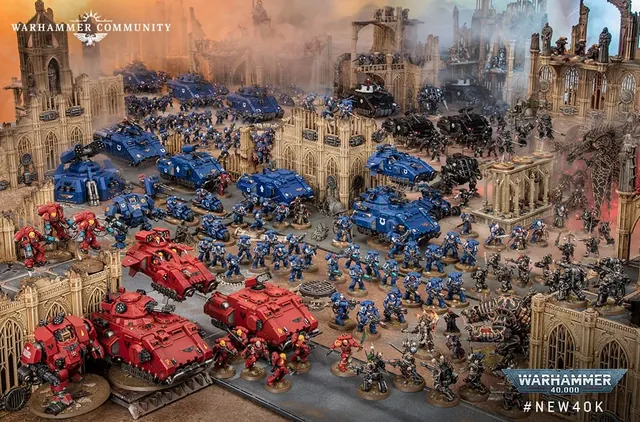
Mixed Space Marine armies displayed on a tabletop; not Blood Ravens gameplay. Credit: Games Workshop / Warhammer Community Official image source.
Read the full Space Marines / Blood Ravens profile →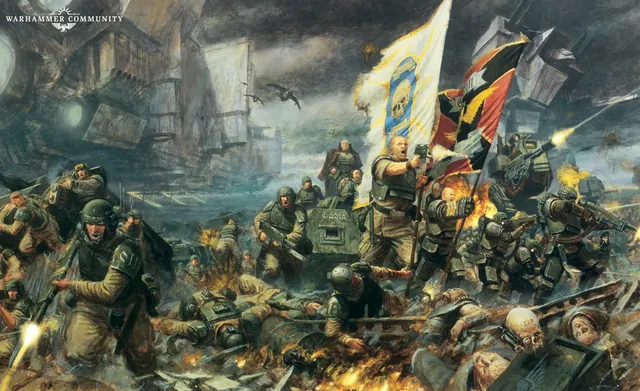
- Homeland / theatre
- Regiments raised across the Imperium
- Major leaders
- Sturnn; Lukas Alexander; Lord General Castor
- Allies & relationships
- Other Imperial forces; their orders can conflict
- Enemies & rivalries
- Chaos and alien armies; disputed Imperial commands
- Gameplay strengths
- Massed infantry with armour and fire support
Imperial Guard infantry advance through ruined streets beneath regimental banners. Credit: Games Workshop / Warhammer Community Official image source.
Read the full Imperial Guard profile →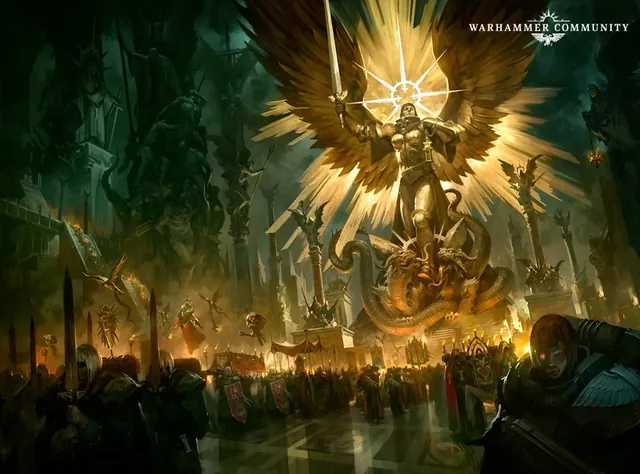
- Homeland / theatre
- Imperial convents and holy sites
- Major leaders
- Canonesses lead the orders
- Allies & relationships
- Ecclesiarchy; other Imperial forces when judged loyal
- Enemies & rivalries
- Heretics, aliens and suspected corruption
- Gameplay strengths
- Armoured infantry, flame weapons and faith abilities
A religious procession and sacred imagery of the Adepta Sororitas. Credit: Games Workshop / Warhammer Community Official image source.
Read the full Sisters of Battle profile →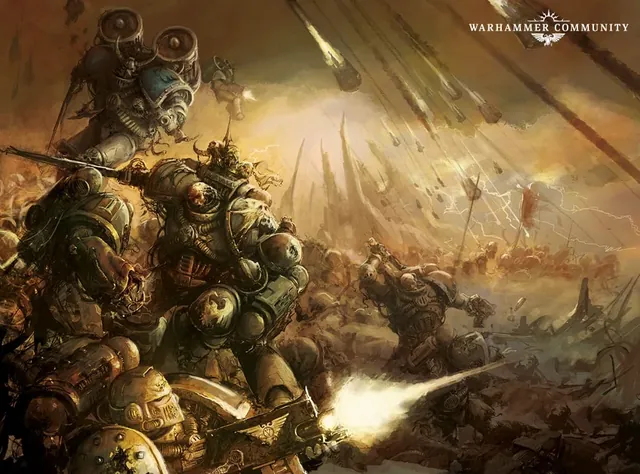
- Homeland / theatre
- Warband strongholds; Warp-linked refuges
- Major leaders
- Eliphas and rival warlords
- Allies & relationships
- Cultists and daemons; warbands also fight each other
- Enemies & rivalries
- The Imperium; competing Chaos powers and alien armies
- Gameplay strengths
- Aggressive specialists, commanders and daemonic support
Death Guard artwork aligned with Nurgle; not Eliphas, the Word Bearers or the Black Legion. Credit: Games Workshop / Warhammer Community Official image source.
Read the full Chaos Space Marines profile →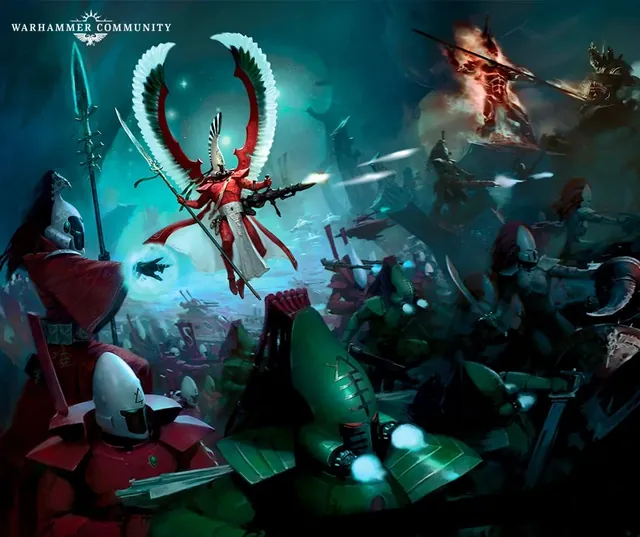
- Homeland / theatre
- Vast craftworlds travelling through space
- Major leaders
- Macha and other Farseers
- Allies & relationships
- Other Aeldari; occasional alliances to avert greater dangers
- Enemies & rivalries
- Slaanesh; threats foreseen against their people
- Gameplay strengths
- Fast specialists and carefully chosen engagements
Aeldari warriors and seers in official Games Workshop artwork. Credit: Games Workshop / Warhammer Community Official image source.
Read the full Eldar / Aeldari profile →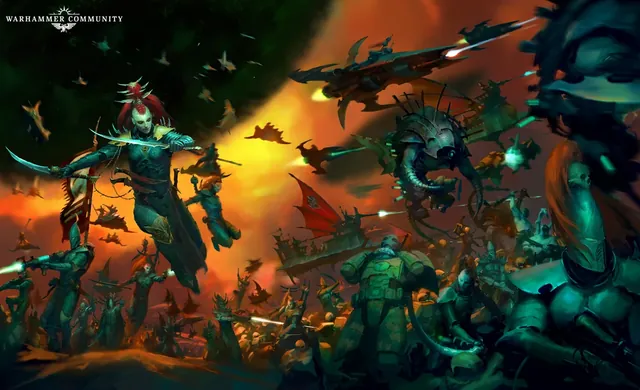
- Homeland / theatre
- Commorragh in the Webway
- Major leaders
- Archons lead competing kabals
- Allies & relationships
- Raiding coalitions; kinship with Aeldari is not unity
- Enemies & rivalries
- Victims and rivals; Slaanesh threatens their souls
- Gameplay strengths
- Fast raids, specialised attacks and Soulstorm soul abilities
Drukhari raiders and flying craft in battle; not Archon Tahril gameplay. Credit: Games Workshop / Warhammer Community Official image source.
Read the full Dark Eldar / Drukhari profile →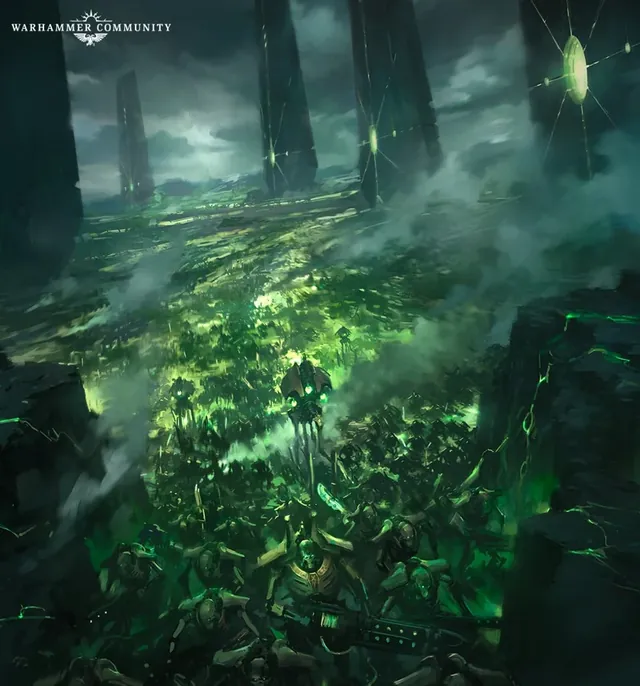
- Homeland / theatre
- Tomb worlds; Kronus in Dark Crusade
- Major leaders
- Dynastic rulers; the Necron Lord on Kronus
- Allies & relationships
- Their own dynasties, which may compete
- Enemies & rivalries
- Occupiers of claimed worlds and ancient rivals
- Gameplay strengths
- Durability, reanimation and unusual resource rules
Necron legions assemble beneath green light in a vast tomb complex. Credit: Games Workshop / Warhammer Community Official image source.
Read the full Necrons profile →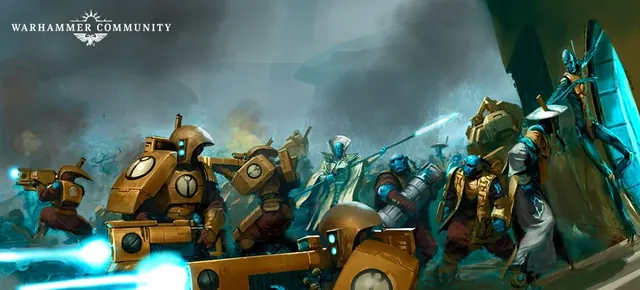
- Homeland / theatre
- T’au space; settlements on Kronus
- Major leaders
- Ethereals; Commander Shas’O Kais on Kronus
- Allies & relationships
- Auxiliary species including Kroot
- Enemies & rivalries
- Rivals for territory, including the Imperium and Necrons
- Gameplay strengths
- Ranged firepower, battlesuits and supporting specialists
T’au leadership and forces. Credit: Games Workshop / Warhammer Community Official image source.
Read the full T’au Empire profile →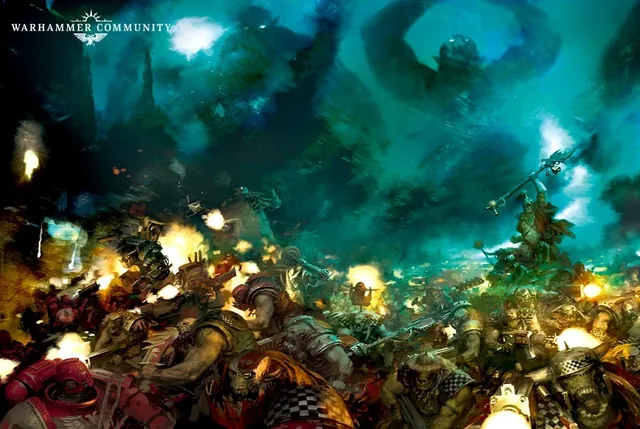
- Homeland / theatre
- Scattered Ork worlds and moving warbands
- Major leaders
- Gorgutz; Kaptin Bluddflagg is a different commander
- Allies & relationships
- Followers rally behind powerful Warbosses
- Enemies & rivalries
- Anyone offering a fight, including other Orks
- Gameplay strengths
- Aggression, numbers and momentum
Ork forces in battle. Credit: Games Workshop / Warhammer Community Official image source.
Read the full Orks profile →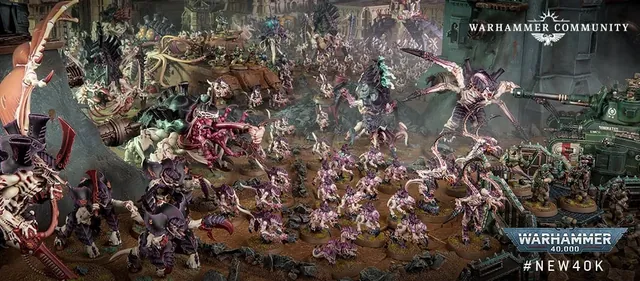
- Homeland / theatre
- Hive fleets arriving from beyond the galaxy
- Major leaders
- Hive Mind; synapse organisms coordinate the swarm
- Allies & relationships
- Organisms of the swarm, not diplomatic allies
- Enemies & rivalries
- Biomass-bearing worlds and forces resisting consumption
- Gameplay strengths
- Swarm coordination; playable story added in Retribution
Modern Tyranid miniature display; not a Dawn of War II unit roster or game screenshot. Credit: Games Workshop / Warhammer Community Official image source.
Read the full Tyranids profile →| Related forces | What connects them | What commanding them tends to involve |
|---|---|---|
| Space Marines and Blood Ravens, Imperial Guard, Sisters of Battle | Three human military institutions within the Imperium. Their separate authorities help explain their clashes on Kronus and Kaurava. | Marines offer adaptable elite squads; Guard need infantry and vehicle support; Sisters combine armoured troops, flame weapons and faith abilities. |
| Chaos Space Marines | Traitor and renegade human warriors fighting alongside cultists and daemons. The Heresy supplies an enduring grievance, but warbands have their own ambitions. | Aggressive specialists, powerful commanders and daemonic support. Chaos Rising also makes corruption a choice within your own squad. |
| Eldar and Dark Eldar | Related survivors of the ancient Aeldari civilisation. Both resist Slaanesh, using very different methods. | Mobile specialists; choose favourable engagements. Soulstorm’s Dark Eldar add soul harvesting and raiding abilities. |
| Necrons and T’au | Unrelated civilisations with rival claims on Kronus: ancient reclamation meets a much younger expanding empire. | Necrons bring durable, often slow forces and unusual resource rules; T’au favour ranged firepower with supporting auxiliaries. |
| Orks and Tyranids | Separate species. Orks seek bigger wars; Tyranids consume worlds to sustain the swarm. Neither is a branch of Chaos. | Orks build fighting momentum; Tyranids combine specialised organisms and synapse support. Their playable story arrives in Retribution. |
The profiles below explain these origins and exceptions, while the campaign roster table shows where each army is playable, because appearing in a story doesn’t guarantee a campaign of its own.
The Imperium, Chaos and the Blood Ravens
The Imperium of Man is humanity's vast, authoritarian empire, and while its soldiers defend human worlds, its institutions also persecute suspected heretics, suppress knowledge and sacrifice whole populations. Being the faction you control doesn't make it the good guys. That tension matters whenever an Imperial commander decides that saving a planet and obeying an order are different things.
“Human,” “Imperial” and “Blood Raven” describe different levels of identity: the Imperium is the state, Space Marines are a military institution, and the Blood Ravens are one Space Marine Chapter. The Guard and Sisters are human too, but neither belongs to the Blood Ravens.
| Institution | Its authority and role | Why it matters in Dawn of War |
|---|---|---|
| Space Marine Chapters | Largely autonomous warrior brotherhoods, each with its own leadership. A Chapter Master leads the Chapter; captains command its companies. | A Blood Ravens captain does not automatically command every Imperial soldier on a planet. |
| Imperial Guard / Astra Militarum | The Imperium’s mass armies, raised as regiments and directed through their own command structures. | Sturnn and Alexander have military obligations that may conflict with a Chapter’s demands. |
| Ecclesiarchy and Sisters of Battle | The Imperial church and the militant orders associated with it. | Religious judgements can put the Sisters at odds with other nominal allies. |
| Inquisition | Investigators with sweeping authority to confront threats to the Imperium, supported by their own influence and resources. | An Inquisitor’s demand can turn a military decision into a dispute over loyalty or heresy. |
| Adeptus Mechanicus | The technology priesthood and its forge worlds, with its own hierarchy and military forces. | Human technological religion, distinct from the alien Necrons; announced as playable in Dawn of War IV. |
These institutions serve the Emperor through overlapping chains of authority, so their disagreements can come from the system itself without either side having secretly joined Chaos. Imperial institutions
The Warp is a psychic dimension used for much interstellar travel and as the source of psychic abilities. A psyker can draw on it, but that exposure brings danger from daemons and corruption. A Space Marine psyker is called a Librarian: a warrior who also preserves the Chapter’s knowledge. A warp storm can isolate a system or swallow a world, which is why these storms change the campaigns’ geography and urgency. The Warp · Librarians
The four central Chaos gods are Khorne (bloodshed), Tzeentch (change and sorcery), Nurgle (disease and decay) and Slaanesh (excess and obsession). Their followers compete as well as cooperate. A daemon is a supernatural being of the Warp; a Chaos Space Marine is a corrupted or rebellious human warrior. Daemon Princes were once mortals raised to daemonhood, whereas Greater Daemons embody their patron god’s power. Those are different origins, not two military ranks. Games Workshop’s daemon introduction
The primarchs were the Emperor’s extraordinary gene-crafted sons and the commanders of the original Space Marine Legions. Later Chapters inherit genetic lineages from that earlier structure; their Chapter Masters are not new primarchs. Gabriel Angelos is a Blood Ravens commander, not a primarch or the Emperor’s biological son. The Imperium worships the Emperor as a god, but worship, military rank and supernatural power are different questions. Games Workshop’s primarch introduction
The history these campaigns inherit
The ancient alien wars belong to a much earlier timescale than humanity’s empire. The later sequence explains how the Emperor’s attempt to reunite human civilisation became the fractured Imperium the Blood Ravens serve.
- War in Heaven
Necrons emerge from biotransference; ancient wars leave tombs and enemies that outlast human civilisations.
- Human worlds become isolated
The Age of Strife fragments human civilisation. The Emperor conquers Terra during the Unification Wars.
- The Fall of the Aeldari
Slaanesh is born; Aeldari survivors seek protection for their souls. The wider subsiding of warp storms permits renewed human expansion.
- The Great Crusade
The Emperor’s forces conquer and reunite scattered human worlds; the primarchs command the Space Marine Legions.
- The Horus Heresy
Civil war divides the Legions. The wounded Emperor is confined to the Golden Throne; traitor forces continue their war.
- The Dawn of War campaigns
Separate Imperial institutions defend their claims while Chaos warbands, alien powers and Tyranid invasions collide with them.
Read the visual and view sources
Selected military lineage, not the whole Imperial government. Photos/art show modern faction references, not the Heresy itself.
The Necrons’ ancient history, the Aeldari’s Fall and the Great Crusade supply these different foundations. The Horus Heresy explains why the Blood Ravens’ Chaos opponents can share so much of their military heritage.
Why the Blood Ravens keep searching their own past
The Blood Ravens have an unusually strong interest in scholarship and relics, partly because their own origins are uncertain. Their founding and primarch ancestry aren’t firmly established. The popular idea that they descend from the Thousand Sons is a fan theory, not established lore. That gap in their history gives the campaigns a recurring question: how much should they risk to recover knowledge? Blood Ravens history and sources
| Character | What to remember before playing |
|---|---|
| Gabriel Angelos | The Blood Ravens captain introduced on Tartarus. His decisions connect the original campaign to later conflicts. |
| Davian Thule | Commands the Blood Ravens on Kronus and returns in Dawn of War II. His presence makes Dark Crusade more relevant to the sequel than its conquest format initially suggests. |
| Macha | An Eldar Farseer introduced in the original game. Her concern with future dangers repeatedly clashes with Imperial priorities. |
| Gorgutz ’Ead ’Unter | An Ork Warboss introduced in Winter Assault, with a continuing presence in Dark Crusade, Soulstorm and Dawn of War III. |
| Eliphas the Inheritor | A Chaos commander introduced in Dark Crusade who matters again in the Dawn of War II expansions. |
You only need to recognise these names, not memorise them; their alliances and loyalties are better left for the campaigns to develop. Gabriel Angelos · Gorgutz’s appearances
Warhammer 40,000: Dawn of War
Tartarus campaign: the opening mission. Narrated gameplay by Costin Gaming, from the original release.
The Blood Ravens arrive on Tartarus
An Ork invasion gives Captain Gabriel Angelos an apparently straightforward reason to deploy. The Blood Ravens arrive to help defend an Imperial world, but the approaching warp storm makes time a problem. Inquisitor Mordecai Toth wants Angelos to leave, while the Eldar’s interventions suggest that the invasion is only part of what is happening. Gabriel’s Librarian, Isador Akios, becomes central to the investigation. Tartarus campaign background
The story works as an introduction because it starts with recognisable military objectives, then gradually makes the situation less comfortable. The player learns why Imperial suspicion is sometimes justified and why certainty can still be disastrous. Angelos also carries the memory of Cyrene, his own homeworld, whose destruction he helped bring about after discovering corruption there. That history gives his reluctance to abandon another population a particular weight. Gabriel’s history
On the battlefield, you build a base, produce squads and vehicles, and fight for strategic points that supply requisition. Generators provide power. Squads can receive reinforcements and weapon upgrades; morale affects their ability to fight. Expansion is therefore tied to holding ground, which encourages you to move beyond a comfortable defensive position. Original game manual
This is the best starting point for understanding the cast, and its fixed sequence gives a newcomer fewer decisions to manage than a conquest map. Its limitation is freedom: the campaign follows the Blood Ravens through eleven missions, even though other armies are available in skirmish. If the base-building appeals but you want to choose the war yourself, Dark Crusade is the natural destination after this campaign. Campaign structure
Warhammer 40,000: Dawn of War – Winter Assault
Lorn V campaign: the Order opening and its later branches. No-commentary walkthrough by Azjenco; the full video also contains the Disorder campaign and endings.
Four armies compete for Lorn V
Winter Assault moves away from Angelos to a struggle over the fallen Imperial Titan Dominatus on Lorn V. Titans are enormous war machines, valuable enough to justify an expedition of their own. General Sturnn’s Imperial Guard want to recover it, while Farseer Taldeer, Ork Warboss Gorgutz and Chaos Lord Crull bring competing objectives to the planet. The alliances are temporary arrangements between people who have good reasons to distrust one another. Winter Assault’s setting and campaign
The campaign divides into Order, pairing the Imperial Guard and Eldar, and Disorder, pairing the Orks and Chaos. Later choices determine which faction you follow. “Order” is a campaign label, not a promise that these factions agree or act kindly. Play both branches if you want Winter Assault’s fuller picture. Dawn of War and Winter Assault manual
The Imperial Guard are the big mechanical addition, and they play nothing like Space Marines: individual Guardsmen can't absorb much punishment, so their strength comes from numbers, officers, defensive positions and heavy vehicles. Their introduction helps explain the scale of Imperial warfare. Space Marines are exceptional troops, while ordinary humans carry much of the fighting. Winter Assault’s official description
Keep this expansion in the complete tour for its faction perspectives and recurring cast. You can skip it in a focused Blood Ravens run, but doing so loses the beginning of Gorgutz’s career in the series. Its branching missions suit players who want authored scenarios; anyone impatient to command a persistent planetary conquest will get that change in Dark Crusade.
Warhammer 40,000: Dawn of War – Dark Crusade
Kronus campaign: the opening of a Space Marine conquest on Hard difficulty. Gameplay by Mitra artiM.
Why seven armies want Kronus
Dark Crusade gives you a whole planet to conquer: you pick one of seven armies, attack provinces, earn rewards for your commander and take on enemy strongholds. Ordinary territorial battles supply the campaign’s repetition; the strongholds supply its most distinctive objectives and faction confrontations. The Necrons and T’au join the playable roster. Official game description
Kronus makes more sense once you know who claims it: the T'au have established their own rule there, Imperial forces want the world back, and the Necrons are waking beneath land that younger civilisations have built on. Fear of that awakening even drives a local cult to summon Eliphas and his Word Bearers, so one invasion helps produce another, while the Eldar intervene against an ancient threat and Gorgutz gathers strength in the fighting. Kronus campaign background · The cult that summoned Eliphas
The most revealing confrontation pits two Imperial armies against each other: Captain Davian Thule’s Blood Ravens demand that Governor-Militant Lukas Alexander withdraw, but Alexander’s orders require him to hold the planet. Both claim to serve the Emperor. Their clash shows how the Imperium’s separate chains of command can turn loyalty into a justification for fighting fellow humans. It also gives the Blood Ravens a more unsettling role than a conventional liberating army.
Choose Space Marines if you’re following the series’ central story, because this route gives the clearest preparation for the Blood Ravens characters and events revisited in Dawn of War II. Other faction endings are alternative conquest outcomes, rather than events that all happened before the sequel. Campaign outcomes and later references
For a player who wants to choose an army and remain with it, this is the strongest starting recommendation in the first generation. The cost is repetition: provincial attacks and defences can interrupt the momentum between memorable strongholds. You gain ownership of the campaign’s direction, while losing some of the original game’s narrative pace.
Warhammer 40,000: Dawn of War – Soulstorm
Kaurava campaign: an Ork playthrough in Definitive Edition. Gameplay by StarkadAL.Gaming; start at 3:36 for the campaign map and play. Later chapters contain stronghold and ending spoilers.
A larger conquest and two new armies
Soulstorm stretches the conquest format across the whole Kaurava system, with the Sisters of Battle and Dark Eldar bringing the roster to nine and flying units adding another layer to its battles. Its chief attraction is the range of armies available within the original Dawn of War style. Soulstorm’s official overview
The new arrivals also expose divisions that a simple “humans against aliens” explanation misses. The Sisters’ religious authority can collide with other Imperial forces. The Dark Eldar share ancestry with the Eldar but pursue raids, captives and their own survival. Meanwhile, a warp storm brings further disruption to a system already containing rival populations and ancient threats.
For the Blood Ravens story, Soulstorm supplies useful background rather than a necessary full playthrough. Later games refer back to Kaurava, but the selectable conquest endings are alternatives. Do not treat a Space Marine victory in your own playthrough as the established bridge into Dawn of War II. Series continuity and Kaurava
Play it when a particular army interests you or when you want more of the conquest format after Kronus. It is a weaker recommendation for someone whose main goal is to keep the Blood Ravens plot moving, because its broader campaign adds considerable fighting between the story moments. Choose the Orks if you are following Gorgutz, or use the opportunity to see the setting through an army you have not commanded before.
Warhammer 40,000: Dawn of War II
The Aurelia campaign: full gameplay walkthrough by Secret.Archive. The opening demonstrates the squad-based campaign; later chapters reveal the story’s outcomes.
Defending the Blood Ravens’ recruiting worlds
Dawn of War II begins with a new Force Commander and a small group of Blood Ravens operating in sub-sector Aurelia. These worlds supply recruits and resources to the Chapter, so defending them also means protecting its future. Ork attacks and Eldar operations gradually reveal a much larger problem: a Tyranid invasion threatening to consume the region. Dawn of War II campaign introduction
The campaign drops base-building for a persistent strike force: you pick squads for each mission, assign their equipment and develop their abilities between deployments. Cover, suppression, flanking and retreat matter more than managing a large production queue. A weapon choice can change what a squad is useful for, so the preparation screen becomes part of the tactical decision. Official gameplay description
Tactical Sergeant Tarkus, heavy-weapons specialist Avitus, Scout Sergeant Cyrus and assault specialist Thaddeus give those choices personalities. Tarkus and Avitus served on Kronus; Cyrus survived Kaurava. Their arguments carry experience from the earlier wars, and Davian Thule’s return adds another connection to Dark Crusade. You are seeing what happens to veterans after the earlier campaign’s victory screen. The Blood Ravens’ campaign veterans
This is the better entry point if you enjoy equipment, character progression and controlling a handful of units closely. The trade-off is scale: someone who loved building an expanding army in the original may find the campaign too restrictive, and repeat deployments can expose familiar mission patterns. The new format is intentional, so judge it on whether that smaller command interests you.
That only applies to the campaign; Dawn of War II's competitive modes still involve recruiting units and contesting resources. Campaign footage alone doesn’t describe everything the game offers. Official mode and gameplay overview
Warhammer 40,000: Dawn of War II – Chaos Rising
Aurelia campaign: no-commentary walkthrough of Chaos Rising by Blogan Gaming. This full playthrough includes late-game decisions and endings.
A returning world and a threat inside the Chapter
Chaos Rising is set one year after Dawn of War II, when the planet Aurelia, lost in the Warp for a thousand years, drops back into normal space. Its reappearance creates a military emergency and draws the Blood Ravens into a conflict with Chaos that becomes increasingly personal. Chaos Rising manual
Keep your completed Dawn of War II save, because Chaos Rising can import your squad progression and much of the equipment they had equipped, although some items are changed or restricted. It isn’t an unrestricted transfer of everything in your inventory. Starting fresh is possible, but importing gives this campaign a more direct sense of continuity.
Corruption is the big addition: choices during missions and the use of certain equipment can push characters towards Chaos, opening powerful abilities while closing off some alternatives. The temptation has a practical shape: a useful item or an easier course of action can carry consequences beyond the current fight. That makes the Blood Ravens’ existing attraction to dangerous knowledge part of how you play.
The returning cast and the investigation within the Chapter are the reason to play this directly after II. It asks you to judge soldiers you already know, and Eliphas’s involvement adds another connection to Dark Crusade. Explaining the traitor or listing every ending here would undermine the campaign, so those details can wait until you have finished it. Story connections
Chaos Rising is essential for the story route, though its more consequential choices develop the same small-squad approach and are unlikely to persuade you if that was what you disliked about II.
Warhammer 40,000: Dawn of War II – Retribution
Aurelia campaign: the opening of the Space Marine route. Narrated gameplay by SurrealBeliefs.
Six perspectives on the same crisis
Retribution is set ten years after Chaos Rising, and the war has dragged on long enough for the Inquisition to consider Exterminatus, the destruction of worlds judged beyond saving. Six playable armies approach this crisis with different reasons to intervene. Retribution manual
You follow Captain Apollo Diomedes in the Space Marine campaign, while Lord General Castor and Inquisitor Adrastia bring the Imperial Guard into the conflict; Kayleth leads the Eldar, Eliphas the Chaos forces, and Kaptin Bluddflagg the Orks. The Tyranid route follows a surviving swarm trying to rebuild its connection and strength. These objectives overlap because each faction needs to overcome threats in the same region, even when their desired outcomes are incompatible. Faction campaign premises
The gameplay allows a larger supporting force alongside your heroes, with recruitment and unit upgrades providing more army-building than the first two campaigns. It still does not become the original game’s full base-building system. The interesting choice is how much responsibility to give your heroes and how much to invest in the troops around them.
Start with Space Marines if you want the clearest continuation of the Blood Ravens’ internal conflict. Then replay as an army whose motives interest you. These routes share much of their mission structure, so six selectable factions should not be read as six wholly different campaigns. The variations in dialogue, abilities and perspective provide the reason to replay.
Retribution supplies the conclusion the earlier two campaigns have been working towards, but it also demonstrates why a universal “canon route” is awkward. Different victories can’t all be treated as simultaneous events. Follow the Space Marine perspective for continuity, then enjoy the other endings as alternative results of the same crisis.
Warhammer 40,000: Dawn of War III
Space Marine gameplay published by GameSpot before the 2017 launch. This shows the game’s army scale and elite units, rather than serving as a current-version comparison.
Gabriel, Macha and Gorgutz return
Dawn of War III brings Gabriel Angelos, Macha and Gorgutz into a struggle connected to the mysterious world of Acheron and a legendary weapon. Its seventeen-mission campaign alternates between Space Marines, Eldar and Orks. You see the war from all three sides instead of choosing one faction and staying with it. Official Dawn of War III manual
Base-building and larger armies return, alongside powerful elite units and major battlefield abilities. The result demands attention at two scales: maintaining your forces and positioning exceptional units whose actions can decide an engagement. It offers more large-army spectacle than II’s campaign, but does not preserve II’s persistent squad-and-equipment structure. Feral’s official gameplay overview
Its familiar characters make it worth a look after Retribution, but they don't make it an essential purchase for everyone. If your favourite part was developing II’s small squad, III changes that relationship substantially. If you want to see several armies collide and are comfortable learning another system, the rotating campaign gives you a reason to try all three.
Older write-ups judge its multiplayer by the launch Power Core mode alone, which is out of date: Relic later added Annihilation Classic and Annihilation with Defenses. Relic’s June 2017 update
The factions and the histories behind their wars
The directory introduced the armies side by side; these profiles go further into their histories, and into how shared origins, rival claims and different methods of survival shape the conflicts you encounter.
Space Marines and the Blood Ravens
Space Marines are made through genetic alteration, surgery and extreme conditioning, and although their Chapters share equipment and a duty to defend the Imperium, each keeps a distinctive culture. A Chapter’s priorities need not match an Imperial governor’s, which is why the confrontation on Kronus matters beyond that one mission. Space Marine background
The Blood Ravens’ particular concern is knowledge: relics, records and the possibility of recovering their own past. Their Librarians are warriors and custodians of that knowledge, making the boundary between investigation and temptation especially uncomfortable. The campaigns repeatedly return to the consequences of trusting a commander, an artefact or a supposed revelation too readily.
In the first game’s army, adaptable Tactical Marines, specialist squads and vehicles make a useful introduction to matching units against threats. In II’s campaign, that military flexibility moves into individual squad builds and equipment. The same Chapter therefore gives you two quite different experiences of command. Blood Ravens background · Dawn of War II manual
Imperial Guard: ordinary humans holding extraordinary wars together

The Astra Militarum, called the Imperial Guard in these games, draws regiments from worlds across the Imperium. Those worlds produce different military cultures, but the shared burden is enormous: hold territory, absorb invasions and supply the mass of soldiers and armour that a relatively small Space Marine force cannot provide. Official Astra Militarum history
General Sturnn in Winter Assault, Lukas Alexander in Dark Crusade and Lord General Castor in Retribution show different sides of that obligation. Their orders can collide with the demands of other Imperial institutions. The resulting fights are about authority and responsibility as much as battlefield allegiance.
Their appeal in the games is the combination of vulnerable people and formidable machinery. Infantry need support, while tanks, artillery and commanders turn a mass of ordinary soldiers into a force that can contest ground with monsters. If the Blood Ravens introduce 40K through exceptional warriors, the Guard make the cost of maintaining its empire easier to see.
Chaos Space Marines: a human civil war that never ended
The traitor legions trace their great rebellion to the Horus Heresy, but Chaos is larger than those original armies. Renegades, mortal cultists and daemons join wars driven by devotion, revenge, ambition and rivalries among the gods. Their enemies may worship the same powers and still stand in the way of a commander’s advancement. Official Chaos Space Marine history
Eliphas leads Word Bearers on Kronus and later appears among the Black Legion. His changing allegiance is one reason “Chaos” should not be read as a single unified army with a fixed leadership. The Blood Ravens face opponents who understand human institutions and can work through them. Corruption can begin with a convincing argument, a useful alliance or a weapon that appears to solve an immediate problem. Eliphas’s recorded appearances
Chaos Rising brings that danger into your own equipment choices, where decisions that make your force more effective can also expose it to corruption. When the game offers power with a cost attached, it is translating one of the setting’s central ideas into a decision you have to make.
Orks: war as a way of life
Orks gather around strong Warbosses, and a successful leader can turn scattered fighting into a Waaagh!, a mass movement of warriors, vehicles and growing momentum. Fighting is central to their culture. Their engineers, the Mekboyz, build real, working weapons and machines. Ork belief is often said to help that technology along, but “it only works because they think it does” sells the Mekboyz short. Games Workshop’s Ork introduction
Gorgutz provides a useful thread through the series because his ambitions survive changes of battlefield. He is always looking for a way to gain strength, defeat rivals and build a bigger following. Retribution’s Kaptin Bluddflagg is a different character, with a pirate captain’s interests and personality; he should not be confused with Gorgutz merely because both lead Orks.
For everyone living where an Ork fight happens, their delight in warfare is disastrous, however funny their antics may be. The games use that combination effectively: the dialogue can be funny while the army in front of you remains a serious threat. Gorgutz’s history · Retribution’s cast
Eldar: trying to prevent disasters other factions cannot see
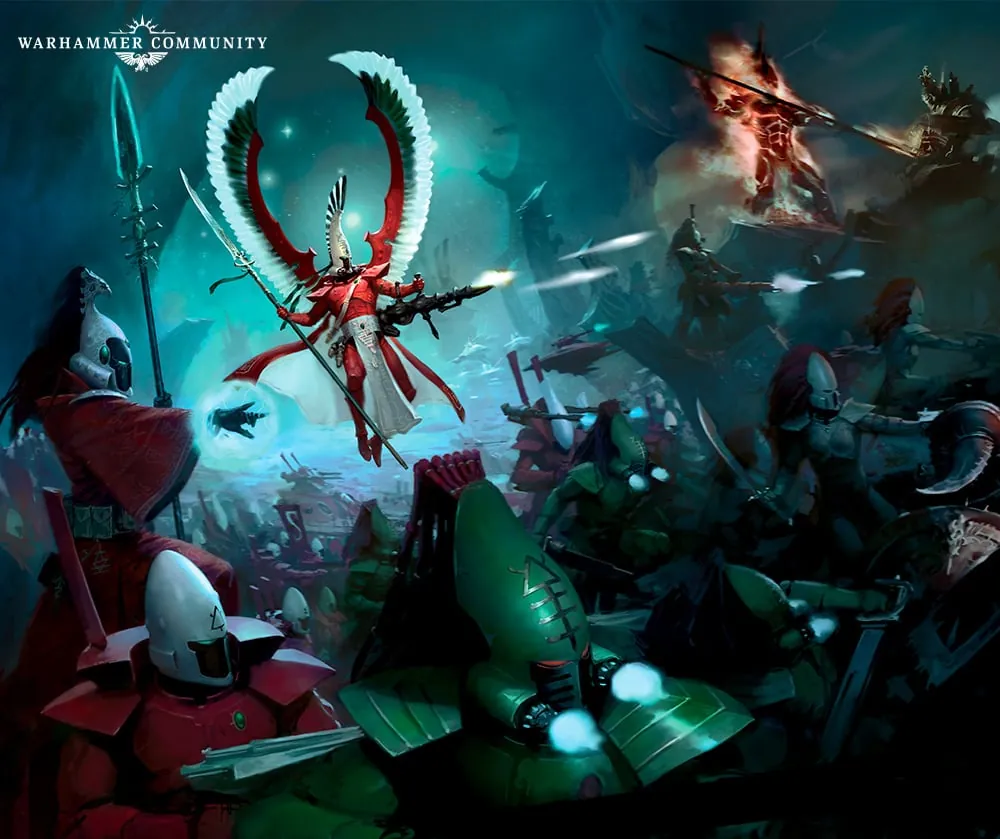
The ancient Aeldari civilisation suffered a catastrophe known as the Fall, whose psychic upheaval brought the Chaos god Slaanesh into being. Craftworld populations escaped aboard vast vessels before that disaster. Their descendants use disciplined Paths to regulate their lives, and spirit stones protect their souls from Slaanesh after death. This is a civilisation shaped by survival after immense loss. Games Workshop’s Aeldari history
Farseers read possible futures, which explains Macha's warnings and the Eldar's interventions without making every decision just or every prediction right. They may regard sacrificing outsiders as an acceptable way to prevent a future catastrophe for their own people. An Imperial commander sees the immediate attack; the Farseer sees a chain of consequences that commander may never accept.
Their specialist troops demand deliberate army control, because a unit that excels at its intended task can be vulnerable when forced into the wrong engagement. In the story and on the battlefield, the Eldar reward understanding what a particular force is trying to achieve before deciding how to answer it.
Dark Eldar: another response to the same catastrophe
Read the visual and view sources
Selected cultures only. Craftworld populations escaped before the Fall; the paths show survival strategies, not a simultaneous migration.
The Drukhari, called Dark Eldar in Soulstorm, share the Aeldari’s ancient origins but centre their society on Commorragh within the Webway, a network distinct from ordinary space. Slaanesh drains their souls, and they stave off that decline through the suffering of others. Raiding for captives is therefore tied to the survival of their society as well as its cruelty. They aren’t simply craftworld Eldar who worship Chaos. Official Drukhari history
This relationship explains why Soulstorm can contain both Eldar and Dark Eldar without treating them as interchangeable armies. Their shared catastrophe produced very different ways of living with the same threat. Where craftworld discipline and spirit stones offer one response, Commorragh sustains itself through predation.
Their interest in slaves and suffering gives them a different stake in Kaurava: prolonged conflict can be profitable without sharing anyone else’s territorial justification. The chaos of an invasion creates opportunities for raiders even when they didn’t cause the original crisis.
Necrons: the people already buried beneath the battlefield
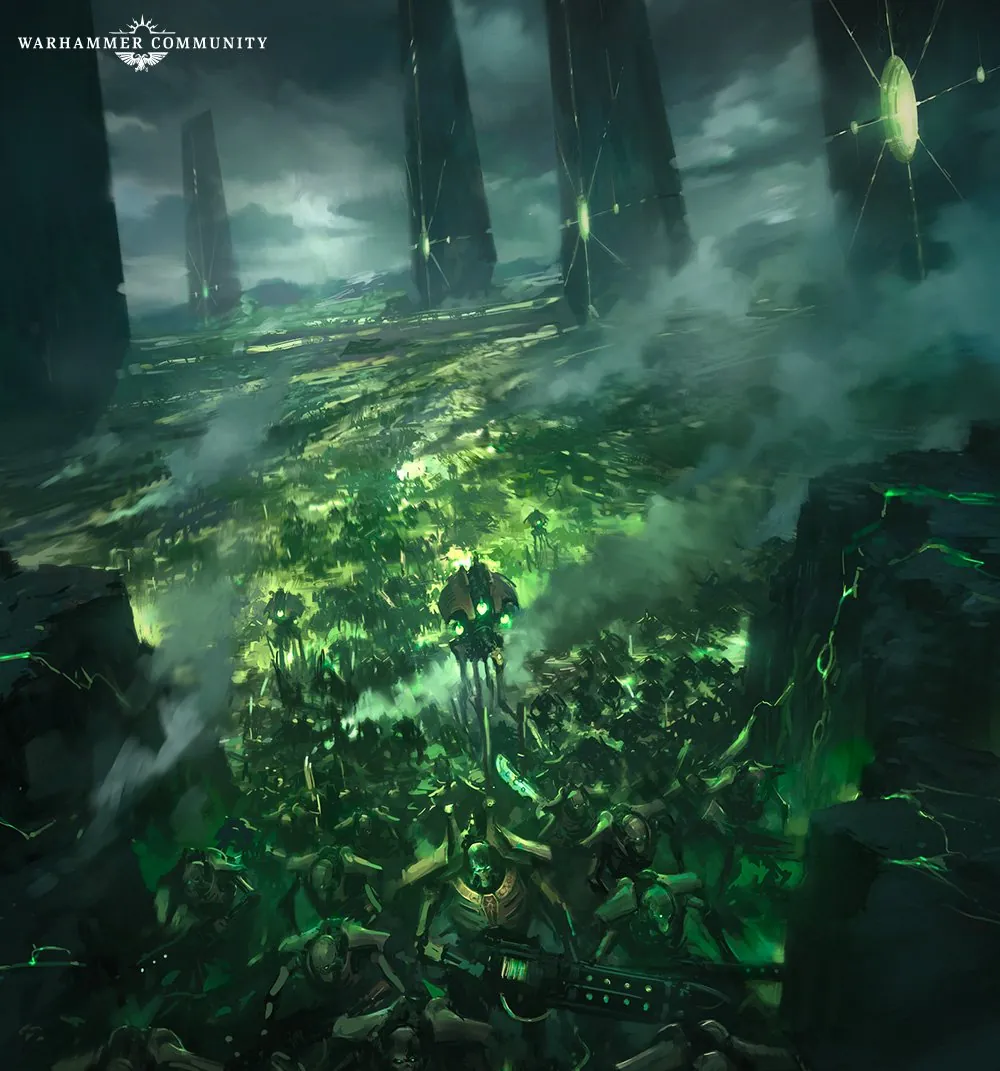
The Necrons were once the Necrontyr, an ancient mortal civilisation whom the C’tan helped draw into biotransference, replacing flesh with living-metal bodies at a terrible cost. Their souls were consumed; many lost much of their individuality. After ancient wars and a long dormancy, awakening dynasties seek to reclaim worlds that other species now inhabit. Official Necron history
That history makes Kronus a dispute over time as well as territory. To the people on its surface, Necrons are an emerging invasion. To its ancient inhabitants, those surface civilisations are recent occupants of their world. In current lore, the Necrons also turned on the C’tan and shattered many of them, enslaving their shards. The Nightbringer, familiar to Dark Crusade players, is one example of a star god whose surviving fragments are now weapons for its former servants. Games Workshop on the Nightbringer’s shards
Dark Crusade also reflects an older portrayal of the faction, with a stronger emphasis on implacable death machines and the C’tan. Modern lore gives Necron dynasties and their rulers more explicit personalities and competing agendas. Keep that publication history in mind: a 2006 game cannot be expected to present every later development. Its particular atmosphere is part of its appeal, but it is not the whole contemporary Necron setting.
T’au Empire: expansion through the Greater Good
The T’au unite their society around the Greater Good, an ideology that places service to the collective above individual interest. Ethereals occupy its ruling caste, while other castes organise warfare, production, diplomacy and travel. Their empire incorporates other species, including Kroot, but cooperation exists within a hierarchy directed by T’au leadership. Their willingness to negotiate doesn’t make their expansion free of coercion. Official T’au history
On Kronus, this produces a different claim from either the Imperium’s reconquest or the Necrons’ awakening. The T’au are defending and extending their own political project. Commander Shas’O Kais gives that project a military face in Dark Crusade.
Their army is a useful choice for players attracted to ranged firepower, battlesuits and supporting specialists. Its identity also makes a broader point about the series: factions can oppose Chaos and still be bitter enemies of one another. A shared threat seldom cancels the argument over who should rule once the battle is over.
Sisters of Battle: Imperial faith with its own army
The Sisters of Battle are the militant orders of the Adepta Sororitas. They are elite human warriors in power armour, not female Space Marines. Their institutional history is tied to the Ecclesiarchy and the aftermath of Goge Vandire’s destructive rule during the Age of Apostasy. Religious devotion gives their military service its purpose and its particular severity. Official Adepta Sororitas history
With the Sisters playable alongside the Guard and Space Marines, Soulstorm gives the Imperial side of the roster three different institutional identities: the mass military, the independent warrior Chapters and the militant religious orders. They can disagree about a commander's loyalty or the correct response to suspected corruption while all claiming to defend the same empire.
Their emphasis on faith, flames and close punishment makes their character easy to recognise, but the political relationship is the more useful introduction. The Imperium contains many centres of power, and shared worship doesn’t guarantee shared judgement.
Tyranids: an invasion that consumes the territory itself
The Tyranids are organisms connected through the Hive Mind, with synapse creatures coordinating the swarm. Their invasions consume biological material to sustain and reproduce their forces. A world is a source of biomass, so the outcome threatens the populations and environments that make the planet worth defending. Official Tyranid introduction
A splinter of Hive Fleet Leviathan brings the Tyranid invasion to Aurelia, threatening both the Blood Ravens’ recruiting worlds and the foundations of the other combatants’ plans for the region. In Retribution, the playable Tyranids are rebuilding from the invasion’s remnants, giving their campaign a direct connection to the earlier war. The Tyranid campaign’s opening
The original Dawn of War II lets you fight Tyranids in the story and command them in competitive modes, and Retribution finally gives them a campaign of their own. A faction’s presence in a game therefore doesn’t tell you whether it has a story you can play from its own side. Official Dawn of War II collection overview
Which armies are playable in each campaign?
This table covers official campaign perspectives only, so scripted allied units don't count as a faction campaign. A faction available in skirmish, a survival-mode hero or a modded army is a different offering.
| Game | Main playable campaign factions | How the choice works |
|---|---|---|
| Warhammer 40,000: Dawn of War | Blood Ravens Space Marines | One fixed story. The original skirmish roster also includes Orks, Eldar and Chaos. |
| Warhammer 40,000: Dawn of War – Winter Assault | Imperial Guard, Eldar, Orks, Chaos | Two paired campaigns with later faction branches. |
| Warhammer 40,000: Dawn of War – Dark Crusade | Space Marines, Imperial Guard, Chaos, Orks, Eldar, Necrons, T’au | Choose one army for a conquest campaign. |
| Warhammer 40,000: Dawn of War – Soulstorm | Dark Crusade’s seven armies, plus Sisters of Battle and Dark Eldar | Choose one of nine armies. |
| Warhammer 40,000: Dawn of War II | Blood Ravens Space Marines | Persistent squad campaign; other launch armies are available in competitive modes. |
| Warhammer 40,000: Dawn of War II – Chaos Rising | Blood Ravens Space Marines | Continues the squad campaign; Chaos also joins the competitive roster. |
| Warhammer 40,000: Dawn of War II – Retribution | Space Marines, Imperial Guard, Chaos, Orks, Eldar, Tyranids | Choose one faction; routes share much of the mission structure. |
| Warhammer 40,000: Dawn of War III | Space Marines, Eldar, Orks | The campaign switches between all three. |
The Necron Overlord and T’au Commander available in The Last Stand, a separate survival mode, do not create full Necron or T’au armies for Dawn of War II’s campaign or competitive matches. They are playable heroes within that mode. Relic’s description of the collection and its eight Last Stand heroes
Which edition should you buy?
For a new PC purchase, check the contents of the current collections before buying old expansion listings individually. The campaign names above describe the original releases; modern packages can include several of them together.
| Current package | Campaigns included | What to check |
|---|---|---|
| Warhammer 40,000: Dawn of War – Definitive Edition | Original campaign, Winter Assault, Dark Crusade and Soulstorm | Updated presentation and support for modern hardware. It revisits the first generation; it is not Dawn of War II. |
| Warhammer 40,000: Dawn of War – Anniversary Edition (Classic) | The original first-generation game and its expansions | Useful if you want the classic versions. Check the required version before choosing a mod. |
| Warhammer 40,000: Dawn of War II – Anniversary Edition (Classic) | Dawn of War II, Chaos Rising and Retribution | The current Steam package collects all three campaigns and additional DLC. |
| Warhammer 40,000: Dawn of War III | Its own three-faction campaign | A separate game, with a different approach to armies and progression. |
Package contents checked 4 November 2026 against the official franchise site, Definitive Edition listing, classic first-game listing and Dawn of War II listing. Prices and discounts depend on region and storefront. Existing owners should inspect their account before buying content again.
Warhammer 40,000: Dawn of War IV
Official game overview. Promotional footage, not gameplay from the finished game.
The next announced entry returns to Kronus, with Space Marines, Orks, Necrons and the Adeptus Mechanicus as its four announced factions. Blood Ravens and Dark Angels are both Space Marine Chapters, so their presence does not mean there are two additional races. Official faction and story announcement
The Adeptus Mechanicus are the Imperium’s technology priesthood, centred on Mars and its forge worlds. Their Tech-Priests and augmented soldiers remain part of human civilisation; they are unrelated to the Necrons’ ancient transformation into living metal. Their search for technology gives a return to a Necron-haunted world an obvious source of tension. Official Adeptus Mechanicus history
As of 4 November 2026, KING Art Games and PLAION list 3 December 2026 as the release date, with Commander Edition access from 30 November. That’s the revised date from the publisher’s August announcement. Leave IV out of a marathon until its finished campaigns are available. Publisher’s release-date update
For the wider relationship between these settings, continue with Warhammer Explained: Fantasy, 40K and Age of Sigmar. For territorial campaigns in the Fantasy world, see Total War: WARHAMMER: Games, Races and Campaigns.
Sources
Games, manuals and current editions: Official Dawn of War site; Dawn of War and Winter Assault manual; Winter Assault; Dark Crusade; Soulstorm; Dawn of War II manual; Chaos Rising manual; Retribution manual; Dawn of War III manual; Dawn of War III overview; Relic’s Anniversary Edition announcement; Definitive Edition; Dawn of War II collection.
Official faction background: Games Workshop’s introductions to Space Marines, Astra Militarum, Chaos Space Marines, Orks, Aeldari, Drukhari, Necrons, T’au, Adepta Sororitas and Tyranids. The dated tabletop rules on these pages are not used as video-game rules.
Campaign continuity and specialist references: Lexicanum’s source-indexed entries for Blood Ravens, Gabriel Angelos, Tartarus and Gorgutz; the Dawn of War Wiki’s original campaign overview; Warhammer 40k Wiki’s Dark Crusade and Retribution references. Community discussions helped identify recurring questions about campaign order; they are not treated as the authority for disputed lore.
Additional continuity and terminology checks: Winter Assault campaign; Dark Crusade outcomes; Chaos Rising story; Blood Ravens veterans; Eliphas; Retribution’s Tyranid campaign; the Warp; Librarians; Games Workshop on the Nightbringer; Relic’s Annihilation update; classic Dawn of War collection.
Dawn of War IV: Games Workshop announcement, PLAION release-date revision and Adeptus Mechanicus background.
Further references: Imperial institutions; Games Workshop’s daemon introduction; Games Workshop’s primarch introduction; Great Crusade; Horus Heresy; Watch Warhammer 40,000: Dawn of War: gameplay; Watch Warhammer 40,000: Dawn of War – Winter Assault: gameplay; Watch Warhammer 40,000: Dawn of War – Dark Crusade: gameplay; Watch Warhammer 40,000: Dawn of War – Soulstorm: gameplay; Watch Warhammer 40,000: Dawn of War II: gameplay; Watch Warhammer 40,000: Dawn of War II – Chaos Rising: gameplay; Watch Warhammer 40,000: Dawn of War II – Retribution: gameplay; Watch Warhammer 40,000: Dawn of War III: gameplay; Watch Warhammer 40,000: Dawn of War IV: official overview.


