You’re Going to Be Fine, Dad. Just Don’t Wait Three Years
You do not need to become a perfect Instagram dad. Be there from the beginning, learn your child and make life easier for the person raising them with you.

If your girlfriend or wife is pregnant and the due date is getting close, you have probably already had the moment when you thought, shit, I have no idea what I am doing. Good. That means you understand something serious is about to happen.
At first, it may genuinely feel as if the baby only needs the mother. She carried them, she may be breastfeeding, and sometimes she will calm them in thirty seconds after you have spent twenty minutes making the situation worse. You are not useless; you are simply new, and the only way to stop being new is to stay involved long enough to learn your own child.
I am not writing this as some perfect Instagram dad who wakes up smiling at 5:30, prepares an organic breakfast, and then posts about gratitude. I could do more; I get things wrong, and I am only a little further into it than the guy waiting for his first child. What I can tell you is that you do not need to wait until your child is three, five, or old enough to kick a football back. Your part starts from the beginning, even when you are not yet sure what that part is.
Quick Answer
After conducting thorough TGK research, which in this case means reading people who study child development because we are not doctors and “come on, obviously” is not a source, babies do start getting to know their fathers before they can speak. They learn your voice, your face, the way you hold them and what happens when they make a sound or become uncomfortable and you respond. The relationship is already forming through carrying them, changing them, going outside together, talking rubbish to them and trying again after the first attempt goes badly.
You will not always be able to do what the mother does, especially during the first months, and no normal family divides every nappy, feeding and bad night exactly 50/50 - the useful part is finding where you fit and then being dependable there. If the baby only wants Mum, try another way to calm them, take them for a walk, prepare dinner, wash the bottles, or clear the kitchen while she handles it. Small jobs sound small until somebody has been holding a baby all day and no longer wants to make one more decision.
Taking the stroller is the easiest useful thing you can do
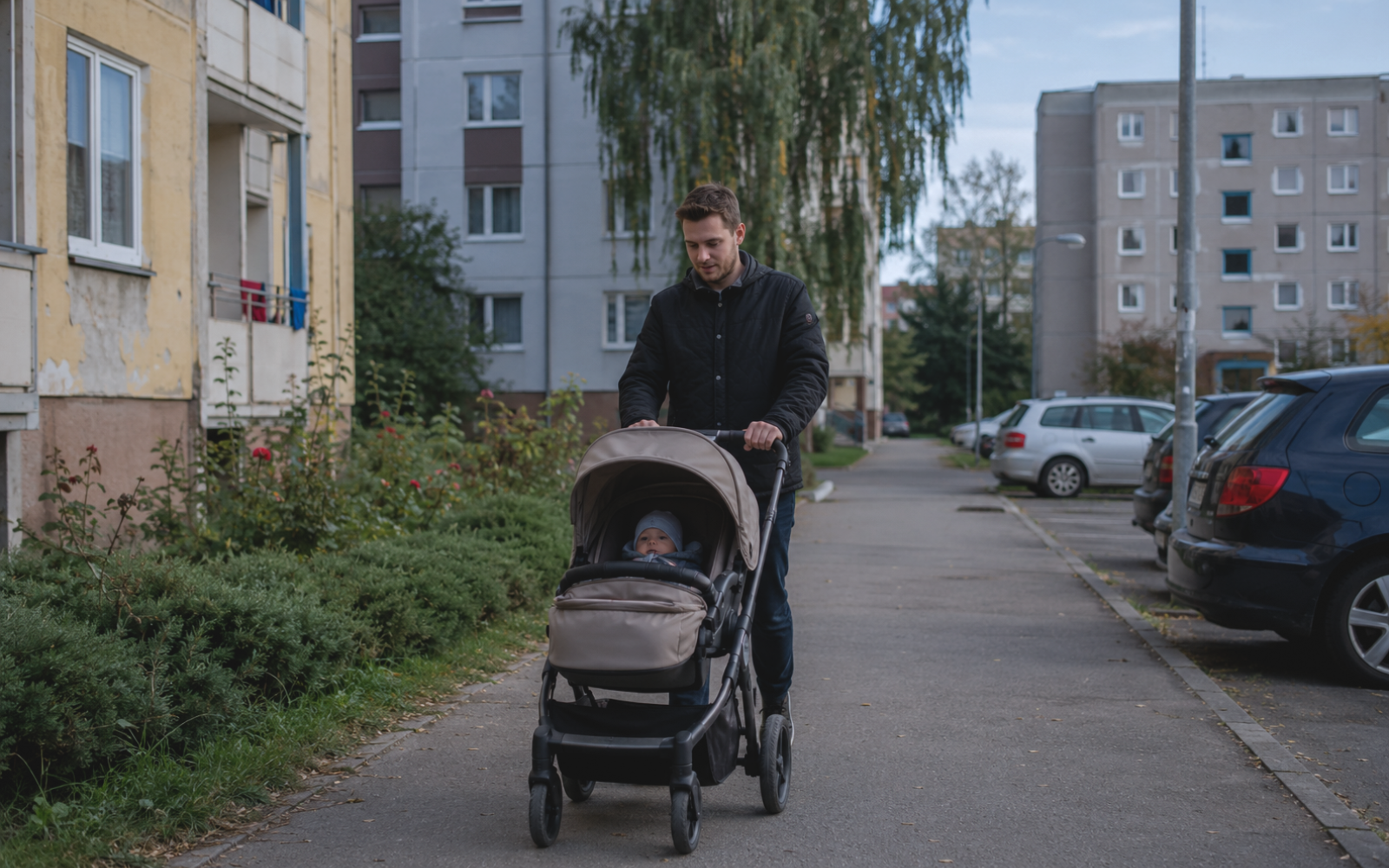
When I go somewhere alone with my child in a stroller, my mother tells me what a good father I am. She means it kindly, because in her generation men usually did much less of this when their children were small, so a father outside alone with a baby still looks like he has completed some advanced parenting qualification.
In reality, the walk is probably the easiest useful thing I can do. There is no rocket science involved: dress the child, take the stroller and walk around for a while. My wife gets a quiet hour, I spend time with my child and, if the child falls asleep, I may even get a coffee without anybody throwing food at me.
I still joke with my wife sometimes that she is lucky because our fathers never did any of this. For some reason, she does not treat a low historical standard as the romantic argument I intend it to be. Fair enough. The point is not to congratulate yourself for taking one walk; it is to notice how many easy ways there are to make the day better for everybody.
The first three years may be the hardest and the happiest
The first three years can be the most difficult years of your life and some of the happiest, and those things do not cancel each other out. You can feel completely finished because the child refused to sleep, then laugh ten minutes later because they discovered a spoon. A lot happens before they can explain any of it to you, including the beginning of your relationship with them.
The older attitude was that there was not much a father could do with a baby anyway. The mother had the natural connection, the father had work, and everybody would meet again in three or five years when the child could speak properly and become more interesting to him. Dad could then teach them to ride a bike, take them fishing or complain about how nobody respected authority anymore.
Most of those fathers were not bad men and they did love their children. They were repeating the family arrangement they had seen, and in post-Soviet countries especially, providing money was treated as the serious male contribution while the early care belonged to women. A 2026 collection of research on fatherhood across post-socialist Europe found that the idea of an involved father has become more popular, but the work still does not always follow the attitude. Long working hours, money, workplace culture and the old expectation that the mother will quietly manage everything keep pulling families back towards the same arrangement.
You do not need to hate your father or pretend he never loved you to decide that you want to do this part differently. Most men copied what they saw, and now we have more information and different lives. We can keep the fishing without skipping everything that happens before it.
Your child is already learning who you are
A baby will not remember the first year the way an adult remembers a holiday, but that does not mean nothing is happening. They are learning patterns before they have words for them. When they cry, make a sound or look towards you and you respond, that little exchange becomes part of how they learn communication and whether the adults around them feel reliable.
Harvard’s Center on the Developing Child calls this “serve and return,” which sounds like a paid tennis lesson but means something extremely normal: the baby makes a face, noise or movement, and you answer with your voice, your eyes, a touch or another stupid face. These exchanges support early language and social development, including before the child can talk.
Fathers can form their own attachment with a baby. A review of fatherhood during the first 1,000 days explains that feeding is not what creates the entire relationship, which should be reassuring because breastfeeding is one area where your enthusiasm will not make you more qualified. The same review makes a less convenient point: you need time with the baby to learn what their different sounds, faces and movements mean.
That is why the mother often looks naturally better at everything when the baby is small. She may have spent far more time learning the child while you were at work, and if she always handles feeding, calming, sleep and every difficult moment, that gap only grows. You will probably be worse at some of it in the beginning, which is normal; give yourself enough time with your child to stop guessing at every sound.
If the baby only wants Mum, get creative
There will be moments when you try to calm the baby and achieve nothing except making both of you more annoyed. Try a walk, a different hold, the carrier, music, a bath, a ridiculous face or whatever strange thing worked yesterday. Babies have no respect for consistency, so the solution may be something that makes no sense to either adult.
If the baby clearly needs Mum, let her take over and be useful around them. Wash the bottles, make food, empty the dishwasher that finished three hours ago, prepare what the child will need tomorrow or rescue the clothes sitting in the machine. It is not the glamorous part of fatherhood, but removing three boring jobs from the evening can make more difference than insisting on winning a battle with a screaming baby.
A 2024 study of mothers with babies and toddlers in rural Western Kenya found a small link between greater father involvement and fewer maternal depressive symptoms, with childcare and household work showing stronger associations than play and affection. It was one observational study in a specific part of the world, so it is not a universal formula, although the basic idea is familiar to anybody who has been exhausted: affection is good, and affection followed by somebody else handling dinner and the dirty plates is even better.
We usually call this helping your wife, and I am not going to start a language trial over the word. What matters is whether life becomes easier for her and whether you learn to notice what needs doing without asking her to write a project brief first.
Most couples find their own balance through small things
I spent around six hours alone with my child once and felt completely finished afterwards. Nothing terrible happened and I was not digging coal, but looking after a small child drains you differently because even while nothing seems to be happening, you are watching, listening and waiting for the next demand. When they finally become quiet, you become suspicious.
Paid work is tiring too, and every family has a different arrangement. Some fathers work long shifts, some families need every euro, some mothers prefer handling more of the childcare, and no serious person expects every bath, nappy and bad night to be divided with mathematical accuracy. You find a balance around work, health, feeding and whichever adult is still capable of making a sentence.
Usually the balance is made from small things rather than a grand discussion about perfect equality. You take the stroller for half an hour, make dinner, handle the bath, wash the bottles or clean the kitchen while she keeps the baby because that is the only arrangement working tonight. Those jobs may not look important from outside the house, but your partner will feel the difference inside it.
Your child needs you to step up
The internet has spent years telling men that they are allowed to cry. Fine, cry if you need to, and if you are genuinely struggling, get help rather than disappearing into yourself and making the whole house guess what is wrong. Fatherhood also asks you to be strong, because your son or daughter needs an adult who can stay useful when everybody is tired and the night has gone badly.
That strength is usually less cinematic than men imagine. Nobody is asking you to slay a dragon, although at three in the morning with a screaming baby and two exhausted adults it can feel close enough. Most days it means controlling your temper, doing the job when you would rather sit down, protecting time for your family, admitting when you got something wrong and trying to be a little better the next day.
There are still men who see nappies, affection and stroller walks as women’s work, as if knowing how to feed their own child gives off pussy vibes. If a baby carrier is enough to destroy your masculinity, it was probably experiencing structural problems already. Taking responsibility for your child is part of becoming a stronger man, and if your plan is to remain exactly as careless as you were before, fatherhood will expose that quickly.
You can still watch football, go fishing, see your friends and drink with your buddies; you simply have people at home who matter more now, so you plan better, come home when you said you would and accept that some nights are no longer yours. Keep doing the job properly and, sooner than seems possible, your son or daughter may be the one driving you home from the pub. Think of it as a long-term investment.
If the bigger fear is that your friends will think you look soft, we have already discussed how the fear of looking cringe makes people boring. Looking after your own child is a strange place to start worrying about their approval.
Younger fathers are already changing the standard
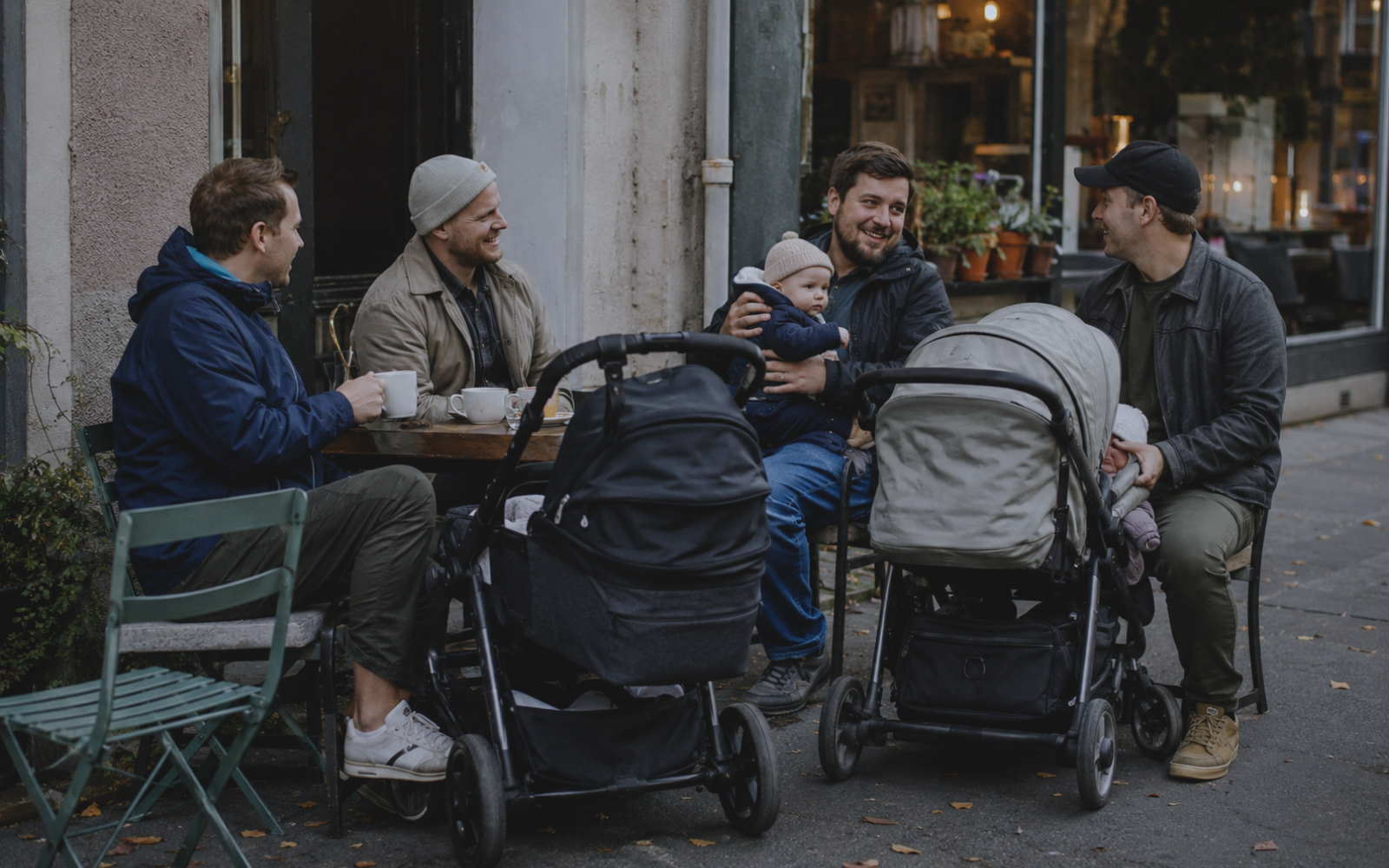
You can see the change in Sweden, where fathers taking parental leave, meeting for coffee with babies and going to daytime activities is normal enough to have produced the “latte dad” stereotype. It is also visible in Estonia and other more traditional parts of Europe now. The dad with a coffee and stroller does not seem lost anymore. He may even know where he is going.
Sweden is not some perfect kingdom where every task has been divided equally. Statistics Sweden says men took less than 1% of parental allowance days when the system began in 1974; by 2023, the share had reached 31%. That is a huge change, while still leaving women with most of the leave.
The same trend is visible across richer countries. In the 22 countries with comparable data, the OECD found that men made up 26.1% of parental-leave benefit recipients in 2023, up from 19.1% ten years earlier. Men are becoming more involved, although the idea has moved faster than the numbers.
This is good. A father should not receive a national award for drinking a latte beside his own baby, but the more normal that sight becomes, the less ridiculous the old excuses start to sound.
You are allowed to have no idea what you are doing
This article is mainly for the guy whose partner is pregnant, whose friends are starting to have children and who is quietly wondering whether his old life is about to collapse. It will change, sometimes in ways that are exhausting and deeply inconvenient, but people much less prepared than you have managed this for thousands of years.
There are parents raising children successfully while still organising their evenings around cringy Love Island. Realistically, you probably cannot be that much worse.
You will make mistakes, argue with your partner about stupid things and occasionally spend an unreasonable amount of time trying to understand why the child refuses an object they demanded eight seconds earlier. You may also struggle more seriously. A meta-analysis of 74 studies estimated that 8.4% of fathers experienced depression during pregnancy or the first year after birth, so persistent low mood, anger, withdrawal or hopelessness should not be dismissed as you failing some test of manhood. Speak to a doctor if that is where you are.
For the ordinary fear, you learn by doing. Take the stroller and go outside alone. Learn one routine properly instead of waiting for instructions every time. Ask your partner what would make tonight easier, then remember the answer tomorrow so she does not have to manage you as well as the baby. Talk to your child even when you receive nothing back except a confused look. You are building something before either of you can properly see it.
Final Verdict
You do not have to become a parenting expert or turn into a completely different man. Be present, learn your child and make life lighter for the person raising them with you; when you cannot calm the baby, try something else, and when nothing works, cook, clean or prepare whatever the family will need next.
Your father may have waited until you were old enough to speak, play and follow him around, and he may still have been a good father later. You have the chance to start earlier, so take it.
You have got this, mate, even when your most useful contribution that evening is making food and cleaning the kitchen while the baby wants nothing to do with you. The first years will be hard, funny, exhausting and probably some of the happiest you will ever have, and you do not need to handle them perfectly; you need to keep showing up and get a little better as you go.
Sources
Center on the Developing Child at Harvard University: Serve and Return
Child Development Perspectives: Birth of a Father
SSM Mental Health: Father involvement and maternal mental health
Statistics Sweden: Women and men in Sweden 2024
PubMed: Prevalence of paternal depression in pregnancy and the postpartum