Manchester City Charges Explained and Our Predictions
City deserves a serious sporting punishment if the findings survive its appeal. We explain the concealed funding, compare past penalties and examine the hypocrisy around rival clubs, Chelsea and Burnham.

Manchester City can afford a fine, which is exactly why a fine alone would be a ridiculous answer to the misconduct described in this case. The commission found that City concealed funding and costs to make its finances look compliant while gaining a sporting advantage. Letting the club keep that advantage for a price its owners can comfortably pay would make breaking the rules a fairly attractive investment.
City is appealing, former players are arguing about medals, rival clubs have suddenly become very interested in fairness, and Andy Burnham is worried about losing the owners' investment in Manchester. I have sympathy for players and supporters who trusted the club, but if the central findings survive the appeal, City deserves a punishment serious enough to send it down. Its football was excellent, its rivals have their own ugly history, and neither gives the people running the club a reason to escape the consequences.
Quick Answer
An independent commission found Manchester City guilty of serious financial-rule breaches covering 2009/10 to 2017/18, including disguised owner funding, concealed costs and inaccurate accounts. City denies wrongdoing and lodged an appeal on 1 October 2026; as of 4 October, its punishment has yet to be announced.
I support relegation if the central findings stand, alongside recruitment restrictions and removal of titles where the rules allow it and the proven breaches justify it. I expect a substantial points deduction and a fine, with City more likely to stay in the Premier League than leave it. The punishment I think it deserves is harsher than the outcome I think is most likely.
How other clubs have been punished
Football has already relegated major clubs, removed titles and deducted points for financial misconduct, so none of those possibilities was invented by angry City rivals. Juventus is the obvious example, although its two biggest recent scandals involved different kinds of wrongdoing. Everton and Nottingham Forest are closer to home because their deductions already settled whether a team can lose points for financial decisions its players did not make.
| Club and case | What went wrong | Punishment |
|---|---|---|
| Juventus, 2006 | Influence over the refereeing system in the Calciopoli scandal. | Relegation to Serie B and removal of two league titles. |
| Juventus, 2023 | Artificial capital gains in player-transfer accounting. | A ten-point deduction in Serie A. |
| Everton, 2023/24 | Two breaches of the Premier League's permitted-loss rules. | Eight points in total after appeals. |
| Nottingham Forest, 2023/24 | A breach of the Premier League's permitted-loss rules. | Four points. |
| Leicester, 2025/26 | A breach of EFL financial-loss rules. | Six points, upheld on appeal in April 2026. |
| Reading, February 2024 | Persistent late payments to HMRC. | Two points immediately, with another two suspended. |
| Chelsea, March 2026 | Undisclosed historical payments and separate academy-rule breaches. | £10.75m in combined fines; a one-year first-team transfer ban suspended for two years; a nine-month academy registration ban. |
Calciopoli shows that being a huge club with a long history offers no guarantee against relegation or losing championships. Juventus's 2023 case probably is the closer financial comparison because the accounting improved how the club's finances appeared - they help explain the range of punishments football has used, but City's commission still has to judge its conduct under its own rules.
Reading's February 2024 deduction concerned unpaid tax, against a background of wider financial problems. Those failures endangered people who depended on the owner keeping the club functioning, and they deserved consequences. City's case involves a different problem: arrangements that concealed the finances regulators needed to assess. Treating every financial offence as interchangeable makes the argument easier to shout and much harder to understand.
Everton and Forest's deductions affected footballers who had no control over the submissions behind them. The league has already accepted that club misconduct can produce a sporting penalty, even when it hurts innocent people. With City, the argument is about the size of that penalty and the seriousness of the concealment.
What City was found guilty of
According to the commission's findings, some sponsors paid only part of the sponsorship fees recorded in City's accounts. Abu Dhabi United Group, the owner's company, supplied the rest, while City presented the money as sponsorship income. The club also used arrangements that concealed operating costs, including payments involving Fordham and players' image rights. The Premier League puts the combined revenue inflation and cost understatement at more than £900 million across the affected period.
That is a huge distortion of the accounts, and it helps explain why calling this an argument over paperwork is so dishonest. The paperwork was how the club showed the league it was complying with the spending limits. Once the funding and expenses were reported properly, the commission found substantial breaches of those limits.
An owner's contribution and a sponsor's payment can both put real money into the club, but the spending rules treat them differently. Sponsorship is income from a commercial partner paying for advertising and association with the club. Money supplied by the owner remains owner funding, however it reaches the bank account. Presenting that contribution as sponsorship makes the club look as though its business earned more than it actually did.
The same problem arises when another company pays an expense that properly belongs in the club's accounts, because the expense still has to be recorded. Otherwise, an owner could improve the financial picture simply by sending the bills somewhere else, while the team continued enjoying everything those payments bought.
The Fordham arrangement involved image rights, meaning commercial use of a player's name and likeness in advertising and similar work. The commission found that Fordham's payment to acquire those rights was really owner funding, while related payments to the players remained club expenses. City had counted money coming in as business income and left money going out off its costs. The core decision puts the income overstatement from misclassified owner contributions at more than £830 million across the affected years.
City says the decision contains material errors of law, principle and fact and maintains that its finances were legitimate. It has every right to challenge the findings, and a successful appeal could change the outcome. For now, a commission has examined the case and found against the club; the appeal section below explains what City still has to overturn.
How the money helped City
Now the answer to the important question: Football's spending limits depend on the income, costs and losses a club reports, with specific adjustments for permitted spending. Under the old PSR and FFP rules, a rich owner being able to pay every bill did not give the club permission to spend whatever it wanted. Reporting more commercial income or fewer football costs could make the accounts look healthier and create apparent room for spending that the real finances would not support.
Take a simple hypothetical club that earns £100 million through its business and receives another £80 million from its owner. If it calls the owner's contribution sponsorship, its reported business income becomes £180 million. Then imagine a separate company pays £20 million of costs belonging to the club and those expenses are left out. The income now looks larger and the costs smaller, so the regulator begins its assessment with the wrong numbers.
| In this hypothetical example | Accurate account | Misleading account |
|---|---|---|
| Business income | £100m | £180m |
| Owner contribution | £80m identified separately | Presented as business income |
| £20m of club costs paid elsewhere | Included in the club's expenses | Omitted from those expenses |
On the pitch, more spending room means more choices. You can buy a player a rival has to pass on, keep an expensive squad together or replace a disappointing signing without selling somebody important first. Fans usually remember the brilliant purchases and forget the expensive failures, but being able to recover from those failures matters enormously. One club can spend years paying for a bad transfer while another moves on, keeps its successful recruits and tries again.
I also think the advantage can outlast the accounting period. A stronger team helps attract players, supporters and commercial income, putting the club in a better position for its next signing. By the time an investigation reaches a decision, some of the benefits may already be supporting further success, which makes a small punishment years later feel especially inadequate.
City's coaches and players still had to turn their resources into an excellent team, and its opponents still had opportunities to win. In our summer transfer-window review, published before these findings, we called City England's most balanced squad. I can give its recruitment and players credit while expecting the club to answer for the finances behind its success.
Why this case is different
The Premier League calls this the most significant disciplinary case in its history, and the combination of scale, duration and concealment explains why. The findings cover years of distorted accounts and arrangements that hid the underlying financial position, alongside failures to cooperate with the investigation. That gives the league a much bigger problem than an overspend visible in a properly reported set of accounts.
The core decision also found that certain important City witnesses knowingly gave untrue evidence. Once that finding enters the discussion, the idea that everyone is arguing over an innocent accounting technicality becomes very difficult to defend. A regulator can assess a declared loss and apply its rules; uncovering agreements behind misleading records takes far more time and work. A punishment should take that concealment seriously, otherwise clubs gain another reason to make enforcement difficult.
The delay also limits what any punishment can repair. A deduction today can damage City's current league position, but rivals have already lost celebrations, opportunities and potentially different futures. We cannot reconstruct every decision they would have made with another title, more prize money or European qualification, which is precisely why a serious current penalty will not settle every argument about City's old trophies.
Can City win the appeal
City maintains that it is innocent and has evidence supporting its account of the money. Its appeal challenges the findings themselves, rather than admitting the conduct and asking for a lighter punishment. Chief executive Ferran Soriano has called the case a conspiracy theory and said financial records and testimony support the club's position. Those arguments now have to persuade the appeal body; reassuring supporters will not change the decision on its own.
The commission also set out alternative findings, which makes City's challenge more complicated. Even if some agreements were not legally classified as “shams,” their substance could still require different accounting, and sponsorship values could still need adjustment. City has to overturn the relevant accounting and spending-rule conclusions, so winning one argument about how a contract should be described may leave other findings standing.
Its defenders often return to the 2020 Court of Arbitration for Sport decision, when CAS overturned UEFA's two-year European ban. Some allegations were not established and others were time-barred, meaning UEFA had pursued them outside the permitted deadline, while a €10 million fine for non-cooperation remained. City genuinely won that appeal, and reducing the whole result to a technicality gives an incomplete account of it.
The Premier League case has its own rules and appeal route, with no appeal to CAS available here. The earlier UEFA outcome belongs in the history, but City still needs to win the proceedings it is facing now. The fact that one regulator's ban was overturned in 2020 cannot settle a different commission's findings in 2026.
Why Haaland and Guéhi cost less
Some critics weaken the case against City by treating every cheap transfer as another hidden payment. Haaland's fee sounded extraordinary because people compared his ability with the headline price and skipped the contract. In 2022, City activated a release clause of about £51.1 million, while Sky reported an expected acquisition package of roughly £85.5 million once agent fees, signing payments and other costs were included. Earlier interest from another club could not change the price Dortmund was entitled to demand once the clause became available.
As we explain in why football transfer fees feel broken, a fee includes the seller's bargaining position, contract length and competition between buyers. It can vary dramatically without telling you much about the player's quality, and the headline figure still leaves out other costs of acquiring and employing him. People are free to question enormous agent payments, but Haaland's release clause already explains the transfer fee.
Marc Guéhi's move followed a similar logic: Liverpool's proposed £35 million deal fell through in summer 2025, while City paid an initial £20 million in January 2026 with his Palace contract approaching its end. A seller with time to negotiate faces a different choice from one risking a free departure months later.
The accumulated financial advantage is a stronger criticism because building a successful, desirable club can help it recruit well afterwards, including through legitimate deals. That is worth discussing without assuming every later signing was crooked. The published findings are already serious enough to argue for a severe punishment, and attaching an unsupported theory to every transfer only makes the argument easier to dismiss.
What former players are saying
A lot of the former players on Sky Sports sound like professional Twitter rage-baiters with a football background, and this City debate has brought out exactly what irritates me about them. They've played at the highest level, but their old club loyalties are hardly a secret, and a loud opinion does not suddenly become sensible because a famous footballer said it.
Roy Keane saying he would throw his medals away is foolish to me, because I don't believe he would be nearly as enthusiastic if the medals were his own United ones. Put him in that situation, and I suspect we'd hear about the players having no idea what was happening upstairs, trusting their employer and doing their jobs on the pitch. That would be a reasonable defence of the players, which is why his certainty about throwing somebody else's achievements in the bin annoys me.
Carragher is painfully predictable whenever Liverpool is involved, and calling them “probably the biggest losers” does nothing to hide that. He never won a Premier League title himself, yet has plenty to say about what should happen to other people's, with the same certainty he brings to every Liverpool argument. He has played enough football to know the game and says he feels for City's players, but I still hear the club allegiance through the analysis. I support reviewing City's official titles if the findings justify it, and I wish he could discuss that without making Liverpool the centre of everything.
Wayne Rooney surprised me kinda by giving the most reasonable answer of the lot, because United and Liverpool pundits are usually the last people I expect to stay rational in a City argument. He opposes stripping City's 2011/12 title or accepting a replacement United medal, while supporting relegation and spending restrictions. Ferdinand and De Gea have suggested retrospective recognition, but Rooney accepts that United did not do enough to win that season. I can disagree with him about the official title record and still respect an answer that takes the players seriously while demanding a proper punishment for the club.
Micah Richards’ attachment to City is obvious too, but his reaction is harder to take seriously when you compare it with how he spoke about Chelsea during their own scandals. He was much less sympathetic then, yet now that the club he spent years at is under scrutiny, the emphasis is on how “devastating” it is for the people who gave years to City. Ally McCoist and Alan Brazil also pushed back against Keane, arguing that the players should not be blamed for decisions made above them. That argument is reasonable, but Richards’ change in tone is still difficult to ignore.
The hypocrisy annoys me because apparently a footballer is supposed to know every detail of his employer's finances once the employer is somebody else's club. Were these pundits tracing sponsorship money and checking agent payments throughout their own careers? If they weren't, they can support a severe punishment for City without turning players who trusted their bosses into frauds for the sake of another angry clip.
Are the players responsible
A footballer's job usually keeps him far from tracing sponsorship money. He can sign a contract, trust the people running the club and concentrate on playing, and the published case does not establish that everyone who wore a City shirt knowingly participated. If the leadership misled the players too, they are among the people affected, even though they benefited from the squad those finances helped assemble.
A club penalty will still reach innocent people. Points deductions affect the team, recruitment restrictions make the next season harder, and relegation hurts supporters and employees who never prepared an account. Football has already accepted those consequences in other cases because otherwise meaningful sporting punishment would become almost impossible. Every club could find an honest player or an employee whose life would be made worse by enforcement.
You can respect City's players and support relegation without pretending every match was fixed, or every goal was fake. Their ability was real, while the commission found that the organisation gave them a prohibited advantage. We will never know the result of every match in an alternative version of those seasons, but uncertainty about individual results cannot give a club permanent protection from consequences for the advantage it obtained.
Other big clubs have their own history
United, Arsenal and Liverpool have every right to demand that the rules are enforced, but the idea that elite football was an innocent competition until City arrived is bullshit. Their own histories contain enough uncomfortable episodes to make the moral superiority irritating, especially when people want to judge another club's footballers by standards they never applied to themselves.
In 1915, Manchester United and Liverpool players fixed United's 2–0 win, with seven players found guilty. Liverpool acknowledges the episode on its own website, so supporters do not have to trust a rival's account of it. The established wrongdoing was a conspiracy involving players, rather than proof that both club boards ordered the result. That distinction matters for the same reason it matters when judging City's players: responsibility belongs to the people whose involvement can be established.
Arsenal sacked George Graham before he was banned from football for a year in 1995 over £425,000 in irregular transfer-related payments. There is a documented case to discuss there, without relying on the unproven bribery stories about Arsenal's 1919 promotion. Graham's success as a manager did not make the payments acceptable, just as City's excellent football cannot answer the questions about its funding.
United faced an FA inquiry in 2004 into agent payments during the Tim Howard transfer and later stopped using Elite, the agency linked to Alex Ferguson's son. The club's review said the disputed payments had not reached anyone connected with United, which limits the accusation we can make. Even so, questions about an agent's fee and whose interests he serves remain reasonable when the manager happens to be one of the most respected people in football.
The 2021 Super League attempt gives us a much more recent example of the big clubs protecting themselves. United, Arsenal and Liverpool joined City, Chelsea and Tottenham in pursuing a breakaway that offered their clubs a protected position. After it collapsed, all six settled with the Premier League and FA, including a combined £22 million contribution. City was part of that group too, which makes its image as a heroic outsider fighting the establishment fairly difficult to maintain.
There is a serious argument that revenue-linked spending rules protect the established clubs. A huge existing commercial business gives a club more spending room than a challenger trying to catch up, and years of earlier financial power helped build that business. I understand why supporters question a system that lets the already rich clubs spend the most, but a club still has to report its finances honestly while the rule applies. Concealing a breach gives it an advantage over everyone else being assessed under those terms.
The consistency test applies to City supporters as well. If you wanted another club deducted points or sent down, you need a better reason to protect your own than sympathy for innocent players and fans. Those people existed at the other club too, and discovering them only when your badge is involved is a fairly convenient change of principle.
Barcelona and Real Madrid
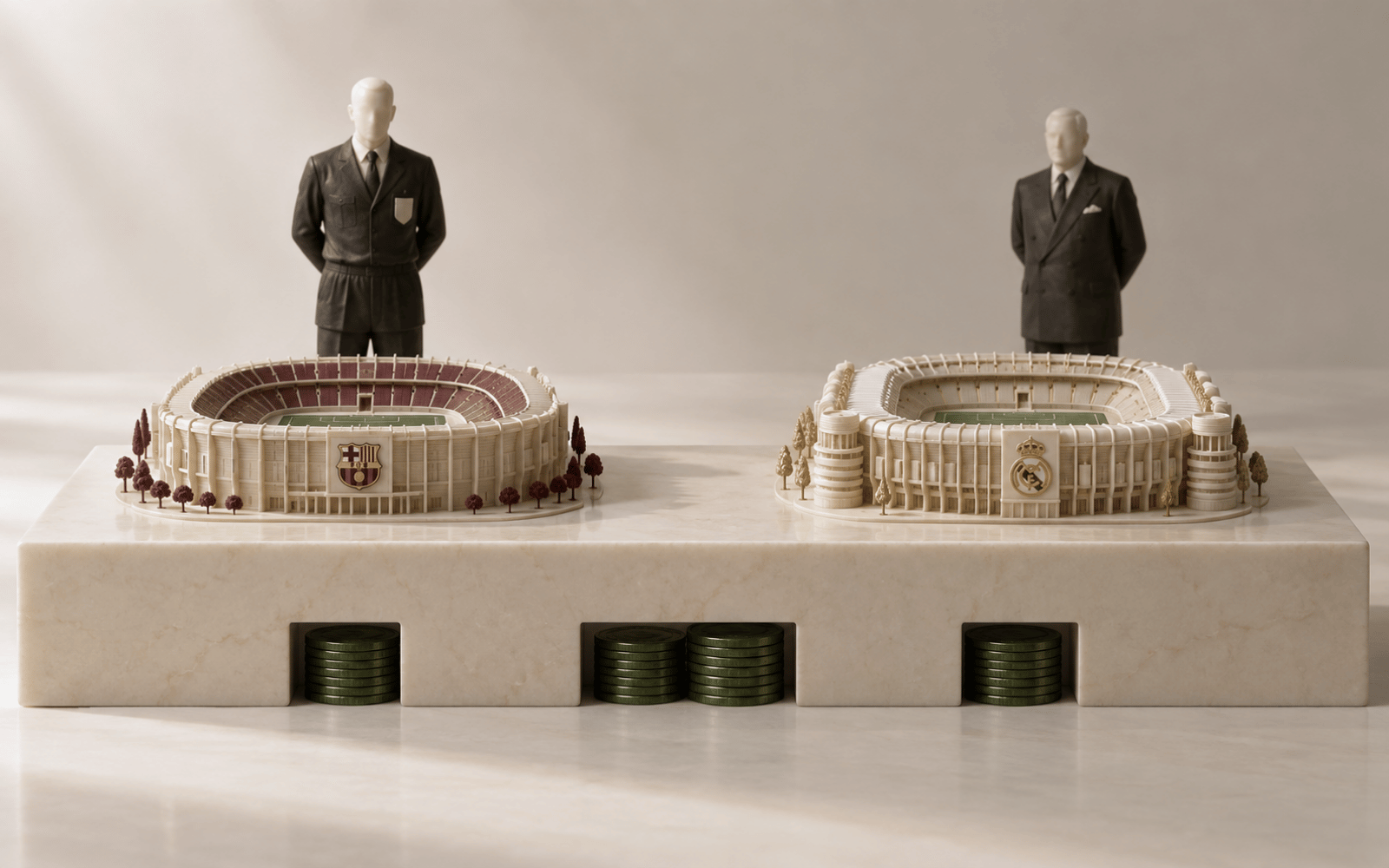
Barcelona's Negreira case makes the moral lectures from powerful clubs even harder to take; the investigation concerns €7.3 million paid between 2001 and 2018 through companies linked to José María Enríquez Negreira and his son. Negreira was a deputy head of Spain's refereeing committee, while Barcelona says it paid for "technical advice and reports", so the investigation remains open, with no final finding that the club bought favourable refereeing, for now.
Paying a senior figure in the organisation overseeing referees is an obvious conflict-of-interest concern, whatever description appears on the invoice, and the service Barcelona says it bought has to be examined alongside the relationship itself. On 1 October 2026, the club published UEFA's confirmation that Real Madrid had supplied documents for the existing investigation, stressing that the proceedings had never closed. Madrid can press for scrutiny, but investigators still have to assess the evidence before the allegations are settled.
City also has a real management connection with Barcelona. Ferran Soriano moved from Barcelona's senior management to become City's chief executive in 2012, and Txiki Begiristain became central to City's sporting management before leaving in July 2025. That gives people a reason to examine who made decisions and what oversight existed at each club. Shared careers alone cannot establish that the two clubs operated a connected scheme.
Real Madrid's relationship with political power deserves more care than the usual argument about whether Franco personally delivered every trophy. Historical research documents how the dictatorship used Madrid's international success in the 1950s and 1960s to promote Spain. The club's achievements were useful to the regime, which is a real political relationship worth understanding without attributing every result to the dictator.
There is a clearer financial example involving Madrid and Barcelona, alongside Athletic Bilbao and Osasuna. Their retained legal status gave them access to a preferential tax regime, and in 2021 the Court of Justice upheld the European Commission's treatment of that scheme as state aid. They benefited from a state-created advantage that most competitors could not access on the same terms.
Powerful clubs have gained from money, political relationships and systems that protected their position for a long time. They can demand accountability from City, and they should, but I would find that demand easier to respect if it came with less pretending that their own history was clean.
Why Chelsea avoided a points deduction
Chelsea's undisclosed historical payments are a closer comparison with City than most of the cases above. Payments made for the club's benefit should have been reported and were not, which deserves criticism regardless of how much Abramovich meant to supporters. The reasons Chelsea avoided a Premier League points deduction include both its response to the breaches and what the corrected accounts showed.
The new owners voluntarily disclosed potential breaches, Chelsea admitted the relevant conduct and cooperated extensively. Crucially, the Premier League concluded that adding the omitted payments would not have caused a breach of the applicable permitted-loss limits. City is challenging findings that properly reported finances would have exposed substantial spending-rule breaches, alongside concealment and failures to cooperate. Those differences give the league reasons to impose different penalties.
Chelsea still received a financial penalty and registration restrictions, as the earlier table shows, while the March Premier League settlement left separate proceedings to be concluded. The club announced the end of its FA case in July 2026. Describing Chelsea as having escaped all punishment leaves out what really happened; questioning whether the punishment was strong enough is a much more reasonable argument.
I understand Chelsea supporters asking for a consistent standard, especially after the political crisis their club went through in 2022. Their case is stronger when they acknowledge Chelsea's own misconduct and explain the differences, rather than treating past hardship as proof that everything their club did was acceptable.
Why Chelsea fans question Burnham
Chelsea's 2022 crisis involved UK sanctions against Abramovich after Russia invaded Ukraine. The club became dependent on an operating licence and a government-approved sale, with its ability to function placed at serious risk. In May, the government told Parliament that without further action Chelsea would have been unable to finish the season and would likely have entered administration. It issued a licence to keep football operations running while preventing Abramovich from benefiting.
For supporters, that meant watching a club they loved depend on permission to keep going. The government took steps to prevent its collapse, but those steps do not make the threat imaginary or the restrictions harmless. Saying there was a deliberate plan to destroy Chelsea would go further than the evidence; saying the sanctions nearly paralysed the club is supported by the government's own explanation.
Abramovich's sale statement also helps explain why so many Chelsea supporters remained attached to him. He described the club as a personal passion and said he would not ask for his loans to be repaid. Fans could value what his ownership had meant to Chelsea without settling every question about his wider business, and their affection was hardly going to disappear because the government imposed sanctions.
Then, on 30 September 2026, Prime Minister Andy Burnham praised City's owners for their investment in Manchester and said he would be “really concerned” if they sold the club. That choice of emphasis is what bothers me. After serious findings against a football club, concern about losing useful investors was a remarkably sympathetic place to start, especially for anyone who remembered Chelsea fighting for the ability to operate.
Burnham had been willing to question the Premier League's fairness before Everton played Chelsea in April 2024, so he understands why people demand consistency. His office subsequently said the independent process should run its course and wrongdoing should have consequences. That was the right position, but it does not explain why protecting Manchester's investment appeared so prominently in his initial response.
The Guardian has also reported that the verdict could affect major UK investments from the UAE. The prospect of economic pressure makes the political response worth watching closely, although the reporting does not establish that a disciplinary decision has been compromised. If investors are threatening to withdraw money to seek leniency, politicians should defend the independence of the process rather than reassure them that their financial importance has been understood.
Chelsea and City faced different governments, different laws and different geopolitical circumstances, so identical legal treatment was never the sensible expectation. What Chelsea supporters can reasonably question is why City's owners receive such sympathetic language about the value they bring. Investment should not buy an exemption from football's rules, and a smaller club should not face a harsher standard because losing its owner would matter less to the economy.
How the investigation started
Rui Pinto's Football Leaks disclosures helped expose arrangements that led to scrutiny of City. Football Leaks began in 2015 and released confidential documents across the industry, so City was one part of a much wider story. Pinto's own record is complicated: a Lisbon court gave him a four-year suspended sentence in 2023 for offences including illegal data access and attempted extortion.
His conviction gives critics a reason to challenge his methods, while the documents still have to be assessed for authenticity and meaning. Approving or disapproving of the person who obtained them cannot establish what the club did. The Premier League referred its charges to a commission in February 2023, and the decision arrived in September 2026, years after the disclosures that helped start the scrutiny.
That delay is part of why the case frustrates people. A club can keep winning, collecting income and strengthening its position while investigations, hearings and legal arguments continue. By the time a punishment arrives, much of the advantage may already have been enjoyed, which makes recovering it harder and gives a small financial penalty even less force.
Pinto's lawyers now say his Portuguese witness protection will end on 10 October and have raised concerns about his safety. That deserves attention without turning the timing into an unsupported accusation against City or the UAE. We can take his security seriously and still require evidence before saying who caused the decision.
Our punishment predictions
My likeliest outcome is a substantial points deduction and a fine, with City remaining in the Premier League. The findings justify a serious sporting punishment, but the appeal could narrow or overturn them, and the commission has considerable discretion over what follows. These are my rough estimates of City's eventual league position after the appeals.
| Where City ends up | My estimate |
|---|---|
| No points deduction or expulsion | 15% |
| Points deduction, probably with a fine, while remaining in the Premier League | 45% |
| Points deduction that results in relegation | 30% |
| Expulsion from the Premier League | 10% |
That gives City a 40% chance of ending outside the Premier League through these proceedings, which I consider a serious possibility. I still expect it to stay more often than leave, while giving a sporting penalty the largest combined share because of the sustained competitive advantage described in the findings. The 15% allows for a successful appeal, substantially reduced findings or penalties that leave the points total intact; fines and recruitment restrictions could accompany several outcomes.
Kieran Maguire has discussed a possible 50–60-point deduction, giving an indication of the scale a football-finance expert thinks could be considered. Even 50 points would not automatically relegate a team: City could earn 90, lose 50 and finish with 40, with survival depending on that season's table. Our 2026/27 league predictions assessed the teams before this verdict; a deduction would add another major uncertainty to City's prospects, however strong the squad looks.
Expulsion gets my smallest individual share because it is the most drastic outcome and creates questions about league membership beyond the points total. There is also no useful formula that multiplies a headline charge count by Everton's or Forest's deduction. Several rule breaches can come from the same arrangement, so the commission has to assess the conduct and appropriate punishment rather than price every charge as an identical offence.
I put the chance of at least one league title being removed at about 25%, and at least one being awarded retrospectively to another club at about 10%. Those possibilities overlap with the table because City could lose points and a title in the same decision. Reassignment is a further judgment about who should receive the championship, which makes it a less likely outcome than simply removing City's name.
The 2011/12, 2013/14 and 2017/18 league wins sit within the wider accounting period, but the applicable rules changed during those years. The original complaint covered UEFA compliance from 2013/14 to 2017/18 and Premier League loss-limit compliance from 2015/16 to 2017/18. Removing a particular title would require a case connecting that season's proven breaches with the powers available to the disciplinary body, rather than treating every trophy since the takeover as one identical offence.
When City could be punished
There is no confirmed date for the punishment, and the appeal against the findings has to be dealt with separately from any later challenge to a sanction. Under the new fast-track rules, an appeal hearing should take place within 12 weeks, followed by a decision within 30 days of its conclusion. That makes January 2027 a possible window for the appeal decision, although City could challenge applying the new timetable to proceedings that began earlier.
An appeal decision would not necessarily finish the whole case because a sanction could face its own challenge. The commission published its findings on 29 September and City appealed on 1 October; no initial penalty or date for the end of every challenge has been announced. Anyone promising an exact punishment on an exact date is getting ahead of the process.
Expulsion would create another practical question because City could not simply assume a place in the Championship. Finishing in a relegation position and being expelled involve different membership decisions, and the EFL would have to resolve whether and where an expelled club could enter.
The Treasury Committee chair has also asked HMRC about the tax implications of the findings, so scrutiny outside football could continue after the sporting punishment is settled.
Final Verdict
If the central findings survive the appeal, City deserves relegation; I would support a points deduction severe enough to produce it, along with recruitment restrictions that prevent the club immediately buying its way through the consequences. I also support removing titles connected to proven misconduct where the disciplinary rules allow it, with reassignment to another club treated as a separate decision.
I have far more sympathy for the players than for the people responsible for the accounts. Their talent, training and performances were real, and anyone accusing them personally needs evidence that they knew or participated. A club still has to face a sporting punishment even when it reaches honest players, ordinary employees and supporters, because those consequences cannot become a permanent excuse for the leadership.
United, Arsenal and Liverpool should demand enforcement and spare us the moral superiority. Chelsea supporters have a reasonable argument about political sympathy, provided they acknowledge their club's own financial breaches. And if you were happy to see another club struggle until the same conversation reached City, your sudden concern for innocent fans is difficult to take seriously. They were innocent when you wanted their club punished too.
Burnham's concern about losing investment is the part I find hardest to stomach. Chelsea needed government permission to function during its sanctions crisis, while City's owners now receive public sympathy for the money they bring to Manchester. The legal cases differ, but useful investors should not receive protection from football's consequences because politicians would miss them.
City played outstanding football while, according to the findings, the organisation behind it misrepresented the finances supporting that success. After years of enjoying the advantage, it should face a sporting consequence proportionate to what it gained. Relegation would be painful, but the difficulty of dealing with punishment is a poor reason to let a club keep the benefits of breaking the rules.
Sources
TGK
- Why Chelsea Avoided a Points Deduction After the £10m Fine, 1 August 2026.
- FFP and PSR Explained for Normal People, 27 July 2026.
- Europe's Top Five Leagues: Transfers and 2026/27 Predictions, 21 August 2026.
- €50m Isn't Star Money Anymore: Why Football Transfer Fees Feel Broken, 10 July 2026.
- The transfer window is closed. So what did everyone end up with?, 2 September 2026.
Official decisions and statements
- Premier League: findings against Manchester City, 29 September 2026.
- Premier League: original charges and relevant periods, 6 February 2023.
- Independent commission: Manchester City redacted core decision, published 29 September 2026.
- Manchester City: appeal statement, October 2026.
- Manchester City: official team honours.
- FIGC: Juventus ten-point deduction, 22 May 2023.
- Premier League: Everton's final deductions, 10 May 2024.
- Premier League handbook 2025/26: historical tables, including Forest's four-point deduction.
- Premier League: Leicester appeal decision, 8 April 2026.
- Premier League: Chelsea sanctions and reasons, 16 March 2026.
- Chelsea: conclusion of its FA case, 31 July 2026.
- UEFA: response to the CAS Manchester City decision, 13 July 2020.
- Liverpool: Thomas Fairfoul and the 1915 match-fixing case.
- FA and Premier League: Super League settlement, 9 June 2021.
- Manchester City: Soriano's appointment, August 2012.
- Manchester City: Begiristain's departure, July 2025.
- Barcelona: current Negreira proceedings and UEFA's response, 1 October 2026.
- Court of Justice: Spanish football clubs' tax treatment, 4 March 2021.
- UK government statement to Parliament: Chelsea's sale and sanctions, 26 May 2022.
- Roman Abramovich: Chelsea sale statement, 2 March 2022.
- Treasury Committee: Manchester City tax questions, 1 October 2026.
Reporting and interviews
- Reuters: Juventus's history and punishments, 15 December 2025.
- Sky Sports: Reading's tax-payment deduction, 27 February 2024.
- Sky Sports: City's financial findings, 30 September 2026.
- Cadena SER: Soriano's response, 29 September 2026.
- AP: timeline of the Premier League and Manchester City case, September 2026.
- Sky Sports: appeal procedure, 26 September 2026.
- Sky Sports: Haaland's release clause and acquisition costs, 11 May 2022.
- Sky Sports: Guéhi's transfer and contract, 19 January 2026.
- RTÉ: Guardiola, Keane, Richards and Carragher reactions, 30 September 2026.
- Reuters: Rooney on titles and punishment, 29 September 2026.
- talkSPORT: Keane and fellow pundits' responses, 30 September 2026.
- The Independent: George Graham's ban, 13 July 1995.
- The Guardian: United's review and Elite Sports, 26 May 2004.
- The Independent: inquiry into the Howard transfer payments, January 2004.
- Channels Television: the six English Super League clubs, 9 June 2021.
- Reuters via ThePrint: Negreira allegations, 28 September 2023.
- AS: Negreira investigation update, 1 September 2026.
- Reuters: Burnham's ownership remarks, 30 September 2026.
- Goodison News: Burnham's Chelsea/Everton post, 14 April 2024.
- Reuters: the prime minister's office on consequences, 1 October 2026.
- The Guardian: reported UAE investment pressure, 3 October 2026.
- Reuters: Pinto's witness protection, 2 October 2026.
- RTÉ: Pinto's conviction, 11 September 2023.
- talkSPORT: Maguire's points-deduction estimate, 4 October 2026.
- Reuters: City's filed appeal, 2 October 2026.
- Sky Sports: timetable, sanctions and EFL questions, 30 September 2026.
- The Guardian: rivals and the expedited timetable, 30 September 2026.
Historical research