How an F1 Weekend Works: Practice, Qualifying and Race Day
Practice, qualifying, Sprint weekends and race day all have different jobs. Here is how an F1 weekend fits together.

Formula 1 becomes confusing at exactly the moment it gets interesting, usually when the leader disappears into the pits, the broadcast starts talking about tyre deltas and somebody who qualified third turns up seventh on the starting grid. A Safety Car can wipe out a twenty-second lead, a slower car can stay ahead for half the race, and everyone watching with you appears to understand why except you.
The rules behind it are easier than the commentary makes them sound. Practice helps teams work out what the car needs, qualifying decides the provisional grid, and Sunday is where the largest number of points are won. Everything that makes F1 look complicated comes from those parts affecting each other: a poor setup hurts qualifying, a poor grid position limits strategy, and one badly timed pit stop can waste the speed the team spent all weekend finding.
This guide covers the whole weekend under the 2026 rules, including the 22-car grid and the systems that replaced DRS. You do not need an engineering degree, although after a few races you may still find yourself questioning the strategic wisdom of people who have one.
Quick Answer
A normal Formula 1 weekend gives teams three one-hour practice sessions before qualifying on Saturday and the Grand Prix on Sunday. Qualifying is split into Q1, Q2 and Q3: the six slowest drivers are eliminated after Q1, another six leave after Q2, and the remaining ten fight for pole position. Sprint weekends replace two practice sessions with Sprint Qualifying and a short Saturday race, while a separate qualifying session still sets the grid for Sunday.
The top ten finishers score Grand Prix points, beginning with 25 for the winner, and the first eight score in a Sprint. Drivers keep their own total for the Drivers’ Championship; each team combines the points from both cars for the Constructors’ Championship. Having the fastest car is the largest advantage in F1, but it cannot protect a driver from a poor start, tyre wear, traffic, a slow pit stop, mechanical failure or a Safety Car arriving at the worst possible moment.
What happens during a normal F1 weekend?
Most race weekends contain five Formula 1 sessions across three days. The local start times change, but the order is familiar:
| Day | Session | What it is for |
|---|---|---|
| Friday | Free Practice 1 (FP1) | Learning the circuit and beginning setup work |
| Friday | Free Practice 2 (FP2) | Longer runs, tyre data and further setup work |
| Saturday | Free Practice 3 (FP3) | Final preparation before qualifying |
| Saturday | Qualifying | Setting the provisional Grand Prix grid |
| Sunday | Grand Prix | The main race and biggest points award |
Practice has a timing screen, although treating it like a league table will often tell you very little. One driver may be testing qualifying pace with little fuel and soft tyres while another carries more fuel for a long run. Engine settings and test programmes differ as well, which is why Friday’s fastest car can look rather ordinary by Sunday.
What matters during practice is the work behind the lap time. An F1 car has to be set up for each circuit, so teams adjust the ride height, wings, suspension and energy use while the drivers describe where the car feels nervous or refuses to turn. Monza rewards low drag because the cars spend so much time at high speed; Monaco needs a car that behaves through slow corners and inspires enough confidence for the driver to attack the walls.
Teams also compare the tyre compounds and watch how quickly each one loses performance. The rubber does not have to fall apart before it becomes a problem. If the lap time drops far enough, stopping for a fresh set may be quicker even after accounting for the time lost in the pit lane.
Once qualifying begins, parc fermé restrictions limit most setup changes. Teams therefore need a car that can produce a quick qualifying lap without becoming miserable to drive over a full race distance. Finding that compromise is the main job of practice, rather than winning FP2 and collecting a flattering headline.
How F1 qualifying decides the starting order
Qualifying is decided by the fastest single lap, and although drivers can make several attempts, only their best valid time in each session counts. The 2026 format reduces the field twice before the final ten compete for pole:
| Session | Length | Drivers at the start | What happens |
|---|---|---|---|
| Q1 | 18 minutes | 22 | Six drivers are eliminated into positions 17–22 |
| Q2 | 15 minutes | 16 | Six drivers are eliminated into positions 11–16 |
| Q3 | 13 minutes | 10 | Ten drivers compete for positions 1–10 |
The fastest driver in Q3 takes provisional pole position, and the others are ordered by their best times in the furthest session they reached. A driver eliminated in Q2 cannot qualify ahead of somebody who reached Q3, even if changing conditions later make an earlier lap look quicker.
The final minutes of Q1 and Q2 are often the best part because the circuit tends to improve as more rubber goes down. A driver sitting safely in tenth can fall towards elimination when everyone completes a final attempt, while traffic, rain, a yellow flag or a deleted lap can catch a genuinely fast car. There is enough time for another run only if the team has judged the session properly.
Why qualifying results and starting grids can differ
Qualifying produces an order, then penalties and post-session changes can rearrange it before Sunday. A driver may lose grid places for using restricted power-unit components, causing an incident or committing another offence; a team that breaks parc fermé conditions can be required to start from the pit lane. A driver can therefore qualify fourth and start ninth without anything mysterious happening overnight, because the lap remains in the qualifying record while the penalty applies to the grid.
How an F1 Sprint weekend works
A Sprint weekend keeps the Grand Prix on Sunday and removes two of the three practice sessions to make room for another qualifying session and a short race:
| Day | Session | What it decides |
|---|---|---|
| Friday | Free Practice 1 | The weekend’s only practice session |
| Friday | Sprint Qualifying | The grid for Saturday’s Sprint |
| Saturday | Sprint | A short race worth championship points |
| Saturday | Grand Prix Qualifying | The grid for Sunday’s Grand Prix |
| Sunday | Grand Prix | The main race |
Sprint Qualifying follows the same elimination idea as normal qualifying, only faster. SQ1 lasts 12 minutes, SQ2 lasts 10 and SQ3 lasts eight; medium tyres are prescribed for the first two parts and softs for the last, according to Formula 1’s current Sprint guide.
The Sprint covers roughly 100 kilometres, usually takes around half an hour and has no mandatory pit stop. The first eight drivers score points from eight down to one. Its finishing order does not decide Sunday’s grid because Grand Prix qualifying is held separately later on Saturday.
With only one hour of practice, teams have less time to rescue a poor setup or understand unusual tyre behaviour. That pressure is the point of the format: the serious running starts before everybody has polished away every problem.
How the Grand Prix works
Drivers complete a formation lap before returning to their grid positions. Five red lights come on above the track and the race begins when they go out; moving too early can earn a penalty, while reacting badly can lose several places before the first corner.
Under the 2026 FIA sporting regulations, a standard Grand Prix lasts for the smallest whole number of laps that exceeds 305 kilometres. Monaco is shorter at 260 kilometres because its slow street circuit takes much longer to complete relative to the distance covered. Racing can continue for up to two hours, with a three-hour overall limit when stoppages interrupt the event.
The FIA has approved a reduction to 290 kilometres for standard Grands Prix in 2027, so that figure will change next season. For 2026, 305 kilometres remains the normal distance.
A driver can finish one or more laps behind the winner and still be classified. Cars that retire late may also appear in the final results if they completed enough of the race, which is why “classified” does not always mean “reached the chequered flag.”
Pit stops and the tyre rule
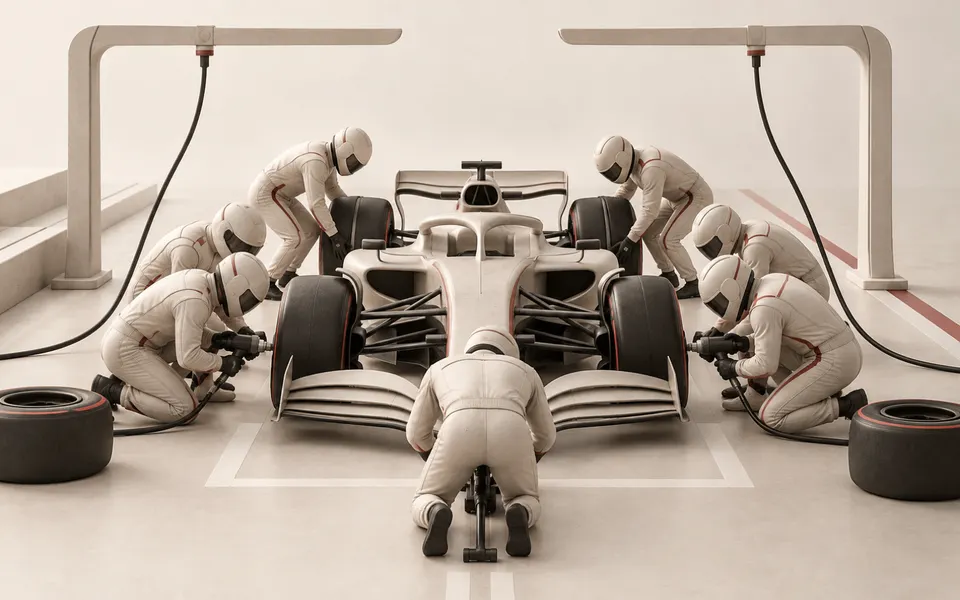
During a dry Grand Prix, every driver must use at least two different slick tyre compounds. Changing compounds requires a pit stop, so a dry race normally includes at least one stop per car; once intermediate or full-wet tyres are used, that requirement no longer applies under the FIA tyre rules.
One stop is not automatically the quickest plan. Fresh tyres can recover more time than the stop costs, particularly at circuits with heavy degradation, while a Safety Car can make stopping cheaper because the rest of the field is moving slowly. The team must also consider traffic: returning to the track behind a group of slower cars can destroy the benefit of the new tyres.
Pirelli brings three dry compounds to each weekend and labels them soft, medium and hard. Softs carry red markings and usually provide the most immediate grip, mediums are yellow, and the white-marked hards tend to last longer. Green is used for intermediate tyres on a damp track and blue for full wets. The names are relative to that weekend, so the tyre called “soft” at one circuit may be a different underlying compound at another.
You can follow most races with that basic understanding of the compounds. Our planned guide to F1 strategy, tyres, pit stops and undercuts will go further into the decisions behind them, including why a team may surrender a position now because it expects to recover the place ten laps later.
Safety Cars, red flags and the delta commentators keep mentioning
A local yellow flag warns drivers about danger in one part of the circuit. They must slow down and cannot overtake in the affected area; double yellows demand a greater reduction in speed and readiness to stop.
The Virtual Safety Car slows everyone without sending a physical Safety Car onto the circuit. Drivers must stay above a minimum time through the timing sectors, shown to them as a delta. The gaps between cars are broadly preserved, although a pit stop can cost less race time because the cars staying out are circulating slowly.
A physical Safety Car gathers the field into a queue. Large gaps disappear, drivers run at reduced speed and teams often use the opportunity to change tyres, though the exact benefit depends on where every car is when the Safety Car appears. A driver who was twenty seconds behind may suddenly be back in the fight; a leader who spent an hour building that advantage gets no sympathy from the stopwatch.
Red flags stop the session when the circuit is unsafe, perhaps because of a serious crash, damaged barriers, debris or extreme weather. During a race, the drivers return to the pit lane and wait while officials decide whether to restart from the grid, continue behind the Safety Car or end the event. Safety comes first, but a new standing start can completely alter the result.
What the Grand Prix Result Decides
The Grand Prix awards the largest number of points available during the weekend, with the first ten classified drivers scoring. Sprint races award a smaller set of points to the first eight, and every result contributes to both the Drivers’ and Constructors’ Championships.
That is enough championship detail for this guide. Our complete explanation of how the F1 championship works covers the full scoring table, Sprint points, tie-breaks, shortened races and the calculation that decides whether a driver can still win the title.
Why the fastest F1 car does not always win
The car matters more than romantic sporting speeches tend to admit. A brilliant driver cannot invent missing straight-line speed or grip, and over a full season the quickest reliable package should spend a lot of time near the front. Sunday still gives teams plenty of ways to waste it.
A car may be superb for one qualifying lap and hard on its tyres during a long stint. It may fly through fast corners yet struggle through slow ones, or lose enough performance in another car’s disturbed air that passing becomes difficult. At Monaco, starting ahead can be worth more than having slightly better race pace because there may be nowhere sensible to use it.
Speed still has to survive the human part of the weekend. The driver needs a clean qualifying lap, a good start and enough restraint to keep the tyres alive, while the team must choose the right moment to stop, fit four wheels properly and return the car to a useful part of the track. Rain, contact, mechanical failure or an inconvenient Safety Car can overturn a good plan before anyone has time to invent an excuse for it.
On a straightforward afternoon, the fastest car starts first and disappears. When the race becomes awkward, victory often goes to the team that protects its tyres, reads the timing gaps properly and wastes the least time. Once you can see that happening, the practice leaderboard becomes one clue rather than the answer to the whole weekend.
What replaced DRS in 2026?
Older races, games and videos talk constantly about DRS, the system that opened part of the rear wing when an attacking driver was close enough to the car ahead. The 2026 cars replaced it with Active Aero and Overtake Mode.
Active Aero lets drivers change the wing configuration in designated parts of the circuit to reduce drag, regardless of whether they are chasing another car. Overtake Mode provides the chasing advantage: a driver within one second of the car ahead at the detection point receives access to a different electrical deployment profile on the next lap.
You can leave the detailed energy figures for later and remember the useful part: entering that one-second window may give the following driver extra help to attack on the next lap. The hardware has changed, but the broadcast is still showing you when a close pursuer gains an overtaking advantage.
F1 terms worth learning first
| Term | Plain-English meaning |
|---|---|
| Pole position | First place on the starting grid |
| Stint | The laps between two pit stops, or between the start and a stop |
| Box | The radio instruction telling a driver to enter the pits |
| In-lap | The lap on which a driver comes into the pits |
| Out-lap | The first lap after leaving the pits |
| Track position | Where the car sits in the running order |
| Pit window | The range of laps when a planned stop becomes practical |
| Undercut | Pitting earlier and using fresh-tyre speed to pass when the rival stops |
| Overcut | Staying out longer and trying to gain the place later |
| Dirty air | Turbulent air from a car ahead that reduces the following car’s grip |
| DNF | Did not finish |
| DNS | Did not start |
| Parc fermé | The period when teams can make only limited changes to the car |
Once these stop sounding like code words, most commentary becomes easy to follow. The highly technical material can come later, if you decide that calculating aerodynamic load is how you would like to spend a Sunday.
What to watch during your first races
Start with the running order, the gaps and the tyre colours rather than staring only at the leader. A driver ten seconds behind on fresh mediums may be in a stronger position than somebody five seconds behind on old softs, especially when another pit stop is still required.
The comparison between teammates is useful because they have the closest thing F1 offers to equal machinery, although damage, traffic and different strategies can still make the gap misleading. Also watch the estimated pit-stop loss shown by the broadcast. If a stop costs around twenty seconds and the leader has a twenty-two-second advantage, you will understand why the mechanics are preparing tyres before the radio message arrives.
After a few races, the timing screen starts telling its own story. You can see who is trapped in traffic, who has protected a pit-stop gap and who is trying to make dying tyres last three laps longer than they reasonably should.
Final Verdict
Formula 1 does not require you to memorise the sporting regulations before the first lap. Learn what each session is trying to achieve, remember that qualifying sets a provisional grid, and keep one eye on the tyres and the gaps once the race begins. That gives you enough context to understand most of what happens.
The sport becomes interesting once those details begin connecting in your head. Friday’s setup work affects qualifying, qualifying determines track position, and that position can rule out strategies before the race has properly settled. The fastest car starts with the strongest hand, but the team must still protect the tyres, hit the pit window and react when the afternoon stops following the plan.
Once you understand that basic shape, Formula 1 becomes much easier to read. You are watching very clever people make difficult decisions while the cars travel at more than 300 kilometres per hour, which is exactly why those decisions still go badly wrong often enough to keep everyone arguing until the next race.