Stop Buying Cheap EQ Plugins. Your DAW Already Has One.
Your mix probably does not need another cheap EQ plugin. It needs better EQ decisions. Stock EQs are already good, Pro-Q makes sense later, and most “analog magic” is not as magic as the marketing says.
EQ is mandatory.
Buying random EQ plugins is not.
Every serious DAW already gives you a usable EQ. FL Studio, Logic, Ableton, Pro Tools, Studio One, Cubase, all of them. You can clean mud, cut harshness, shape vocals, control low end, fix masking, and learn the basic language of mixing with the EQ that came with your software.
So when people ask for the best cheap EQ plugin, the honest answer is usually boring:
Use the one you already have.
If you are going to spend money, spend it on something that solves a real problem. For most people, that means FabFilter Pro-Q. Not because it has magic inside it, but because it is fast, clear, flexible, and hard to outgrow.
Cheap clean EQs are where things get weird. If the plugin is doing the same clean digital EQ job your stock EQ already does, what exactly are you buying?
Quick Answer
Use your stock EQ first.
It is good enough for learning, producing, writing, mixing, and fixing most normal problems. If you are new, do not buy an EQ because someone on YouTube has a nice-looking plugin chain.
If you want one paid EQ that can handle almost everything, get FabFilter Pro-Q. Pro-Q 3 is already enough for most people. Pro-Q 4 adds newer features like dynamic EQ improvements, spectral dynamics, and character modes, but the bigger point is the same: it is the paid EQ that makes sense if you want one serious all-rounder. FabFilter lists Pro-Q 4 with dynamic EQ, spectral dynamics, EQ Match, linear phase, mid/side processing, and character modes.
Analog-style EQs are a different thing. They can be cool. They can push you to make broader, more musical moves. Some can add tone. But they are not a replacement for learning EQ.
Our Take
The best cheap EQ plugin is probably your stock EQ.
That is not a cute answer. It is just true.
A clean EQ is not some rare secret anymore. Your DAW EQ can cut 300 Hz, boost 10 kHz, high-pass a vocal, low-pass a synth, remove rumble, and fix annoying resonances. The listener does not care whether that curve came from Ableton EQ Eight, Logic Channel EQ, Fruity Parametric EQ 2, Pro Tools EQ III, or a paid plugin with a darker interface.
Where paid EQs start to matter is workflow.
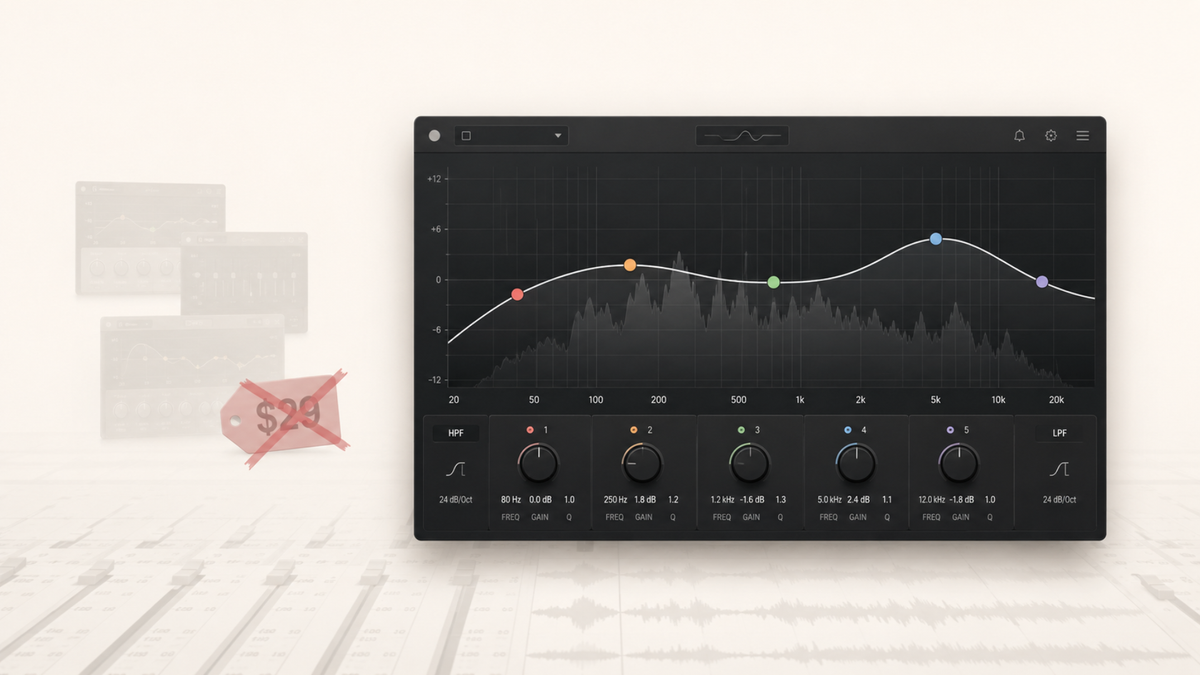
Pro-Q is popular because it makes EQ fast. You see what you are doing. You can work surgically. You can use dynamic bands. You can work mid/side. You can compare, solo bands, match EQ, and move quickly without fighting the plugin.
That is worth paying for once you know why you need it.
But buying a cheap EQ just because it looks more serious than your stock one? That is usually plugin shopping pretending to be music production.
Stock EQs Are Better Than People Think
A lot of beginners disrespect stock plugins because they look too normal.
That is a mistake.
Stock EQs are not toys. They are the tools DAW companies expect thousands of producers, engineers, writers, and editors to use every day. They are usually clean, reliable, low-CPU, and built into the workflow of the software.
If your mix sounds bad, the problem is probably not that your EQ is too basic.
It is probably that you do not yet know what to cut, what to leave alone, how much is too much, or how to listen for the problem before touching the plugin.
That sounds harsh, but it is better to learn that early.
A better EQ will not tell you that your vocal has too much low-mid buildup. It will not tell you that your hi-hats are killing the vocal. It will not tell you that your bass and kick are fighting. It gives you better tools to make decisions, but you still have to make the decisions.
So if you are starting out, stock EQ is not a limitation. It is where you should learn.
Cheap Clean EQs Are Usually Pointless
This is why the cheap EQ category feels weak.
If a cheap EQ is just another clean parametric EQ, why buy it?
Maybe it has a nicer interface. Maybe it has a slightly different analyzer. Maybe the knobs feel smoother. Fine. But for most people, that is not a real reason to spend money.
Your DAW already has a clean EQ.
If you are cutting mud, taming harshness, high-passing a vocal, shaping a kick, or making space for the lead, the stock EQ can do the work. A cheap third-party EQ will not magically make those moves smarter.
A lot of plugin buying comes from being stuck.
You open the session. Something sounds wrong. You do not know what. Then a new plugin starts to feel like the answer. New interface, new preset folder, new YouTube video, new hope.
Most of the time, the fix is not a new EQ. The fix is better listening.
Pro-Q Is The Paid EQ That Makes Sense
If you are going to buy one EQ, FabFilter Pro-Q is the obvious answer.
Not because it makes everything sound expensive. That is not the point. Pro-Q is good because it gets out of the way and lets you work fast.
You can use it for simple moves. You can use it for surgical cleanup. You can use dynamic EQ when one frequency only becomes annoying sometimes. You can work mid/side when the middle and sides need different treatment. You can use linear phase when it makes sense. In Pro-Q 4, FabFilter added spectral dynamics and character modes, with Clean, Subtle, and Warm options. FabFilter’s own help page describes the character modes as Clean, Subtle, and Warm.
That is useful because it means Pro-Q is no longer only the clean surgical EQ in the old sense. It still does that job, but now it can cover more ground.
Still, the reason to buy it is workflow.
It makes EQ decisions easier to see, faster to adjust, and cleaner to manage across a session. If you mix a lot, that matters. If you are still learning what a high-pass filter does, it does not matter yet.
Learn first. Upgrade later.
Pro-Q 3 Or Pro-Q 4?
Do not overthink this.
If you already have Pro-Q 3, you are not suddenly lost. Pro-Q 3 is still more EQ than most people need.
If you are buying now, Pro-Q 4 makes sense because it is the current version and has the newer tools. FabFilter says Pro-Q 4 includes spectral dynamics, which works differently from traditional dynamic EQ by reacting to specific frequencies inside a band instead of moving the whole band in the same way. FabFilter explains spectral dynamics here.
That is cool, but let’s not pretend every beginner needs to care.
For most normal EQ work, Pro-Q 3 and Pro-Q 4 are both serious. The bigger question is whether you need Pro-Q at all right now.
If you are making music casually, writing ideas, producing beats, or learning mixing, stock EQ is fine.
If you are mixing often and want one EQ that can stay with you for years, Pro-Q is the one.
Analog EQs Are A Different Conversation
Analog-style EQs can be good.
Neve-style EQs. SSL-style EQs. Pultec-style EQs. Manley Massive Passive-style EQs. These are not really competing with your stock EQ in the same way.
They are more about tone, workflow, curves, gain staging, and limitation.
Sometimes limitation is good. A stock EQ or Pro-Q lets you do almost anything. That can make you overthink. An analog-style EQ gives you fewer options, broader bands, and a different way of touching the sound.
You stop staring at tiny frequency numbers and start asking simpler questions.
Does the vocal need more body?
Does the drum bus need more bite?
Does the mix need a smoother top?
That can be useful.
Analog Obsession is worth mentioning here because they make a lot of analog-inspired EQs, channel strips, preamps, and saturation plugins, with a big free/donation-based culture around the brand. Their site has whole sections for equalization, dynamic processing, color, preamp, saturation, and channel strips. Analog Obsession lists its plugin categories here.
Waves also has plenty of analog-style EQs. UAD has strong ones too. The Manley Massive Passive emulations are often mentioned because that kind of EQ is less about surgical correction and more about tone and curves.
But do not confuse this with basic EQ.
An analog-style EQ is not better because it looks vintage. It is only better if the curve, workflow, or tone helps you make a better move.
The “Color” Thing Gets Oversold
This is where plugin marketing gets annoying.
A lot of EQ plugins sell warmth, depth, analog feel, silky top, musical curves, and all that. Sometimes there is something there. Sometimes the plugin changes the tone in a nice way. Sometimes it adds harmonics or saturation. Sometimes the curve itself is just pleasing.
But a lot of the time, the difference is tiny.
And once the whole mix is playing, with drums, bass, vocals, synths, reverb, compression, limiting, and everything fighting for space, that “expensive analog color” may not matter nearly as much as people think.
This does not mean coloring EQs are useless.
It means people should stop acting like every EQ with a vintage faceplate is secret sauce.
If you want color, use something that gives real color. Saturation. Tape. Preamp emulation. Transformer-style plugins. A proper analog-modeled EQ where you can hear the difference after gain matching.
If you bypass the plugin and the mix barely changes, maybe the magic was mostly in the marketing.
Small Pro Tip: Gain-Match Before You Judge
This one matters.
Louder usually sounds better for five seconds.
If you boost with an EQ and the signal gets louder, your brain may think the plugin sounds better. Maybe it does. Maybe it is just louder.
So before deciding that one EQ sounds warmer, wider, deeper, or more expensive, match the volume. Bypass it. Turn it on. Compare at the same loudness.
A lot of plugin myths die right there.
This is especially important with analog-style EQs. If the plugin adds level, saturation, or low-end weight, it can feel better immediately. But when the volume is matched, the difference may be smaller than you thought.
Still useful sometimes. Just less magical.
Beginners Should Learn EQ On Stock Plugins
If you are new, your goal is not to collect EQs.
Your goal is to understand what EQ does.
Learn what a high-pass filter does without killing the sound. Learn why cutting low mids can make something cleaner. Learn why too much 2–5 kHz can make a vocal painful. Learn what a shelf does. Learn how narrow cuts work. Learn why boosting everything usually makes the mix worse.
Learn masking. Learn mud. Learn harshness. Learn boxiness. Learn presence. Learn air. Learn when not to touch anything.
That last part is underrated.
Beginners often EQ because they feel like they are supposed to. Every channel gets cuts. Every sound gets shaped. Every plugin chain looks busy. Then the mix gets thinner, harsher, and worse.
A stock EQ is perfect for learning because it keeps the focus on the move, not the brand.
If you can make good decisions with the stock EQ, Pro-Q will make you faster.
If you cannot make good decisions with the stock EQ, Pro-Q will only make your bad decisions look more professional.
When Paid EQs Are Worth It
Paid EQs are worth it when they solve a real workflow problem.
Pro-Q makes sense if you mix often, do detailed cleanup, need dynamic EQ, want better visual feedback, use mid/side often, or want one EQ that can handle almost everything.
Analog EQs make sense if you like the sound, the curves, or the way they force simpler moves.
Special EQs make sense when they do something your stock EQ does not. Dynamic resonance tools, intelligent EQs, mastering EQs, phase options, matching tools, whatever. If there is a real reason, fine.
But “it was on sale” is not a real reason.
“Everyone on YouTube uses it” is not a real reason.
“It looks more professional” is definitely not a real reason.
What To Use
Use your stock EQ first.
If you are learning, producing, writing, recording vocals, making beats, or doing normal mix moves, the stock EQ is enough.
If you want one paid EQ that can do almost everything, get FabFilter Pro-Q.
If you want analog flavor, test Analog Obsession first, then look at Waves, UAD, Softube, or other analog-style EQs once you know what sound you are chasing.
But do not buy a cheap clean EQ just to own another clean EQ.
That is the whole point.
EQ is one of the most important tools in music production. You need it all the time. You need it more than most fancy plugins people argue about online.
You just probably already have a good one.