Brunello Cucinelli Wants $870 for a Grey T-Shirt. What Are You Paying For?
Social media keeps finding new reasons to buy clothes, luxury brands keep raising prices, and Chinese factories can manufacture at almost any quality level. So what is really inside an $870 T-shirt besides silk, cotton and a very expensive name?
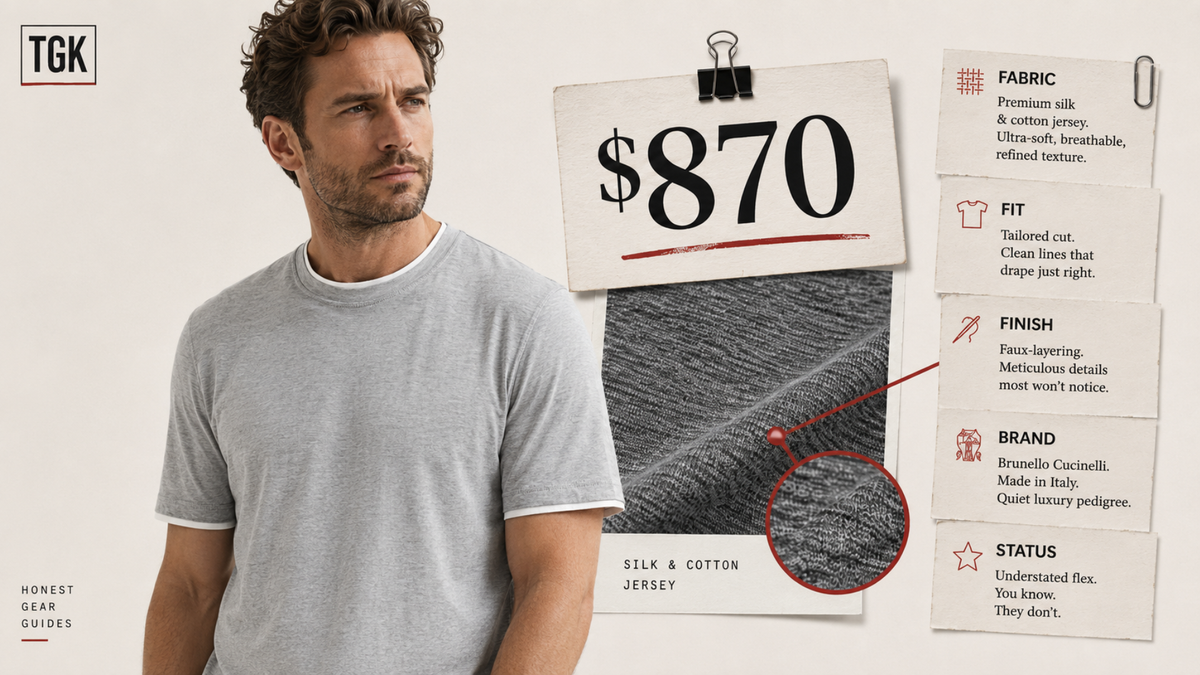
Brunello Cucinelli wants $870 for a grey T-shirt made from silk and cotton. Nice fabric, clean cut, made in Italy. Fine. But it is still a T-shirt, and there is no amount of jersey, stitching or soft-spoken Italian philosophy that turns a few panels of fabric into $870 worth of clothing.
People have been asking “what am I actually paying for?” for years, but social media made the pressure to keep buying almost impossible to escape. Loud Louis Vuitton logos became Supreme drops, then Balenciaga clothes that looked pulled from a bin, followed by quiet luxury and old-money basics. The clothes changed. The flex did not. Now the logo is hidden, the colours are grey and beige, and the price is supposed to prove that you understand quality.
The awkward part is that most people do not. They cannot reliably tell excellent silk from average silk, good leather from heavily coated rubbish, or a genuinely well-made shirt from an expensive one. At the same time, Chinese factories can produce everything from H&M-level basics to clothing capable of competing with high-end European brands, depending on the factory, fabric, specification and price.
So one side offers an $870 shirt with an Italian story, while another offers something similar for $80 and promises “the same quality.” Both know that most customers cannot properly check.
This is not about whether the Brunello shirt is nice. It probably is. The question is how much of the $870 belongs to the shirt, and how much belongs to everything built around the name.
Quick Answer
Brunello Cucinelli’s $870 T-shirt may be genuinely excellent. The official listing says it is made in Solomeo, Italy, from 62% silk and 38% cotton, with a lightweight jersey fabric and faux-layered detailing around the neck and sleeves. There is no evidence that this particular shirt costs $20 to produce, and pretending otherwise would be cheap clickbait. (Brunello Cucinelli)
But there is also no serious reason to believe that the fabric, sewing and fairer Italian labour account for anything close to the full $870. You are paying for those things, then paying again for Brunello Cucinelli, the shops, the service, the limited production, the Solomeo story and the quiet little signal the shirt sends to people who recognise it.
China can probably produce something close for far less money. That does not mean the first online seller promising “same factory quality” is telling the truth. The whole problem is that most of us are poorly equipped to prove either side.
People Were Already Asking the Question
People have been looking at luxury prices for years and wondering what the hell they are paying for. That part is not new.
What changed is that social media made the pressure continuous. You used to see a fashion campaign in a magazine, pass a shop window or notice what somebody was wearing at dinner. Now TikTok and Instagram can show you fifty people before breakfast explaining that your jeans are wrong, your trainers are finished and your wardrobe needs a new personality.
Call it sexist if you want, but the female-facing fashion and beauty side of TikTok and Reels is especially relentless. That is not because women invented consumerism or are somehow uniquely easy to fool. It is because an enormous influencer economy has been built around clothes, skincare, makeup, interiors and lifestyle products, much of it presented as friendly advice from a woman talking into a tiny microphone in her bedroom. Affiliate platforms now turn that advice directly into commission, while social feeds increasingly blur the line between somebody sharing her taste and somebody running a shop through her personality. (The Times)
The trends change, but the instruction underneath them stays remarkably consistent: buy something.
First you needed visible designer logos. Then you needed Supreme and limited drops. Balenciaga convinced people that looking deliberately wrecked was a serious fashion position. Quiet luxury arrived as the supposed adult response, followed by old-money outfits, capsule wardrobes and expensive basics in fifty shades of oatmeal.
Even underconsumption became a TikTok aesthetic. Apparently, using a bottle of shampoo until it is empty now requires a movement and a hashtag. (The Guardian)
Quiet Luxury Did Not End Flexing
Quiet luxury was sold as the death of loud branding, but people did not suddenly stop flexing. They changed the password.
A giant Gucci logo tells everyone that you bought Gucci. A plain Brunello Cucinelli shirt tells a smaller group that you know Brunello Cucinelli, can recognise the cut and can afford to spend $870 without needing strangers across the road to notice.
That can look more tasteful because, frankly, it usually does. A well-cut grey shirt is easier on the eyes than a chest covered in monograms. But the social function has not disappeared. The flex has become selective.
The person wearing it can say that he only cares about fabric and construction, while quietly enjoying the fact that the right people know exactly what it is. There is nothing shocking about that. Clothes have always been communication. It only becomes annoying when status buying is dressed up as a purely rational decision about fibre quality.
You may love the shirt because it hangs perfectly and feels incredible. You may also love being the kind of person who wears Brunello Cucinelli. Both can be true, so there is no need to pretend the second part does not exist.
This Shirt Is a Better Test Than a Gucci Logo Tee
The usual luxury-pricing argument starts with some $500 Gucci or Dior cotton shirt with a logo printed across it. That example is almost too easy because everybody understands that the logo is a large part of the product.
The Brunello shirt is more interesting. There is no obvious billboard on the chest. The official product page describes a smooth, lightweight silk-and-cotton jersey, a slight shine from the silk, a fluid cotton appearance and contrasting inserts that create the faux-layered effect. The shirt has a regular fit and is machine washable on a delicate cycle, which at least makes it more practical than an $870 T-shirt that needs to be delivered to a specialist every time somebody drops sauce on it. (Brunello Cucinelli)
Brunello Cucinelli also has a more credible defence than many luxury brands. The company has spent years promoting what it calls humanistic capitalism, with stricter working hours, higher pay and an emphasis on worker dignity. Reporting from Vogue, the Financial Times and The New Yorker has documented parts of that culture rather than relying entirely on the company’s own marketing. (Vogue)
This could be a beautiful shirt made by properly paid people in a place that takes craftsmanship seriously. I am willing to believe that.
I still do not believe there is $870 hiding inside it.
Good Quality and Good Value Are Different Questions
This is where luxury arguments usually fall apart. One side says the shirt is expensive, therefore it must be exceptional. The other finds a grey T-shirt for $60 and declares it identical from a product photograph.
Neither side has proved much.
The Brunello shirt could use finer silk, better yarn, a more stable jersey, cleaner finishing and a pattern that sits noticeably better on the body. Those differences are real, especially once you compare garments in person and wear them for a while. A shirt that keeps its shape, drapes properly and makes you look better every time you put it on has value.
It still does not follow that an $870 shirt is eleven times better than an $80 one. Clothing quality does not move neatly alongside price forever. There is usually a huge improvement when you move away from the very cheapest clothes, another meaningful improvement when you enter genuinely good materials and construction, and then a point where every extra dollar buys less product and more story.
Brunello Cucinelli lives well beyond that point.
The brand is not hiding this. Luxury pricing is not calculated by adding silk, thread and labour together, then applying a polite little margin. The price is part of the positioning. It needs to be high enough that the shirt remains Brunello Cucinelli rather than becoming another nice grey top anybody can buy.
That scarcity is manufactured, but the desire for it is real.
Luxury Prices Have Run Away From the Products
The distrust did not appear because people suddenly forgot that designer clothes were expensive.
Luxury groups pushed prices hard during and after the pandemic. HSBC analysts estimated that prices for iconic luxury products sold in France rose by an average of 54% between the end of 2019 and September 2024. Reuters noted that the same strategy helped LVMH reach a 27% operating margin in 2021. (Reuters)
The products did not become 54% better.
Raw materials became more expensive. Labour, energy, transport and prime retail space cost money. Luxury companies also employ designers, pattern makers, salespeople, photographers, marketers and plenty of other people who do not touch the final garment but still need to be paid.
Nobody sensible expects a shirt to retail for the cost of the fabric plus one person sitting at a sewing machine.
There is still a limit to how long the craftsmanship speech can carry the pricing. When every basic item rises faster than the quality a customer can see or feel, people begin treating the label as an accusation rather than reassurance.
That is the dangerous question luxury brands created for themselves: is this genuinely better, or have you simply learned that enough people will keep paying?
What Does a T-Shirt Really Cost to Make?
There is no honest way to give an exact production cost for this Brunello shirt without seeing its contracts, material invoices, development costs and factory figures.
We can still look at the wider gap between making a T-shirt and selling one.
A detailed investigation shared for this article found that independent brands producing smaller runs of good cotton shirts reported manufacturing costs around $19 to $30 in Portugal, Canada and Los Angeles. It also described designer-fashion retail markups commonly taking a $100 wholesale item to roughly $250 to $320 at retail. One former luxury production manager estimated that a $480 Gucci logo shirt cost roughly €10 to €12 to manufacture, although Gucci did not provide a figure in response. Valentino explicitly denied a separate estimate concerning one of its shirts.
Those figures do not prove that Brunello’s silk-and-cotton shirt costs $30. Silk costs more, Italian labour costs more, and the production may involve more development, wastage and finishing.
They do show how little the retail price can tell you about the physical object.
Brendon Babenzien, the founder of Noah, described pricing as dishonest when the company knowingly contributes to poverty and the people making the product cannot maintain a reasonable quality of life. His line was blunt: “your final price is a lie.”
That is a much more interesting standard than asking whether the markup is technically allowed. Of course it is allowed. The question is whether the brand has earned the story it uses to justify it.
China Is Not a Quality Level
A lot of Western shoppers still talk about Chinese manufacturing as if China were one enormous factory making the same cheap polyester shirt twenty-four hours a day.
People who work around clothes know this is nonsense.
China has factories capable of producing technical sportswear, high-grade knitwear, complicated outerwear, mass-market basics and complete rubbish. Different factories have different machinery, workers, material access, minimum orders, quality systems and prices. Even within one factory, the result depends on what the client orders and how much it is willing to pay.
I would not call random Chinese suppliers “Birkin-level factories” without evidence. Hermès does not send its leather, patterns and standards to anybody with a sewing machine and a WhatsApp account. But the broader point is right: China has manufacturers capable of work far beyond the cheap quality Western consumers still associate with the label.
China’s advantage is bigger than low wages. It has dense manufacturing clusters where fabric suppliers, dyeing facilities, pattern teams, sewing workshops, zipper makers, button suppliers and packaging companies operate close together. Reuters reported that Shein’s Chinese network included roughly 7,000 factories, mainly in Guangdong, and that Guangzhou could achieve speed and low prices partly because specialised workers, fabrics and trim suppliers were concentrated in the same region. Attempts to recreate that model elsewhere have struggled with slower delivery, higher costs and less concentrated infrastructure. (Reuters)
Saying that “nobody can compete with China” is too absolute. Italy, Portugal, Japan, Turkey, Vietnam and Bangladesh all have real strengths, and some lead in particular products or types of craftsmanship. Very few countries can match China across the whole combination of scale, speed, supplier depth and price.
That is why so much comes from there, and why the words “Made in China” tell you almost nothing about whether the product is good.
The Same Factory Story Is Usually Missing Half the Story
Social media sellers love one claim more than any other:
Same factory.
The implication is that the $80 shirt and the $870 shirt rolled off the same machine, so anybody buying the expensive one is an idiot.
Sometimes a factory may work for brands at several price levels. That still does not make every item identical. One client may supply a custom fabric, require tighter tolerances, reject more imperfect pieces and pay for additional inspections. Another may order a visually similar version using cheaper yarn, lighter fabric, simplified seams and more generous quality limits.
Same building does not mean same specification.
A brand may also control its exact pattern, fabric development, finishing process or colour through contracts and confidential supplier arrangements. A factory capable of producing the original quality is not automatically allowed to sell that exact product to the public. Access to the machinery is not access to the brand’s materials and instructions.
Then there are sellers who never made anything for the brand at all and use “same factory” because it sounds more convincing than “we copied the photograph.”
China can produce a genuinely excellent alternative. The existence of excellent Chinese manufacturing still does not prove that this particular seller has found it.
An Expensive Label Does Not Guarantee Fair Labour Either
Luxury brands often imply that the higher price supports skilled workers and better conditions. Sometimes it does. Brunello Cucinelli has a stronger public case here than most.
The wider luxury industry has given customers plenty of reasons to remain suspicious.
Reuters reviewed Italian court documents showing that Dior’s production arm had used a subcontracting chain in which workshops allegedly employed undocumented workers under sweatshop-like conditions. Suppliers had passed formal audits before police later found serious problems. Similar investigations affected Armani and other Italian luxury businesses, exposing how brands could promote craftsmanship and responsibility while losing control of what happened deeper inside their subcontracting networks. (Reuters)
The famous €53 Dior figure also needs to be used honestly. Investigators found that a subcontractor received €53 to assemble a bag that sold for more than €2,000. That was not the full cost of the finished bag because it excluded leather, design, logistics, retail and other expenses. It was still an ugly number beside the final price, especially once the working conditions became part of the story. (Financial Times)
A high price does not prove exploitation, but it does not prove ethics either.
If a brand asks the customer to pay for craftsmanship, heritage and dignity, then those things need to exist throughout the supply chain, not only inside the advertisement.
Most People Still Cannot Judge Quality Properly
This is where both luxury brands and questionable online sellers win.
Most shoppers know a few material words. Cotton is good. Cashmere is expensive. Linen creases. Leather should be real. Silk sounds luxurious.
That is enough knowledge to be marketed to, but nowhere near enough to judge a garment.
Two labels can both say 100% cotton while describing shirts that behave completely differently. Fibre length, yarn, knit density, fabric weight, finishing, dyeing and pattern cutting all matter. Then you have the construction itself: whether the collar keeps its shape, whether the seams twist, whether the hem sits flat and whether the fabric recovers after being stretched.
The Brunello page tells us its shirt is 62% silk and 38% cotton. That is useful information, but it does not settle the price. We still do not know the grade of silk, yarn construction, fabric cost per metre, rejection rate or how it performs after a year of wear.
Leather creates even more confusion. “Real leather” describes composition, not excellence. US rules focus on whether sellers accurately disclose leather, imitation materials, backing and bonded leather content. They do not certify that a leather bag is thick, well-tanned, beautifully finished or likely to age well. (law.cornell.edu)
A perfectly legal leather bag can still have weak edge paint, cheap hardware, sloppy stitching and a surface coated so heavily that it feels like plastic. Meanwhile, a good synthetic material may be the more practical choice for rain, travel or daily abuse.
Practicality is part of quality, although fashion content rarely talks about it because “this jacket has useful pockets and survives bad weather” does not look as glamorous in a Reel.
So What Are You Really Paying For?
With the Brunello shirt, you are probably paying for good material, Italian production, careful fit and a company that appears to take worker treatment more seriously than much of the luxury industry.
You are also paying for the label, the controlled distribution, the beautiful shops, the packaging, the staff, the service, the village in Umbria, the philosophy and the feeling that you bought from one of the respectable ones.
Then comes the margin.
That does not make the shirt fraudulent. Luxury goods are emotional purchases, and people are allowed to spend money on pleasure, taste and status. A mechanical watch does not need to outperform a phone. A sports car does not need to make sense in traffic. A painting does not need to perform any practical task at all.
The problem begins when an emotional purchase gets defended as objective value.
Someone may put this shirt on and find that the fit is perfect, the fabric is unlike anything else in his wardrobe and the whole item gives him enough pleasure to justify the money. Fair enough. Another person can try it, recognise that it is lovely and still decide that $870 for a grey T-shirt is ridiculous.
That person does not “fail to understand quality.” He understands diminishing returns.
The TGK Take
The Brunello Cucinelli shirt is probably very good, and the random $80 version online is not automatically the same because it looks similar in a photograph. China’s factories can manufacture at almost any level, but you only receive luxury-level work when somebody pays for the right materials, specification, labour and quality control.
Still, $870 is not a fabric price. It is a Brunello Cucinelli price, built from a good shirt, a respected name and a carefully maintained world around it.
Buy it because you want all three. Just do not pretend the $870 is hiding inside the silk.
There it is: a plain grey crew-neck T-shirt, with a little white fabric showing around the collar and sleeves to create a layered effect.
Price: $870.
There is no giant logo across the chest, no monogram and no Balenciaga explanation that requires three paragraphs from the designer to explain why the holes are intentional. This is quiet luxury in its cleanest form. The whole pitch rests on the fabric, the fit, Italian manufacturing and the belief that people who know clothes will understand why it costs that much.
So, do they?
Quick Answer
The Brunello Cucinelli shirt is not a $20 cotton blank with an expensive name stitched into it. It is made from 62% silk and 38% cotton, manufactured in Solomeo, Italy, and sold by a company with a stronger public record on Italian production and worker treatment than many giant fashion groups. It could be an excellent T-shirt. (shop.brunellocucinelli.com)
But we have no verified production cost for this specific shirt, so claiming it costs $20 to make would be made-up clickbait. What we can say is that fabric and sewing alone do not explain an $870 retail price.
You are paying for the shirt, but also for Brunello Cucinelli, Solomeo, Italian craftsmanship, the boutiques, the service, the limited market, the philosophy, the prestige and a very healthy margin.
That does not make it fake. It makes it luxury.
The mistake is pretending luxury and value are the same thing.
At Least This Shirt Is Trying to Earn the Price
Brunello Cucinelli is a better example than the usual $500 Gucci logo tee because the product has something to argue with.
The official listing describes a lightweight silk-and-cotton jersey with a smooth texture and subtle shine. It has contrasting inserts around the neckline and sleeves, a regular fit and a fabric composition of 62% silk and 38% cotton. The company says the garment is manufactured in Solomeo, Italy, “respecting human beings and labor dignity.” (shop.brunellocucinelli.com)
That matters.
Silk is more expensive and difficult to handle than the basic cotton used in most T-shirts. Italian production costs more than mass production in Bangladesh or a giant low-cost factory network. Smaller production runs also lose the savings that come from ordering hundreds of thousands of identical pieces.
Brunello Cucinelli has also built the company around what it calls “humanistic capitalism.” The brand says workers should earn better wages, work reasonable hours and be treated with dignity. Reporting on the company has supported at least parts of that reputation, including higher pay and stricter boundaries around working hours. (Vogue)
So no, this is not the cleanest target for an article claiming luxury clothes are all mall-brand rubbish with a different label.
It may be properly made. The people producing it may be treated better. The material may feel fantastic. The fit may be difficult to recreate with a random $30 alternative.
It is still $870.
There Is No $870 Hidden Gold Inside the Fabric
This is where luxury conversations become silly.
A defender of the shirt points out the silk, the Italian labour, the design process and the finishing. All fair. Then someone else finds a vaguely similar grey T-shirt online for $70 and declares it identical. Usually, neither person has touched both shirts.
The cheap one is not automatically the same. The expensive one is not automatically ten times better.
A detailed Highsnobiety investigation into T-shirt production found that material, labour, finishing, quantity, transport and retail structure can all move manufacturing costs considerably. It cited independent brands paying around $19 to $30 to produce higher-quality cotton shirts in Portugal, Canada and Los Angeles, before wholesale and retail markups were added. Designer-fashion retail markups commonly pushed wholesale prices up by roughly 2.5 to 3.2 times.
Those figures cannot be pasted onto this Brunello shirt. Silk changes the material cost, and we do not know its yarn quality, production volume, wastage, development costs or exact labour time.
Still, they show how far retail price can travel from the physical cost of a garment.
An $870 T-shirt does not need $800 worth of silk and sewing inside it. The price is partly there because Brunello Cucinelli has found a customer who wants Brunello Cucinelli and does not need the purchase justified through a spreadsheet.
That customer is buying taste, confidence and membership in a very expensive little club.
Luxury Brands Have Pushed the Joke Too Far
The suspicion around luxury prices did not appear because everyone suddenly became jealous of rich people.
Brands have spent years raising prices while continuing to use the same speeches about heritage, craftsmanship and timeless quality. HSBC analysts estimated that the prices of iconic luxury products sold in France rose by an average of 54% between the end of 2019 and September 2024. LVMH’s operating margin reached 27% in 2021 and stayed elevated afterward. (Reuters)
The products did not all become 54% better.
Material, wages, energy, transport and rent became more expensive, of course. Luxury businesses also carry design teams, unsold inventory, flagships in the most expensive streets on Earth and advertising campaigns involving people who do not come cheap.
But luxury pricing is not a simple cost-plus calculation. Price is part of the product. The higher number helps maintain distance between the brand and everyone else.
That works until customers begin feeling stupid.
A grey T-shirt at $870 sits right on that line. It is expensive enough that even someone who appreciates good fabric has to ask whether the quality is exceptional or whether the price itself is doing most of the seduction.
The Price Is High. Is It Honest?
Brendon Babenzien, the founder of Noah and former creative director at Supreme, gave a useful definition of honest pricing: when a company knowingly contributes to poverty and poor living conditions, “your final price is a lie.”
That does not mean every brand must reveal its full cost sheet or sell clothes for barely more than production cost. Businesses need profit, and a designer’s name can add real value. Design is work. Taste is work. Building a company people care about is work.
The price becomes harder to respect when a brand charges as if the garment came from some sacred workshop, while squeezing the people making it exactly like fast fashion does.
Recent Italian investigations showed why customers no longer accept the luxury story automatically. Police said an unauthorized subcontractor was paid €93 for an Armani handbag later sold for around €1,800. Workers at the subcontracted workshops were allegedly employed illegally and worked under serious safety and labour violations. Armani denied wrongdoing by its production company and said it had controls intended to prevent abuse. (AP News)
A separate court case found that a Dior supplier paid subcontractors €53 to assemble a handbag retailing for €2,600. The €53 was not the complete cost of the bag because it excluded leather, development, transport, stores and marketing. It was still an ugly number beside the final price. (The Wall Street Journal)
These cases do not prove anything improper about Brunello Cucinelli. In fact, the company’s local production model and public labour philosophy give it a better defence than most.
They do explain why customers look at an Italian label and ask for more than a nice story.
China Made the Question More Awkward
China can make terrible clothes, and China can also make excellent clothes.
That should no longer be controversial, but people still discuss Chinese manufacturing as though every factory receives the same fabric, machines, budget and quality-control instructions from one government office.
Factories make what clients order and pay for. Give a capable manufacturer good material, skilled workers, proper development time and strict tolerances, and it can produce something very good. Demand the lowest possible price and impossible deadlines, and you will probably receive exactly what you paid for.
This is why the viral “same factory” claims should be treated carefully. Chinese sellers have advertised supposedly identical versions of luxury products at a fraction of the price, but many provided no evidence that they were authorized suppliers. Industry experts noted that Chinese manufacturing can be excellent while warning that standards vary massively and an unknown seller cannot guarantee the same material, labour or quality control. (GQ)
Even two products from the same factory do not have to be the same.
One customer can order better fabric, tighter tolerances, more inspection and stronger finishing. Another can order a similar-looking version built to reach the lowest possible number.
The factory address tells you less than the specification.
So the answer is not “Europe good, China bad,” and it is not “China makes the same thing for $50.”
Sometimes an excellent Chinese shirt may genuinely rival something much more expensive from Europe. Sometimes the cheap alternative only resembles it under controlled lighting on a product page.
You still have to know what you are looking at.
Most People Cannot Judge the Difference Anyway
This may be the funniest part of the entire quiet-luxury era.
People abandoned giant logos and started talking about fabric, but many still judge fabric by reading the first line of the composition label.
“100% cotton.”
Fine. What cotton? What yarn? What fabric weight? How was it knitted, dyed and finished? Will the collar sit properly after ten washes? Will the body twist? Will the fabric recover after being stretched?
The same problem exists with leather. People see “genuine leather” and assume the case is closed, even though real leather can be thin, heavily coated, badly stitched and attached to cheap hardware.
This Brunello shirt says 62% silk and 38% cotton. That sounds expensive, and it probably feels nicer than a basic cotton tee. But the percentages alone cannot tell you whether the fabric is exceptional, whether the construction will last, whether the fit works on your body or whether another maker could give you 90% of the experience for $150.
You would need to handle it, wear it, inspect the seams and see how it behaves after months of use.
Looking at a product page and declaring it either a masterpiece or a rip-off is mostly theatre.
Would I Pay $870 for It?
No.
Not because the shirt is fake, ugly or badly made. It may be superb. Brunello Cucinelli has done more than most brands to make the ethical and craftsmanship side of its pricing sound believable.
I still cannot see $870 of value in a grey T-shirt.
At that price, I would need the fabric to feel ridiculous, the fit to look almost custom-made and the shirt to become something I reach for constantly. Even then, most of the payment would be for the pleasure of owning Brunello Cucinelli.
There is nothing wrong with that when the buyer understands it.
People buy watches that tell time less accurately than a phone. They buy sports cars they cannot drive properly in city traffic. They buy art because looking at it makes them happy. Luxury does not have to win a practical-value contest to exist.
Just do not turn the purchase into a lecture about how everyone else fails to understand quality.
The shirt can be excellent and still be wildly overpriced. Those two facts can sit together quite comfortably.
The TGK Take
The $870 Brunello Cucinelli T-shirt is probably much better than a $20 basic, and there is no evidence that it costs $20 to produce. It uses a silk-heavy fabric, is made in Italy and comes from a company that has made worker dignity part of its business model.
But $870 is not a fabric price. It is a Brunello Cucinelli price.
Buy it because you love the fit, the material, the brand and the whole Solomeo story. Do not buy it because you believe there must somehow be $870 hiding inside the silk.
Excerpt: Luxury brands pushed prices into fantasy, Chinese factories got better, and most buyers still judge quality by the label. That is why a €600 grey shirt and an €80 “same factory” copy can both look like a clever purchase.
Quick Answer
Luxury clothing can be better. Better fabric, cleaner construction, stronger shape, more careful finishing and a fit someone spent time getting right all cost money.
The problem is that luxury prices have risen much faster than most people’s ability to judge any of those things. At the same time, Chinese manufacturers have become capable of producing clothes at almost every quality level. The result is a strange market where one buyer trusts a European logo blindly, while another believes a Guangzhou seller promising “the exact same quality” for one-tenth of the price.
Both can get ripped off.
We Have Taken a Long, Stupid Trip Through Expensive Clothes
First, rich meant covering yourself in Louis Vuitton monograms so nobody could possibly miss the point.
Then came the hypebeast years. Supreme box logos, limited drops and teenage boys discussing resale value as if they were managing hedge funds.
Balenciaga pushed it somewhere even stranger, selling distressed clothes and bags that looked like they had already survived a house fire. Once everyone got tired of dressing like an expensive bin bag, quiet luxury arrived to clean the room up.
Suddenly, wealth was beige trousers, suede loafers and a plain grey Brunello Cucinelli shirt that cost hundreds of dollars.
Quiet luxury has not disappeared. People still like clothes that fit properly and do not scream from across the room. The difference now is that buyers are starting to question the bill.
How much better can a grey shirt really be?
Luxury Brands Priced Themselves Into a Trust Problem
This suspicion did not appear from nowhere.
HSBC analysts estimated that prices for major luxury products sold in France increased by an average of 54% between the end of 2019 and September 2024. Brands pushed up the prices of handbags, shoes and clothing throughout the pandemic, helping companies such as LVMH protect unusually strong profit margins. (Reuters)
The clothes did not all become 54% better.
Some increases covered higher wages, materials, transport and rent. Luxury brands also spend huge amounts on boutiques, advertising, fashion shows, design teams and maintaining a global retail operation. Nobody seriously expects a shirt to be sold for the price of its cotton and twenty minutes at a sewing machine.
Still, there is a point where the story starts doing more work than the product.
Bain linked the luxury slowdown of 2024 partly to aggressive price rises and a lack of exciting new products. Customers were being asked to pay more while receiving less reason to care. (AP News)
A beautifully made coat can justify serious money. A basic shirt does not become a family heirloom because an Italian man photographed it beside an old stone wall.
The €53 Dior Bag Story Was Real, With One Important Detail
This is probably the scandal people half-remember when they talk about luxury goods costing almost nothing to make.
An Italian court investigation found that a subcontractor was paid €53 to assemble a Dior handbag that retailed for about €2,600. Dior is owned by LVMH. The €53 figure did not include the leather, design, development, transport, retail costs or marketing, so it was never the complete production cost of the bag. (Reuters)
That context matters. Anyone saying, “Dior’s entire bag costs €53,” is stretching the truth.
It is still a ridiculous-looking number.
The same investigations found ugly labour practices inside parts of Italy’s luxury supply chain. Some workshops relied on undocumented workers, dangerously long hours and machinery with safety systems removed. Audits repeatedly failed to catch serious problems. (Reuters)
The Armani case was even easier to follow through the supply chain. According to the Italian court documents reported by Reuters, bags were sold by workshops to an intermediary for €93, resold to Armani for €250, and then offered to customers for around €1,800. Armani said it had controls intended to prevent abuse and cooperated with the authorities. (Reuters)
Again, retail price is never supposed to equal sewing cost. Design, materials, rejected samples, taxes, stores, staff and unsold inventory all exist.
But come on. What are we talking about?
When the person making the bag receives almost nothing and the final customer pays nearly two grand, the brand needs a stronger explanation than heritage, atmosphere and a glass of champagne in the boutique.
China Is Not a Quality Level
People still talk about “Chinese clothing” as if it describes one type of product.
It does not.
Guangzhou alone has enormous garment-manufacturing networks capable of responding to orders at a speed that helped turn Shein into a company selling more than $30 billion of goods annually. Reuters described hundreds of factories around the city producing small batches and reacting quickly to live purchasing data. (Reuters)
Those networks can produce a flimsy top designed to survive three Instagram photos. They can also work with good yarn, heavy fabric, proper machinery and strict quality control when the customer is willing to pay for it.
A factory does not wake up every morning feeling morally committed to either rubbish or excellence. It makes the product ordered, at the specification and price agreed.
That is why “Made in China” tells you far less than people think. The country of manufacture does not reveal the quality of the fibre, fabric weight, stitching, finishing, pattern cutting or inspection standards.
China’s manufacturing scale also means that places such as Guangzhou contain everything at once: factories, subcontractors, fabric markets, leather suppliers, wholesale buildings and sellers who can put a convincing product in your hands for much less than a European boutique.
Some of those clothes are genuinely excellent.
Some are polished rubbish.
No, The Viral “Same Factory” Video Is Not Proof
During the tariff fights of 2025, Chinese sellers flooded TikTok with videos claiming to manufacture the same luxury products sold by major Western brands. They invited shoppers to skip the label and buy directly from them.
The message was irresistible: your €2,000 bag costs €100, and only an idiot pays for the logo.
There was one problem. Many sellers provided no evidence that they were authorized suppliers to the brands they named. The videos often functioned as advertisements for counterfeits, and buyers had little protection against false materials, inconsistent quality or products that looked nothing like the samples shown online. (The Washington Post)
The same appearance does not prove the same factory. The same factory does not guarantee the same specification either.
A manufacturer can produce two similar-looking shirts using different yarns, fabric weights, dyes, seam construction and quality-control tolerances. One client pays for the better version. Another asks for something that survives long enough to avoid an immediate refund.
So yes, it is possible to find Chinese clothing with quality close to expensive European brands. It is also possible to buy a convincing photograph of a beautiful coat and receive something with the structural integrity of a napkin.
“100% Cotton” Tells You Almost Nothing
This is where most people’s quality knowledge falls apart.
They check the label, see “100% cotton” and assume the investigation is finished.
Two shirts can both be 100% cotton and feel completely different after five washes. Fibre length, yarn quality, fabric density, knitting or weaving method, dyeing and finishing all affect how the finished material behaves. Textile finishing alone can change softness, shine, shrinkage, water resistance and how stable the fabric remains over time. (Wikipedia)
Then the factory has to turn that fabric into clothing.
Are the seams straight? Is there enough material left inside them for repairs? Does the collar keep its shape? Do the patterns line up? Does the fabric twist after washing? Is the knit dense enough to recover when stretched, or will the elbows look exhausted by lunchtime?
A material label tells you what went into the garment. It does not tell you whether anybody gave a damn while making it.
The same applies to cashmere. Seeing “100% cashmere” does not tell you the length or fineness of the fibres, how tightly the yarn was spun, how dense the knit is or how badly the sweater will pill. With wool, fibre diameter is important enough that the international Super S system assigns numbers according to maximum micron measurements. Even then, finer does not automatically mean more practical or durable for every use. (Wikipedia)
This is why touching clothes still matters. So does trying them on, checking the inside and seeing what happens after several months, not five flattering minutes beneath boutique lighting.
Most People Are Even Worse at Judging Leather
Leather has its own library of half-understood words.
People hear “genuine leather” and imagine a stamp of quality. In practice, consumer rules mainly concern whether companies are honest about a product’s composition. US regulations say products described simply as leather must be substantially made from leather, while bonded or reconstituted materials require clearer disclosure of their leather and non-leather content. The regulation does not magically tell you that the bag is good. (Legal Information Institute)
Real leather can still be thin, heavily coated, badly cut or poorly finished. A bag can use respectable hide and then ruin it with weak stitching, cheap edge paint, poor lining and hardware that looks tired after six months.
Good leather should be judged as a complete product. Look at how it bends, whether the surface seems buried beneath a plastic coating, how cleanly the edges are finished and whether the stitching remains consistent around corners and stress points.
Natural variation is not automatically a defect. Perfectly identical grain across every centimetre can sometimes mean the surface has been heavily corrected or embossed. That may be completely suitable for a practical, weather-resistant bag. It just should not be sold to you through romantic speeches about untouched natural hide.
Expensive Clothes Can Still Be Worth It
There is a lazy version of this argument that says every expensive product is a scam and every Chinese alternative is secretly identical.
That is nonsense too.
A luxury brand may offer a better cut, exclusive fabric, unusual colour development, skilled tailoring, stronger quality control, repairs, alterations and a design that cheaper sellers immediately copy because it was good in the first place. Brunello Cucinelli also controls more of its Italian production and has invested directly in cashmere suppliers and local workshops, which is more substantial than simply attaching an Italian label to an anonymous product. (Wikipedia)
You may also be paying for the design, status and pleasure of owning the original. Fine. Nobody has to pretend clothes are purely functional.
Just call the purchase what it is.
If you bought the €600 shirt because the fit is perfect, the fabric feels exceptional and you will wear it for years, there is an argument for it. If you bought it because TikTok said wealthy people wear grey now, you have not escaped logo culture. Your logo is simply quieter.
How to Stop Getting Fooled
Start by forgetting the idea that one number or word proves quality.
A high price proves the seller believes someone will pay it. “Made in Italy” tells you where enough of the legally relevant work happened, not how well every step was performed. “Made in China” does not tell you whether the factory was cheap or excellent. “100% cashmere” does not promise a good sweater. “Real leather” does not promise a good bag.
Handle the garment. Turn it inside out. Check the seams, lining, buttons, zippers and unfinished edges. Stretch the knit gently and see whether it recovers. Hold thin fabric against light and look at its consistency. Read the care label and ask whether the item makes sense for your actual life.
A delicate cashmere sweater may feel wonderful and still be a terrible purchase for someone who wants to throw everything into a washing machine. A tough synthetic jacket may be worth more to that person than something natural, precious and annoying.
Practicality is part of quality. People forget that because it is harder to photograph.
The TGK Take
Luxury brands raised their prices until customers started asking dangerous (rational) questions. Chinese factories became good enough that “Made in China” stopped working as an automatic insult. Buyers are now stuck between a European brand asking €1,000 for trust and an online seller offering “the same thing” for €80 with no proof at all.
The answer is not blind loyalty to either side.
Learn what fabric feels like. Learn how a good seam looks. Learn what leather you are buying and how the item is constructed. Pay extra when the product deserves it, and stop being impressed by a price tag when it does not.
The real flex is being difficult to fool.