Bitcoin Jumped 23%. Now Everyone Wants Back In
Bitcoin jumped 23% after Treasury buybacks, short liquidations and strong ETF inflows. Here is what would turn the rally into a proper recovery, and what could send it back down.

Bitcoin spent months drifting lower while most people either ignored it or decided crypto was finished again. Then it gained around 23% in one week, touched almost $79,500 and suddenly the same people were asking whether they had missed the train.
The timing looks strange because nothing outside crypto became easier during those few days. The conflict with Iran continues, Brent crude has moved above $94, inflation remains a problem, U.S. government debt has passed $40 trillion and groceries have not become cheaper because Bitcoin printed a green candle. What changed was the bond market, followed by trader positioning and fresh money entering Bitcoin ETFs.
That explains why the rally happened. It does not settle what happens next, especially for anyone who noticed Bitcoin only after the first 23% had already gone.
Quick Answer
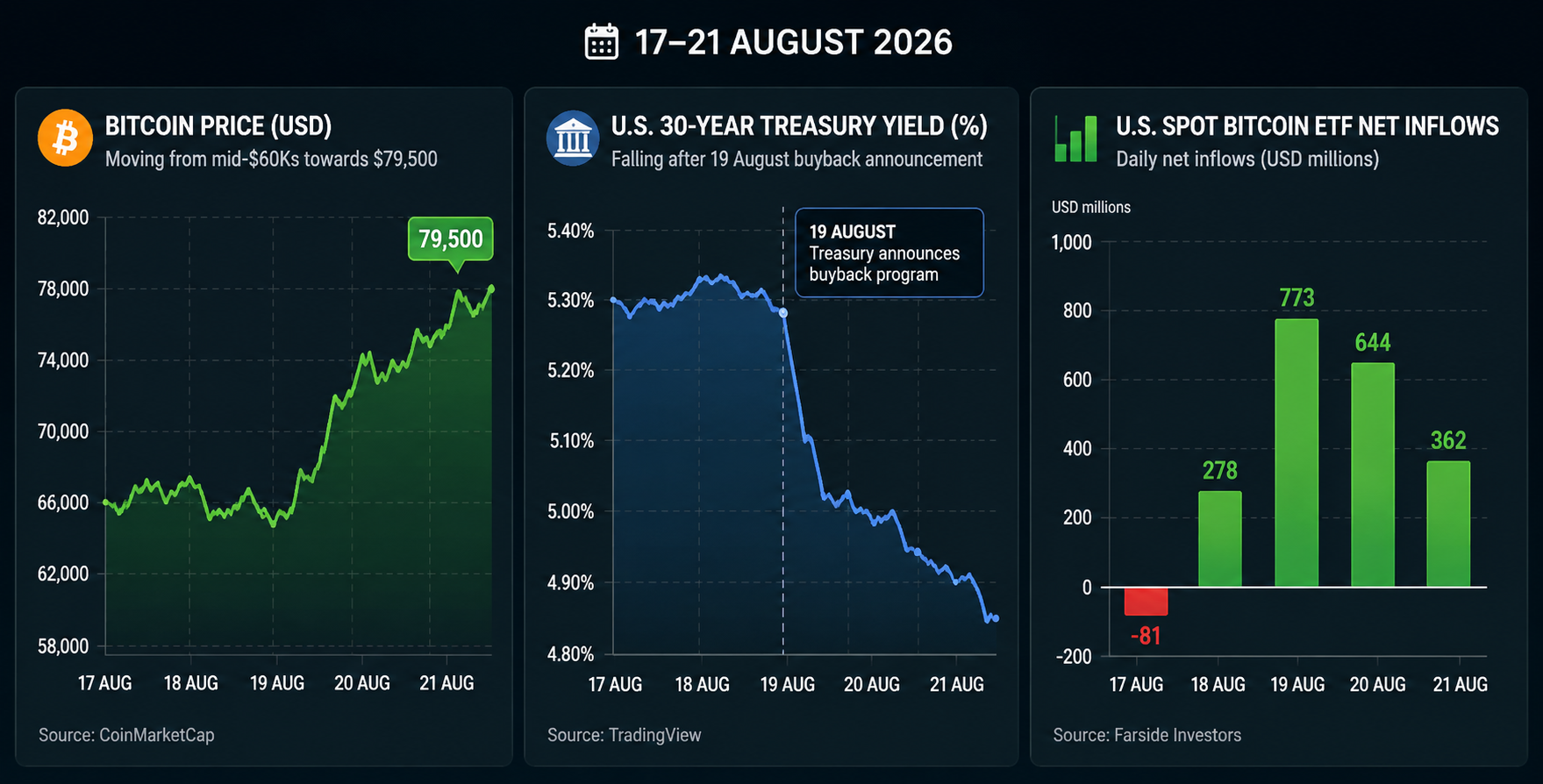
Bitcoin’s rally began after the U.S. Treasury announced that it would double the size of certain long-term bond buybacks, which pulled long-term yields lower and weakened the dollar. Bitcoin was already trading in a quiet, thin market, so the initial move forced more than $4.3 billion in short positions to close, adding a large amount of automatic buying. U.S. spot Bitcoin ETFs then recorded about $1.62 billion of net inflows from Tuesday through Friday, giving the rally some demand beyond the short squeeze.
Those are legitimate reasons for Bitcoin to rise, but they do not confirm that the decline from October 2025 is finished. Bitcoin remains roughly 39% below its record, the Treasury programme is temporary and small compared with the entire bond market, and one strong week of ETF inflows can disappear as quickly as it arrived. Anyone buying now should understand that retail has entered after the first move, when the price is higher and the easy part has probably passed.
This article is general market commentary, not personalised financial advice.
Bitcoin is still 39% below its record
Bitcoin reached approximately $79,463 on Friday before settling around $77,000 to $78,000, leaving it more than 23% higher for the week and on course for its strongest weekly gain in over two years. Ether gained around 26%, Hyperliquid rose roughly 36%, and the wider crypto market added hundreds of billions of dollars in several sessions. Investor’s Business Daily and Business Insider both traced the move to Treasury policy, liquidations and returning fund flows.
A 23% week matters, but the chart needs more context than the number alone provides. Bitcoin’s October 2025 record was close to $126,000, which still leaves the current price roughly 39% below the top. Someone who bought near that record is not celebrating a new bull market at $77,000; they are watching part of a large loss disappear.
Bitcoin had also been falling and trading quietly for long enough that some kind of relief was becoming likely. At the pace it was moving, crypto needed to bounce eventually just to create fresh room for another trip towards zero.
The joke aside, damaged markets regularly produce their largest short-term gains because positioning becomes one-sided and liquidity becomes thin. That can start a proper recovery, but the size of the first bounce does not provide the answer by itself.
The Treasury announcement was the first catalyst
On 19 August, the U.S. Treasury announced that it would increase its long-term liquidity-support buybacks from a maximum of $2 billion to at least $4 billion per operation. The change applies to Treasury securities with maturities between 10 and 30 years and is scheduled to run from 9 September to 4 November. Reuters reported that the announcement came after the 30-year Treasury yield approached 5.34%, its highest level since 2007.
Long-term yields dropped by almost ten basis points after the news, while the dollar weakened and gold rose more than 4%. Stocks received some support as well. When those yields fall, investors receive less compensation from safer assets and financial conditions become a little easier, which tends to help assets such as technology shares, gold and Bitcoin.
This was Treasury debt management rather than a Federal Reserve rate cut, and the difference matters. The programme can improve liquidity and calm a disorderly bond market, but $4 billion operations remain small beside a Treasury market containing more than $32 trillion of publicly held debt. The announcement helped with the immediate pressure without fixing the deficit, inflation or the government’s interest bill.
Bitcoin still reacted hard because it trades around the clock, uses plenty of leverage and had much thinner liquidity than the bond or equity markets. It was ready to move; the Treasury announcement gave it the first reason.
Short liquidations accelerated the move
Before the rally, Bitcoin had spent weeks trading around the low-to-mid-$60,000 range with very little activity. Glassnode reported that spot exchange volume, measured in Bitcoin, had fallen to its lowest level since its data series began in 2019. Fewer coins changing hands meant that a relatively modest change in demand could move the price much further than it would in a busy market.
Once Bitcoin broke above the old range, exchanges began closing losing short positions. A short seller borrows or sells Bitcoin expecting to buy it back at a lower price; when the price rises far enough, the exchange can force that trader to buy back immediately before the loss becomes larger. Those forced purchases push the price higher, which can liquidate the next group of shorts and keep the process moving.
More than $4.3 billion in crypto short positions were reportedly liquidated between Wednesday and Friday. That explains how Bitcoin added thousands of dollars so quickly, although it does not mean everyone had been short or that the entire move was artificial. It means part of the demand came from traders who had no choice but to buy.
After those positions have closed, that source of demand is finished. The important question becomes whether investors who genuinely want Bitcoin continue buying at the new price.
ETF inflows are the better signal
U.S. spot Bitcoin ETFs recorded net inflows of $297.5 million on Monday, $189.3 million on Tuesday, $517.2 million on Wednesday, $606.3 million on Thursday and $307.5 million on Friday. That produced approximately $1.92 billion of inflows across five sessions, including about $1.62 billion during the final four days of the rally, according to Farside Investors.
ETF buyers are more useful for judging the rally than liquidated shorts because their purchases are voluntary. They are choosing to add exposure rather than being forced to close a losing trade, and those flows continued after Bitcoin had already begun moving.
One week is still too short to establish a trend, particularly after several months when institutional demand repeatedly appeared and disappeared. The next test comes when Bitcoin pulls back, because buyers who were comfortable chasing at $77,000 may become less enthusiastic when the screen turns red again.
Bitcoin has now moved above Glassnode’s recent short-term holder cost basis near $68,700, which represents the average entry price of newer holders. A pullback that remains above the former $65,000 to $69,000 range while ETF inflows continue would be far more convincing than another weekend jump driven by leverage.
Iran, oil and inflation have not gone away
The rally does not mean investors suddenly decided that the economy is fine. Oil remained above $94 as tensions involving Iran continued, U.S. debt crossed $40 trillion, interest costs kept rising and the same inflation concerns that pushed long-term yields higher remain unresolved.
Markets respond to changes in money, rates and positioning before they respond to whether ordinary life feels better. If everybody is already defensive and long-term yields suddenly fall, risk assets can rise during a week when the news remains terrible. That does not require peace, cheaper groceries or a convincing economic recovery.
Bitcoin also behaves more like a high-beta liquidity asset than a reliable end-of-the-world hedge. Lower yields and a weaker dollar can bring buyers into Bitcoin and gold at the same time, while a later rise in yields can hurt Bitcoin much faster. Anyone treating the rally as proof that Bitcoin has separated from the financial system is ignoring what started it.
There are good projects in crypto, just as there are bad ones with excellent marketing, but technology alone does not hold up a price. Bitcoin’s main advantage remains its recognition, liquidity, existing network and the amount of demand already built around it. Being first has been extremely valuable, although that advantage still depends on people continuing to use, hold and trade it.
Trump and the CLARITY Act added political support
President Trump hosted executives from Coinbase, Gemini, Ripple, Chainlink, Kraken, Robinhood and other crypto companies at the White House on the same day as the Treasury announcement. He called on Congress to pass what he described as a “fair version” of the CLARITY Act, which would establish clearer rules for deciding when digital assets are securities or commodities and which regulators oversee them. Reuters covered the event.
Clearer regulation could make large institutions more comfortable holding or offering crypto products, so the political support added another valid reason for traders to buy. The Trump crypto club received another White House meeting, and the market was happy to use it.
The bill is far from finished, however. A Senate cloture vote is expected around 15 September and would require 60 votes, while lawmakers continue arguing over anti-money-laundering rules, state enforcement powers and restrictions involving politicians’ own crypto businesses. Reuters described the bill’s passage odds as increasingly difficult.
A successful vote would support the regulatory case for crypto. A failed vote would remove part of the optimism currently included in the price, especially if ETF flows have weakened by then.
Retail arrived after the first move
The clearest sign that public attention had returned came when social media filled with screenshots of altcoin gains and questions about whether it was too late to buy. Jim Cramer also recommended buying Bitcoin on 20 August, only weeks after saying he planned to sell his holdings, which is at least enough to make a cautious person check the exits.
Retail investors do not always lose, but they frequently receive the information after the first move has already happened. A Bank for International Settlements study covering 95 countries found that rising Bitcoin prices were followed by more downloads and use of crypto trading apps, while an estimated 73% to 81% of retail users probably lost money on their initial investment during the period studied. Separate BIS research on the 2022 collapses found that smaller investors were buying while larger and more sophisticated holders were selling.
Those studies cover earlier market cycles and cannot predict this one, but the behaviour has not become difficult to recognise. Interest is quiet near the lows, the first large move attracts attention, and the fear of missing out arrives when the entry price has already become worse.
If you missed the first 23%, you missed the first 23%. There will be another pullback, another rally and another chance to make either a sensible decision or a stupid one, so there is no reason to chase an altcoin after it gains 40% in two days or to add leverage because the green candles look easy.
Easy gains are especially dangerous because they convince people that position size no longer matters. The same leverage that turns a 10% move into a large win can empty an account during a normal pullback, while a fake exchange or unregulated platform can make the result even worse. If you are considering any unfamiliar service, check how to spot a fake crypto trading platform before depositing.
What would make this rally look serious
Before I trust this move, Bitcoin needs to survive longer than one exciting week. A green monthly candle would help, especially after months of weakness, but crypto has printed plenty of green months during larger declines. The better sign would be Bitcoin holding above the old $65,000 to $69,000 area for several weeks, taking a normal pullback without collapsing and finding buyers somewhere around that new support. A quick wick below the range would not bother me much if the price recovered; several daily closes below it would.
I would also want to see something outside crypto stop getting worse. Long-term Treasury yields settling down, oil cooling, inflation data improving or genuine progress around Iran and Hormuz would all make the rally easier to trust. Bitcoin does not need world peace to rise, but relying on one Treasury announcement while every other problem continues building is not a comfortable setup.
The ETF inflows matter too, although nobody needs to check them every morning like a maniac. If the funds keep buying over the next few weeks and Bitcoin can rise again after an ordinary pullback, without another enormous batch of short liquidations doing the work, then this starts looking more like a recovery.
Even a green August candle would not settle it for me, but it would be a decent start. If Bitcoin loses the old range again while oil and yields move higher and ETF demand disappears, the rally probably gave people a better exit and created some fresh room to fall.
Final Verdict
Bitcoin’s 23% week had several clear causes. The Treasury calmed the long end of the bond market, the dollar weakened, a thin crypto market moved higher, more than $4.3 billion of shorts were forced out and spot ETFs attracted nearly $2 billion across five sessions. Calling the entire rally fake would ignore the real money that entered after the initial squeeze.
Calling the bear market finished would require more evidence than one week. Bitcoin is still about 39% below its record, the economic and geopolitical problems that existed before the rally remain in place, and retail attention returned after the price had already moved. The sensible position is neither panic nor FOMO: watch whether ETF and spot demand remain when Bitcoin has a bad day, because that will tell us much more than another excited weekend above $77,000.
FAQ
Why do altcoins move more than Bitcoin?
Most altcoins have a much smaller market value and less trading liquidity than Bitcoin, so a smaller amount of buying or selling can move their prices much further. If Bitcoin falls 8%, a decent lower-cap project can lose 15% or 20%, while a thinly traded meme coin can lose 30% without anything important changing inside the project.
The same effect works on the way up. Once Bitcoin stabilises and traders become more willing to take risks, money moves into smaller coins where each purchase has a larger effect on the price. A 40% altcoin rally therefore says more about market size, liquidity and speculation than it does about the quality of the project.
Sources and market notes
Market information checked on 22 August 2026.
- Investor’s Business Daily: Bitcoin price, weekly gain, ETF flows and short liquidations
- U.S. Treasury buyback announcement
- Reuters: Treasury doubles long-term bond buybacks
- Reuters: Global yields, dollar, gold and oil reaction
- Farside Investors: Daily U.S. spot Bitcoin ETF flows
- Glassnode: Bitcoin volume and holder cost-basis data
- Reuters: Trump’s White House crypto meeting
- Reuters: CLARITY Act September vote and remaining obstacles
- BIS: Crypto trading and retail investor losses
- TheStreet: Jim Cramer recommends buying Bitcoin