Should You Shave Against the Grain?
Against the grain gets closer. It can also leave your neck red for hours. Here is the safer way to shave properly without settling for rough stubble.

Unlike some of my Muslim friends, who seemed to have a full beard by eight, I was never exactly rich in facial hair. I still need to shave, and for some reason I keep forgetting which direction is right. Then I go for the closest possible result and spend the day with a red neck like a schoolboy who borrowed his dad's razor. I am 35. This should no longer require research.
The answer is simple: shave with the grain first. If you need a closer result, apply shaving cream again and make a second pass across the grain. Going directly against the grain cuts closer, but it also raises the chance of razor burn, ingrown hairs and those small red bumps that make a clean shave look worse than a little stubble ever did.
Quick Answer: Should You Shave Against the Grain?
You can shave against the grain, but it is the most irritating direction and is usually a bad idea on a neck that already gets red or bumpy. Start by shaving in the direction each section of hair grows. If your skin is calm and the first pass is not close enough, reapply cream and shave across the grain. Save an against-the-grain pass for small areas that genuinely tolerate it, rather than dragging the razor upward across your whole neck.
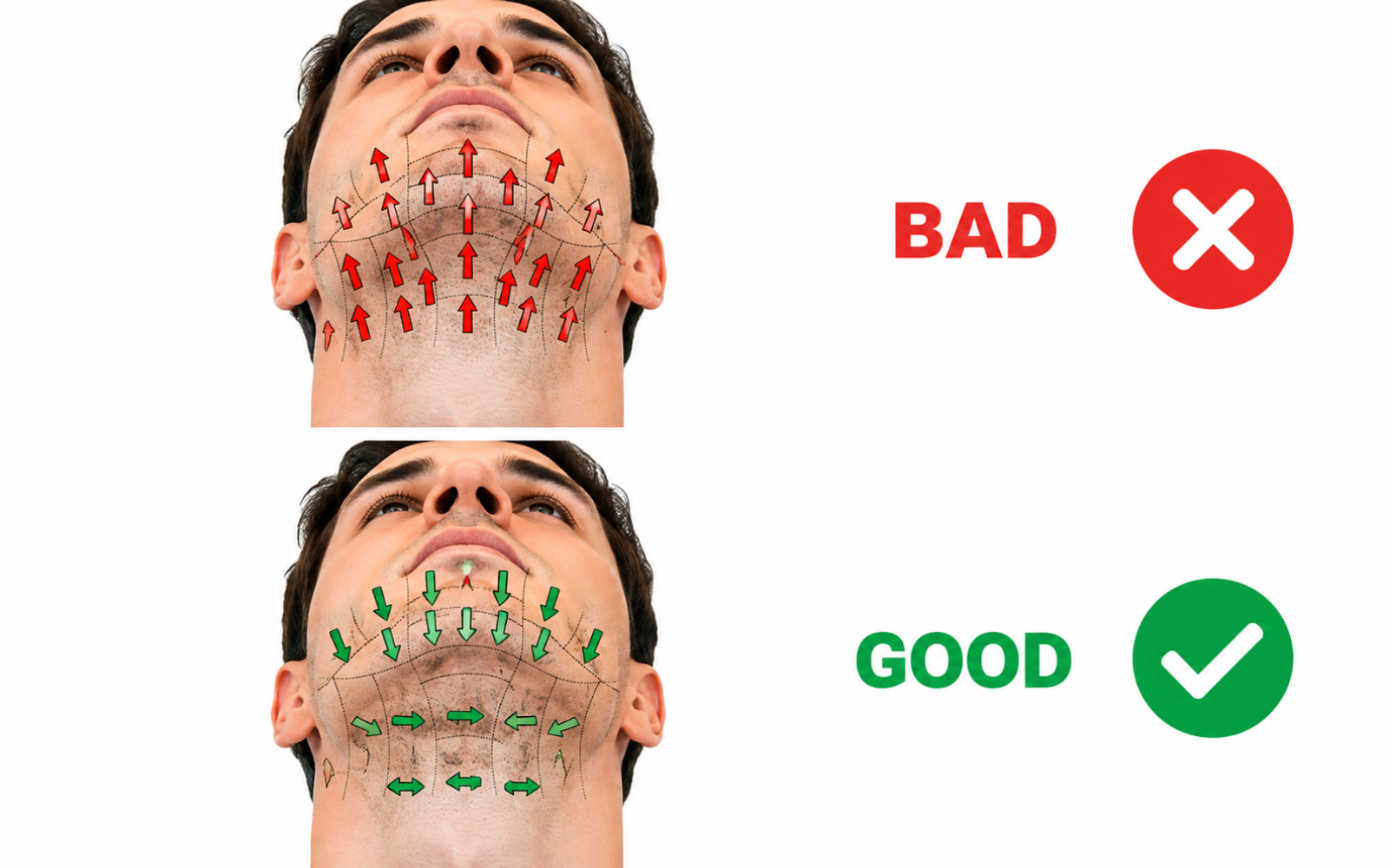
Why Shaving Against the Grain Is Closer
Shaving with the grain follows the direction of growth and leaves a tiny amount of hair above the skin. Against the grain lifts and cuts the hair closer, which is why your face feels smoother when you run a hand over it.
That extra closeness is also the problem. A very closely cut hair can retract below the surface or curve back into the skin as it grows, causing inflammation and razor bumps. Shaving against the grain, stretching the skin and using a blunt blade all increase that risk, especially if your facial hair is coarse or curly. A clinical review of pseudofolliculitis barbae describes the same mechanism.
So yes, against the grain works if the only measurement is closeness. If the result is a smooth face followed by two days of redness and ingrown hairs, it did not work particularly well.
Why Does My Neck Get Razor Burn?
The neck is where most people stop paying attention to the grain. Cheek hair often grows down in a fairly obvious direction, while neck hair can grow sideways, upward or in different directions within a few centimetres. If you keep moving the razor from jaw to collar on autopilot, part of that pass may already be against your grain.
Check the growth when the hair is dry and long enough to see or feel. Rub a finger in each direction. The direction that feels smooth is with the grain; the direction that catches and feels rough is against it. Do this in a few separate areas rather than deciding that your entire neck grows one way.
Direction is only half of it. Dry shaving, too much pressure, repeated passes and an old blade all add friction. Some multi-blade cartridges also cut too closely for people who regularly get bumps. The American Academy of Dermatology recommends trying a single- or double-blade razor, avoiding stretched skin and changing the blade after roughly five to seven shaves when irritation keeps returning.
Razor burn and razor bumps are related but different. Razor burn is usually the flat, red, stinging irritation that appears soon after shaving. Razor bumps are raised spots caused when cut hairs grow back into the skin. You can have both at once, which is why the neck may burn immediately and then break out the next day.
How to Get a Closer Shave Without Irritation
If you want a closer shave without irritation, preparation and two controlled passes work better than pressing harder and making ten touch-ups.
- Map your grain before you start. Check the cheeks, jaw and several parts of the neck separately. You only need to do this properly once, although it is worth checking again if you grow the beard longer.
- Soften the hair. Shave after a warm shower or hold a warm, damp cloth against the beard. Apply a proper shaving cream or gel and give it two or three minutes to soften the hair. DermNet's shaving guidance recommends the same preparation.
- Use a sharp blade with very light pressure. Short strokes are easier to control around changing neck growth. Rinse the blade after every stroke instead of repeatedly scraping clogged metal across the skin.
- Make the first pass with the grain. One pass over each area is enough. Do not stretch the skin to chase another fraction of a millimetre.
- Reapply the cream before a second pass. Go across the grain only where you want a closer finish. Never make a second pass over bare skin because you can no longer see a little patch of stubble.
- Leave the difficult neck patches alone. If one area always burns when shaved perfectly smooth, stop demanding perfectly smooth from it. A faint trace of stubble looks better than an angry red patch.
- Rinse and moisturise. Use a cool, damp cloth, pat the skin dry and apply a plain fragrance-free moisturiser or alcohol-free post-shave balm.
If your cheeks tolerate an against-the-grain touch-up, you can test it there after the first two passes. Use fresh cream, no pressure and stop as soon as the blade drags or the skin stings. If your neck keeps rejecting that direction, stop using it there.
What to Do When Your Neck Is Already Red
Stop shaving the irritated area until it settles. A cool, damp cloth and a fragrance-free moisturiser can calm mild razor burn; alcohol-heavy aftershave is more likely to sting it. Cleveland Clinic also advises pausing hair removal and avoiding fragranced or alcohol-based products while the skin recovers. Razor-burn treatment guidance
Persistent painful bumps, pus, dark marks or scarring deserve a dermatologist rather than another razor experiment. Recurring bumps may be pseudofolliculitis barbae, while pus-filled or worsening spots can involve folliculitis or infection. If a blade keeps causing the problem, an electric shaver or trimmer that leaves around 1 mm of stubble may be the smarter answer.
The TGK Verdict
Do not start against the grain. Map the neck, soften the hair and make one light pass with the grain. Reapply cream and go across the grain if you need to get closer. Against the grain is an optional final touch for skin that can handle it, not the default technique your whole face has to survive.
Leaving half a millimetre more hair on the difficult parts of your neck is a better deal than red skin and bumps for the next two days.
Sources
- American Academy of Dermatology. Six razor-bump prevention tips from dermatologists. Reviewed by board-certified dermatologists; updated 2022.
- American Academy of Dermatology. Skin-care tips for men. Includes shaving technique, blade and product guidance.
- DermNet. Shaving. Clinical overview of preparation, shaving direction, razor burn and ingrown hairs.
- Ogunbiyi A. Pseudofolliculitis barbae: current treatment options. Clinical, Cosmetic and Investigational Dermatology. 2019.
- Cleveland Clinic. How to heal a bad case of razor burn. Medically reviewed treatment guidance.