Five gym myths you can stop believing
The gym has repeated the same five rules for years. We checked what the research says about creatine, protein timing, belly fat, BMI and pain.

The gym community has heard so many stories over the years. Some Pilates sprint guru tells you creatine will destroy your kidneys, some physio grandma on TV says protein gives you hair on your balls, while the biggest guy in the gym is probably telling you that five grams of creatine is basically a children’s dose. You hear the same stuff enough times and eventually you start thinking there must be something to it.
But most of these stories are just myths that somehow survived for years because people kept repeating them. Some are harmless, some make you waste money, and some can genuinely make your training worse. So we picked five of the most common gym myths and checked what the research actually says.
And sorry about the GIFs. We gave our new Gen Z TGK member a shot.
Quick answer
Current evidence does not show that standard creatine use damages healthy kidneys or causes hair loss. The post-workout protein window is much wider than 30 minutes, and your total daily intake matters more than beating a stopwatch. Crunches train your abs but do not reliably tell your body to burn the fat above them. BMI is a useful screening number, not a diagnosis, especially when someone carries a lot of muscle. Soreness is not proof of a productive workout, and sharp or joint pain is not something to collect for points.
1. Creatine ruins your kidneys or makes your hair fall out
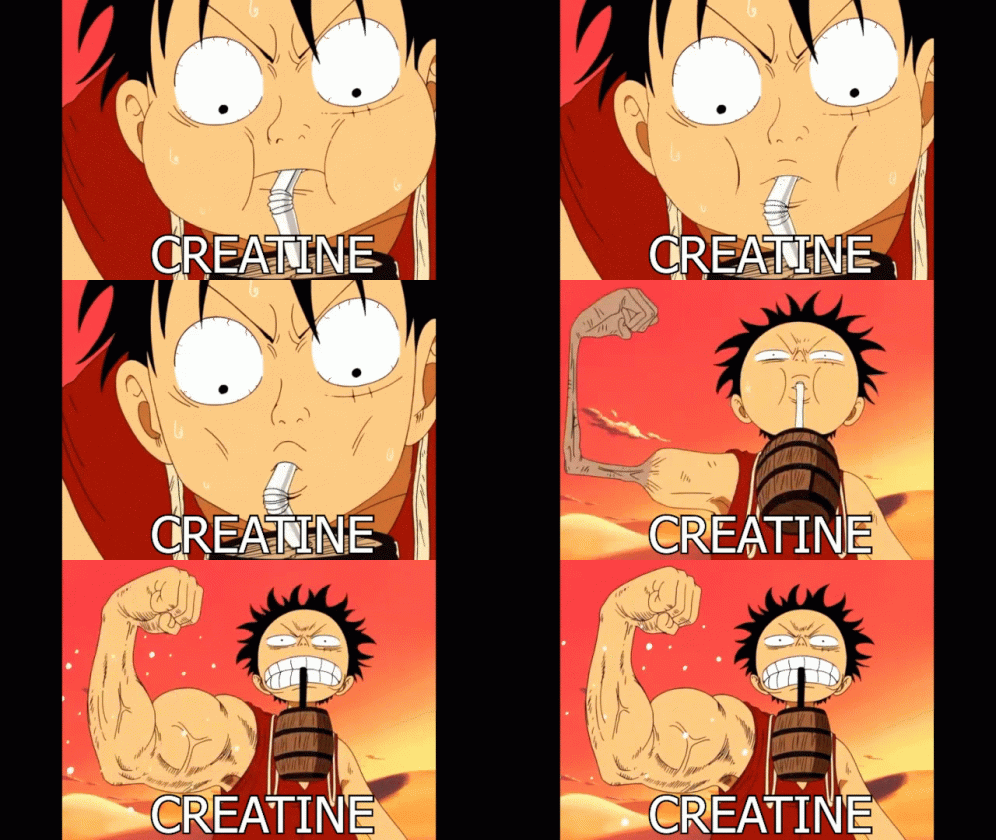
The hair-loss story has an unusually traceable beginning. A small 2009 study of college rugby players found that creatine loading increased dihydrotestosterone, better known as DHT. DHT is involved in male-pattern hair loss, so the internet completed the story by itself.
The study never measured hair loss.
In 2025, researchers finally ran a 12-week randomized trial that measured hair outcomes directly. Resistance-trained men took five grams of creatine a day or a placebo. The researchers found no significant difference in DHT, hair density, follicular units or hair thickness between the groups.
That is much better evidence than a rumour built from one hormone reading. It is not eternal proof for every dose and every person: the trial was short and only involved men. What it does show is that the first study designed to look for the supposed hair damage did not find it.
The kidney claim has a more believable source of confusion. Creatine can raise serum creatinine, which doctors commonly use to estimate kidney function. That can make a creatinine-based eGFR result look worse even when the kidneys themselves have not been damaged.
A 2026 systematic review and meta-analysis of 26 randomized trials found exactly that pattern: creatinine-based estimates could fall, while measured GFR and other markers of kidney injury did not show clinically meaningful harm. The review also found a real gap. There were no trials in people with non-dialysis chronic kidney disease, so the healthy-adult finding should not be lazily extended to everyone.
If you have kidney disease, take medication that affects kidney function or are being investigated for an abnormal result, speak to your clinician and tell them you use creatine. If you are a healthy adult, the current evidence does not support avoiding it because somebody at the gym heard a kidney story in 2014.
2. You have 30 minutes to drink a protein shake

Your muscles do not close for business because you spent 40 minutes showering and getting home.
The famous “anabolic window” is based on a real idea stretched into a much stricter rule than the evidence supports. Muscle remains responsive to protein after resistance training, but the useful window depends partly on when and what you ate before training. It is not a universal 30-minute emergency.
A 2025 systematic review and meta-analysis compared protein consumed before versus after resistance training and found no significant difference in lean mass, muscle size or strength. The evidence base was small, so this does not prove timing never matters. It does make the old “shake immediately or waste the session” warning very difficult to defend.
Total intake is the bigger lever. A meta-analysis of 49 studies involving 1,863 people found that gains in fat-free mass stopped clearly improving beyond roughly 1.6 grams of protein per kilogram of body weight per day during resistance training. Treat that as a population estimate rather than a personal prescription. It is still more useful than staring at the gym clock in fear.
Have some protein within a few hours because it is practical. If you train fasted, eating sooner makes more sense. If you ate a proper meal before training, the shake can survive the journey home.
If you are still building the basics, our beginner guide to gaining muscle covers the full thing: training, food, recovery, protein and where creatine fits without turning your kitchen into a supplement shop.
3. Crunches burn belly fat
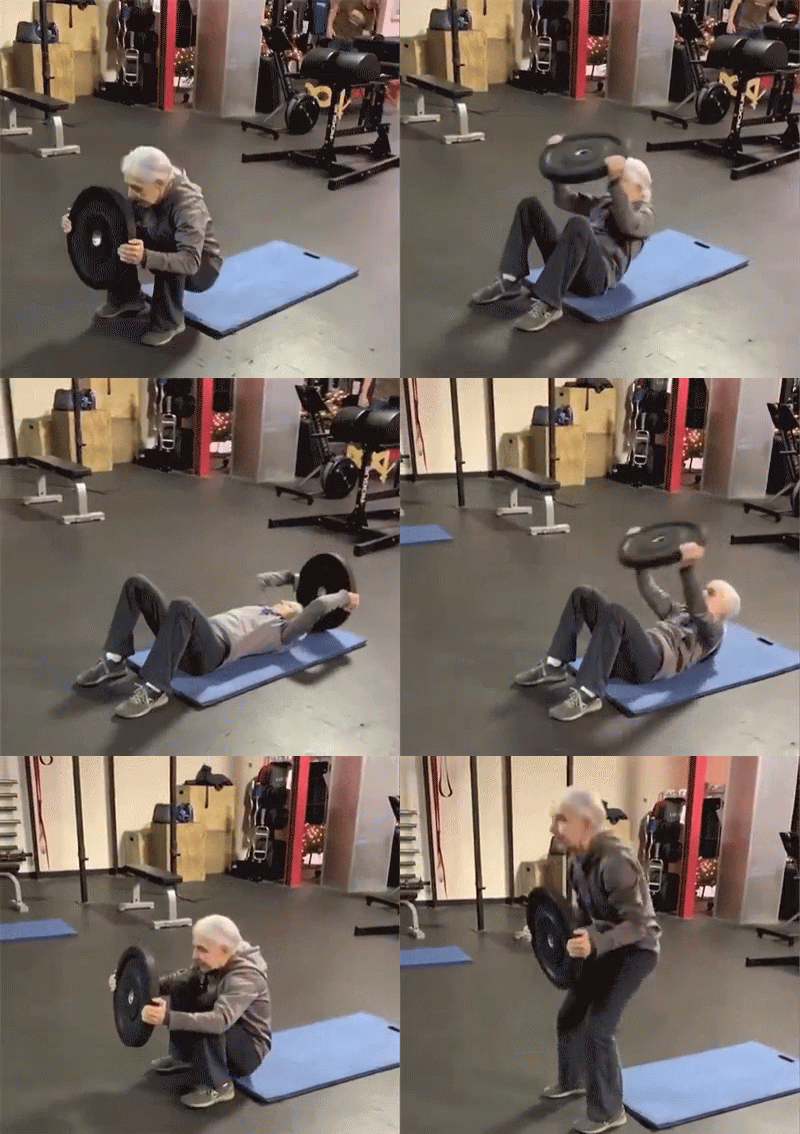
Crunches train the abdominal muscles. They do not normally decide where your body should take fat from.
The strongest broad evidence remains a systematic review and meta-analysis of 13 studies with 1,158 participants. Researchers compared fat changes near trained muscles with untrained areas and found a pooled effect close to zero. Local muscle training did not produce meaningful local fat loss.
There is one wrinkle worth mentioning. A small 2023 randomized trial found greater trunk-fat loss in eight overweight men who completed a high-volume abdominal endurance programme plus treadmill running than in eight men who only ran. The difference was about 697 grams after 10 weeks.
Interesting? Yes. Proof that ordinary crunches melt belly fat? Come on. So, the study involved 16 men, four sessions a week, and a fairly brutal protocol built around long intervals of torso rotations and abdominal crunches. It deserves replication before it overturns a much larger body of evidence.
Train abs because stronger, thicker abdominal muscles are useful and may look better once they are visible. Reducing the fat over them still depends mainly on overall fat loss and where your body prefers to store it.
4. BMI can tell a muscular person whether he is healthy

BMI is weight divided by height squared. It cannot see muscle, fat, bone structure or where somebody carries fat. Asking it to deliver a complete health verdict is giving a cheap screening calculation a job it was never built to do.
The CDC describes BMI as a screening measure, not a standalone diagnosis. It is quick, cheap and useful across populations, but individual assessment should also consider blood pressure, medical history, physical examination and relevant lab results.
Gym people tend to complain that BMI labels muscular men as overweight. That happens, but BMI can also miss excess body fat. In a study of 103 male police trainees, muscular trainees could be classified as overweight, while body-fat percentage identified 13 people as obese compared with only three under BMI. The number can be wrong in both directions.
Do not replace BMI with “how your clothes fit,” which was the bot-draft version of medical progress. Use it as one clue alongside waist measurement, body composition when useful, blood pressure, blood tests, fitness and medical history.
5. No pain means no gain

A hard set can burn. A difficult session can leave you tired. Delayed-onset muscle soreness can turn up the next day and make stairs feel like a personal attack. None of that proves the workout was better.
Mass General’s exercise guidance makes the useful distinction: soreness is not a reliable measure of an effective workout, while true pain is a signal that something may be wrong. Mild soreness that settles quickly is different from sudden sharp pain, pain centred in a joint, swelling or pain that changes how you move.
Even normal soreness does not always mean “keep going as planned.” A review of delayed-onset muscle soreness recommends reducing training intensity and duration for a day or two when soreness is substantial. You can move, train another area or adjust the session without losing whatever imaginary toughness competition is happening in your head.
Progress comes from training hard enough to adapt, then recovering well enough to do it again. You do not need every session to hurt before it counts.
Sources
- Creatine and DHT in college-aged rugby players (2009)
- Creatine and hair loss: 12-week randomized controlled trial (2025)
- Creatine and kidney health: systematic review and meta-analysis (2026)
- Protein timing and exercise adaptations: systematic review and meta-analysis (2025)
- Protein supplementation and resistance training: meta-analysis of 49 studies
- Spot reduction: systematic review and meta-analysis
- Abdominal exercise and localized fat loss: randomized controlled trial (2023)
- CDC: About body mass index
- BMI and body composition in police trainees
- Mass General: Fitness myths and workout pain
- Delayed-onset muscle soreness: treatment strategies and performance