Sinner Won Wimbledon Again. Is Tennis Building the Perfect Era for Him?
Sinner deserved another Wimbledon title, but slower courts, the rush to crown a new permanent rivalry and one remarkably convenient doping suspension make his dominance worth discussing properly.
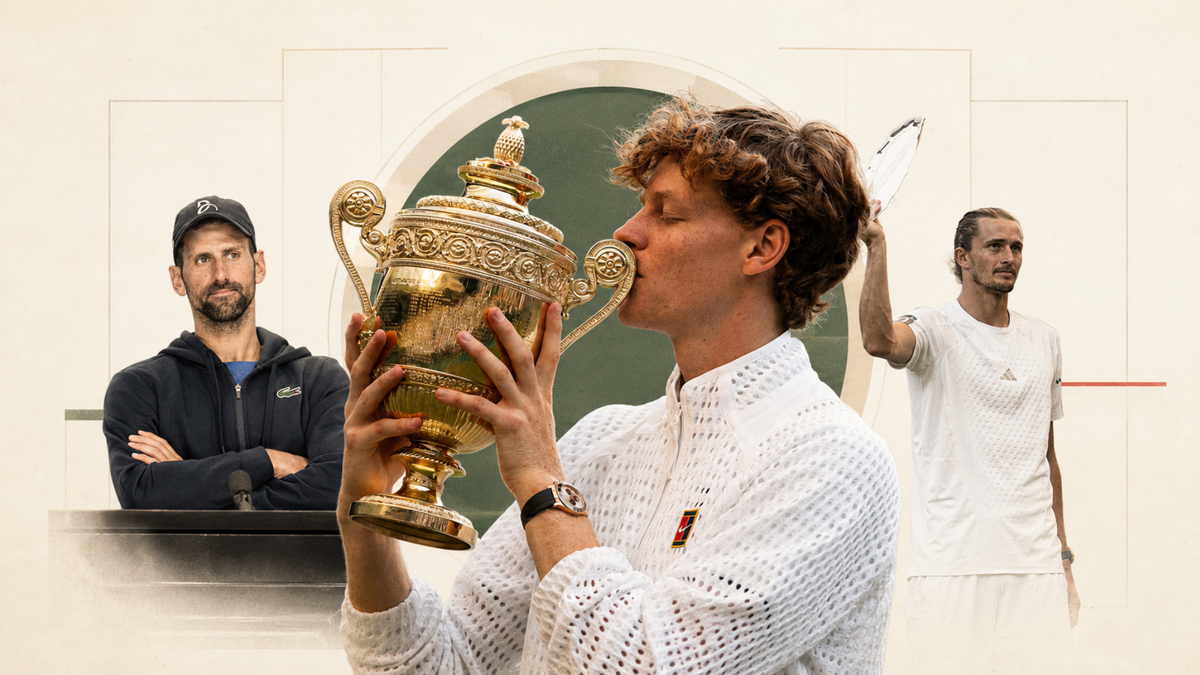
Jannik Sinner deserved to beat Alexander Zverev. He served better when it mattered, stayed calm after losing the first set and, by the end, looked like the only player on Centre Court who still believed the result was undecided.
That does not mean we have to ignore the larger feeling around men’s tennis right now.
Every surface increasingly allows the same style of tennis to win: huge returns, clean power from both wings, elite movement and enough time for the best baseline players to settle into almost every point. Roger Federer has already complained that court speeds have become too similar and suggested that slower conditions naturally help produce the same Sinner-Alcaraz matches again and again. His point was not that either player is fake or does not deserve his titles; it was that Roland Garros, Wimbledon and the US Open should not all reward almost the same game. (The Times)
Sinner and Alcaraz may still be the two best players regardless, and right now that is the most reasonable conclusion. Tennis has also given their style a very comfortable home almost everywhere it goes.
Quick Answer
Sinner did not receive the Wimbledon trophy as part of some secret plan. He beat Zverev 6-7, 7-6, 6-3, 6-4, defended his title and won his fifth Grand Slam because he handled the important points better and remained mentally solid after losing the opening set. Zverev said a third-set fall aggravated an existing knee problem and affected his serve, but from the outside that does not fully explain how quickly his belief disappeared once Sinner took control. (Reuters)
The bigger suspicion comes from everything around the result. Federer has questioned the increasingly similar court speeds, tennis is clearly delighted to have Sinner and Alcaraz ready as its next great rivalry, and Sinner’s two positive clostebol tests eventually produced a three-month suspension placed neatly between the Australian Open and the main clay season.
None of that proves the sport is manufacturing his victories. It does make people wonder whether tennis is simply watching a new era develop or doing everything possible to make that era arrive without complications.
Zverev Lost the Match in His Head
The first two sets were excellent because Zverev did what he usually promises to do and then forgets about when the pressure arrives: he played forward, trusted his forehand and refused to spend the entire match six metres behind the baseline waiting for Sinner to miss.
He took the first-set tiebreak 9-7, which was a serious moment considering Sinner had beaten him in their previous nine meetings and won the previous 14 sets between them. When Sinner answered by dominating the second tiebreak 7-2, though, the mood changed quickly. The match was level, but it no longer felt level. (AP News)
Zverev fell during the third set and later said the incident aggravated a previous knee problem, limiting his serving. I cannot tell him what he felt inside his own knee, and none of us watching through a television can properly assess the injury, but I also do not buy it as the main explanation for the defeat. The fall did not look dramatic enough to explain the mental decline that followed, and tennis history is full of champions competing through far worse-looking physical problems. Nadal won the 2022 French Open after receiving anaesthetic injections that left his chronically injured foot numb, so an injury can explain difficulty without automatically explaining surrender. (Reuters)
What changed most was Zverev’s body language. His movement may have been affected, his serve may have lost something, but he increasingly looked like a man who had already accepted where the match was going. The shoulders dropped, the reactions became flatter and every difficult Sinner service game started to feel like another reminder that the small opening had already passed.
Against an average opponent, perhaps you can survive that period and find your way back. Against Sinner, once you begin waiting for something bad to happen, he normally supplies it.
The knee mattered, but Zverev lost because Sinner remained emotionally present and he did not. That is not an insult to Zverev’s injury; it is the difference between explaining why a match became harder and pretending the physical problem decided everything.
Sinner Never Looked Worried
Sinner’s greatest strength in this final was not a single forehand, serve or tactical change. It was the complete absence of panic.
He lost a tight first-set tiebreak after playing well, then began the next set without carrying the disappointment around with him. Zverev, by contrast, appeared to carry every missed opportunity into the following game, and once Sinner escaped pressure the German seemed to experience the escape twice: first on the scoreboard and then again in his own head.
The numbers support how clean Sinner was. He struck 58 winners against 25 unforced errors and was not broken in either the semifinal against Djokovic or the final against Zverev. He was not flawless, especially during the opening two sets, but he kept forcing Zverev to produce another first serve, another aggressive forehand and another brave decision when the match became uncomfortable. (AP News)
Eventually Zverev stopped producing enough of them.
That is why the injury excuse feels weak to me. It may have reduced his physical level, but champions regularly win matches without their preferred body, serve or movement. The point is not that everyone must become Nadal and play with a numb foot; the point is that the final still offered Zverev moments when his response mattered, and Sinner handled those moments like the stronger man.
Federer Is Right About the Courts
The argument about court speed is not some bitter complaint from an old player who dislikes modern tennis. Federer has praised Sinner and Alcaraz repeatedly, but he also understands better than almost anyone what happens when different surfaces ask genuinely different questions.
His complaint is that tournaments increasingly prefer slower conditions because they create longer rallies and make another meeting between the two biggest young stars more likely. Zverev has made a similar accusation, arguing that tournament directors are reducing the differences between surfaces in a way that benefits Sinner and Alcaraz. (Reuters)
You can disagree with the conspiracy part while still seeing the tennis problem.
Grass should reward earlier ball striking, lower movement, a willingness to attack the net and the ability to finish points before the returner settles into the rally. Clay should give defenders more time, reward patience and demand the physical ability to construct points over longer exchanges. Hard courts should sit somewhere between them, with individual tournaments creating their own personalities through pace, bounce and conditions.
Modern players still adjust, and it would be lazy to claim Sinner uses exactly the same tactics everywhere. His serve has become much more important on grass, his movement is different, and he is willing to finish shorter points when the opportunity appears. Alcaraz also possesses far more variety than the usual description of two baseline machines allows.
The argument is about degree. When the basic winning formula across most major events remains elite returning, huge repeatable groundstrokes, defensive speed and the ability to dominate from the baseline, the two players best equipped for that formula will naturally keep appearing at the end.
Maybe they would dominate in any era and under any conditions. Federer’s point is that we would learn more about their greatness if the tests stopped looking so similar.
Tennis Has Already Chosen the Rivalry It Wants
The sport needed a future after Federer retired, Nadal’s body finally ended the discussion and Djokovic entered the stage where every tournament produces another conversation about whether it might be his last.
Sinner and Alcaraz arrived at the perfect moment. They are young, brilliant, recognisable, commercially easy to work with and different enough in personality and playing style to create a proper rivalry. Alcaraz is emotional, creative and visibly enjoying the performance; Sinner is controlled, efficient and almost suspiciously calm. The contrast sells itself, and the “Sincaraz” branding was established before either man had come close to the historical work completed by the Big Three. (Vanity Fair)
There is nothing wrong with tennis promoting them. Any sport would build around its two best young players, especially after losing three of the most important athletes it has ever had.
The rush becomes irritating when the rest of tennis begins acting as though the previous era has already been cleared from the building.
At the 2026 Australian Open, a journalist asked Djokovic whether he now felt he was chasing Sinner and Alcaraz in the same way he had once chased Federer and Nadal. Djokovic called the framing disrespectful and reminded everyone that he had spent around 15 years dominating the sport and had won 24 Grand Slam titles. He acknowledged that the younger players were performing better at that moment, but rejected the idea that he had suddenly become a historical extra running behind them. (News.com.au)
Djokovic also enjoys the feeling that everybody is against him, and sometimes he can find an enemy in a room that had not realised an argument was taking place. That tension has powered him for years.
Still, the disrespect is not imaginary. Journalists and other people around tennis sometimes speak about him as though his career was an awkward interruption between the beautiful Federer-Nadal era and the clean new Sinner-Alcaraz future. He has more major titles than either Federer or Nadal, yet somehow he remains the man who is always “chasing” somebody else.
The question at the Australian Open captured that perfectly. Everybody understood what the journalist meant in current sporting terms, but the wording also exposed how desperately the sport wants to move the story forward.
The Doping Case Cannot Be Removed From the Conversation
Sinner tested positive twice for clostebol in March 2024. An independent tribunal accepted his explanation that the substance entered his system accidentally after his physiotherapist used a clostebol-containing spray on a cut finger and then treated Sinner without gloves. The tribunal found no fault or negligence on Sinner’s part, although he lost his Indian Wells ranking points and prize money. (Reuters)
WADA appealed because its position was that a player remains responsible for negligence committed by members of his team. The case ended in February 2025 with Sinner accepting a three-month suspension running from February 9 to May 4. WADA accepted that he had not intended to cheat, had received no performance benefit and had not known about the contamination. (Reuters)
That is the official case, and there is no solid basis for claiming Sinner deliberately used clostebol to improve his performance.
The punishment still looked incredibly convenient.
He had already won the Australian Open, served the suspension during February, March and April, then returned in time for Rome and Roland Garros without missing a single Grand Slam. Tim Henman described the timing as too convenient, while Djokovic said many players believed favouritism existed in the anti-doping process and suggested that wealthy leading players with access to the best lawyers could influence the eventual outcome. (Reuters)
That distinction matters because discussions about the case are constantly collapsed into one question. You say the suspension looked suspiciously tidy, and somebody replies that the contamination was accidental.
Those two things can both be true. Sinner may not have knowingly doped, while the process can still appear far more accommodating than the treatment many lower-ranked players would expect to receive.
A player ranked 80th does not have Sinner’s legal resources, commercial importance or ability to negotiate from a position of strength. Maybe the rules technically provided the same route for everyone, but an equal rule is not an equal system when only a handful of players can afford to use every available part of it properly.
Imagine the Same Story With Djokovic’s Name
There is no need to pretend we can calculate the exact suspension Djokovic would have received in an imaginary version of this case.
The reaction is easier to imagine.
Had Djokovic tested positive twice, continued playing while the case remained confidential and then accepted a three-month ban that ended immediately before the important part of the clay season, the coverage would have been nuclear. Every old argument about his character, vaccination position, temper, politics and relationship with tennis institutions would have been dragged into the story, whether any of it had relevance to clostebol or not.
Djokovic would probably have enjoyed parts of the battle because he likes having a wall to push against, but that does not mean the treatment would have been fair. Sinner’s quieter public image gave the story a completely different atmosphere. He is polite, emotionally controlled, commercially useful and rarely gives journalists anything dramatic to work with.
I like Sinner, which is why this is not especially enjoyable to say. He appears to be a decent guy, his explanation was accepted by the relevant experts, and his tennis does not require a doping conspiracy to explain it.
He also received an outcome so perfectly fitted around the calendar that people were always going to suspect the system had worked especially hard to avoid damaging one of its most important stars.
Sinner Can Be Brilliant and Still Receive Too Much Credit
The internet has made it difficult to hold two thoughts at the same time. Either Sinner is an innocent genius who must never be questioned, or he is a protected fraud whose entire career should carry an asterisk.
Both versions are childish.
He is an exceptional player whose balance from both wings makes attacking him almost impossible, whose movement has improved enormously and whose serve now gives opponents fewer opportunities to enter his games. His mental control is probably the greatest difference between him and players such as Zverev, because he can lose a brutal set without allowing the disappointment to shape the next one.
Winning a second consecutive Wimbledon and a fifth major at 24 is not a marketing campaign. He still had to beat Djokovic in the semifinal without facing a break point and then handle Zverev over nearly four hours in the final. (The Guardian)
He can also be over-celebrated when every victory is immediately presented as another chapter in the inevitable Sinner-Alcaraz century. The sport appears almost relieved that it has found two young men good enough to fill the gap, and that relief sometimes produces more certainty than the careers have earned so far.
Zverev showed the problem behind them. He entered Wimbledon as the French Open champion, reached the final and played two very strong sets, but once the moment became emotionally difficult, he looked as though he needed Sinner to lower his level rather than believing he could raise his own. (Reuters)
Sinner did not lower it, so the match ended exactly as everybody had expected before it began.
The TGK Take
Sinner deserved to beat Zverev, and I do not accept the knee as the main reason Zverev lost. It may have affected his movement and serving, but the larger collapse was mental: after losing the second-set tiebreak, Zverev stopped looking like a man who believed he could take the title, while Sinner continued playing as though the first set had never happened.
That is what champions do, and Sinner is clearly one of them.
The wider questions remain fair because Federer believes the surfaces have become too similar, tennis is delighted to present Sinner and Alcaraz as the next permanent rivalry, and Sinner received a three-month doping suspension so conveniently placed that he missed no Grand Slam and returned for the most important part of the clay season.
None of this means Wimbledon handed him the trophy or that his titles are fake. It means the sport has found a player whose game suits the modern conditions, whose personality suits the people selling the sport and whose biggest scandal was resolved with almost surgical neatness.
Sinner may simply be the best player in the world at exactly the right time. When everything around that rise fits so comfortably, though, people are allowed to ask whether tennis is watching its next era happen naturally or helping package it into the cleanest possible product.